Age spots: where they come from and what skincare can do
SKIN CONDITION
Age spots are flat, sharply defined brown patches on areas of skin that have had a lot of sun over the years: the backs of the hands, face, décolleté and forearms. Their medical name is solar lentigines. They are triggered by UV radiation, not by age itself. Skincare can make your complexion look more even and help prevent new spots, but they can only be removed by a dermatologist.
What exactly are age spots?
Age spots are accumulations of pigment in the top layer of the skin, known medically as lentigo solaris or lentigo senilis. They are flat, clearly defined, light to dark brown, and almost always appear where the skin has been exposed to light for decades: the backs of the hands, temples, forehead, décolleté and forearms. The pigment cells in these areas permanently produce more melanin and pass it on to the surrounding skin cells, a process that is also described in our article on niacinamide and how it works in the skin. According to the specialist information from the New Zealand Dermatological Society, the number of pigment cells is normal or only slightly increased; what matters is their increased activity. That is why the surface stays smooth, you cannot feel the spot, and its colour varies over the year: darker in summer, paler in winter. A single spot is usually several millimetres across; over the years more appear and some merge. As a rule, age spots do not go away by themselves.
Why do age spots become more common from 40?
Age spots become visible from around 40 because UV exposure adds up over decades, and at some point the skin can no longer keep its pigment evenly distributed. Every summer, every skiing week, every daily car journey next to the window counts. So the spots do not appear because you are getting older, but because a great deal of sunlight has added up. There is also a second effect: cell renewal slows down, excess pigment is cleared more sluggishly and so stays visible for longer instead of being shed with the stratum corneum. That is exactly why the first spots usually appear on the backs of the hands and on the temples – areas that clothing never protects and that are regularly forgotten when applying cream. How pronounced this is depends on your skin type, your sun habits in childhood and adolescence, and your genetic make-up: fair skin that burns quickly shows spots earlier than skin that tans easily. A more detailed look at which signs of ageing can be influenced can be found in our article on slowing down skin ageing.
How do age spots differ from moles and freckles?
Age spots differ from moles and freckles in when they appear, how they behave over the year and their surface. Freckles usually show up in childhood, are small, often appear in clusters and fade noticeably in winter. Age spots appear later, are larger, stay visible all year round and tend to increase rather than decrease over the years. Moles, on the other hand, are clusters of pigment cells; they can be raised, sometimes feel palpable, and do not change colour with the seasons. There are also dark spots that do not belong to any of these three groups, for example after pregnancy or after an inflammation has healed. This distinction is useful in everyday life, but it does not replace a diagnosis: even experienced eyes need a dermatoscope for some spots. If you are unsure which category a spot falls into, the simple rule further down in this article applies. The overview below summarises the everyday features.
| Feature | Age spot | Freckle | Mole |
|---|---|---|---|
| First appearance | usually from 40 | usually in childhood | possible at any time |
| Colour in winter | stays visible | fades noticeably | stays the same |
| Surface | flat and smooth | flat and smooth | flat or raised |
| Size | usually several millimetres | very small | varies widely |
What can skincare do for age spots, and what can it not do?
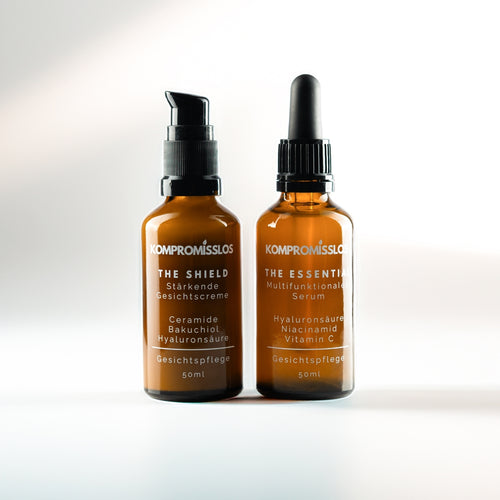
With age spots, skincare can soften their appearance and make your complexion look more even overall, but it cannot dissolve an existing spot. Cosmetic active ingredients act on how pigment is formed and transported, not on the finished spot. For niacinamide, a study in the British Journal of Dermatology showed that it slows down the transfer of melanosomes to the skin cells without blocking pigment formation itself. Vitamin C is used in cosmetics as a complement, to help the complexion look fresher and more even, and the stable form 3-O-ethyl ascorbic acid is well tolerated even by sensitive skin. The Duo contains 5% niacinamide and 2% vitamin C in exactly this form, each relative to the serum and cream together. If you want the details, you will find the full breakdown on our ingredients page. What skincare cannot do is remove an island of pigment that has built up over decades. That requires dermatological procedures.
One customer wrote to tell me that she had two dark spots on the back of one hand and wanted to know whether she could simply dab the serum onto them until they were gone. My answer was honest: dabbing it onto an age spot achieves nothing that applying it all over does not, and the spots will not disappear as a result. What made more sense for her was to protect her hands consistently with sunscreen every morning and to have the two spots looked at during her next skin check. Everything about the right order for serum and cream is on our how to use page.
How can you best prevent new age spots?
The most effective way to prevent new age spots is daily UV protection on your face, neck and the backs of your hands. It is unspectacular, but it is the only lever with a real effect on whether they form. In practice, that means applying sunscreen in the morning after your skincare to every area that is never covered by clothing, in winter as well as in summer, and remembering when driving that glass only filters part of the radiation. In the mountains, reflection from snow adds to this, which increases exposure considerably in winter. Anything that keeps your skin barrier stable also helps, because irritated skin is more likely to darken once the irritation has subsided. Harsh exfoliants, too many active ingredients at once or frequent product changes work against you here. Calm, well-cared-for skin reacts less sensitively to pigment triggers. What a routine for more mature skin looks like, without overloading it, is shown in our article on caring for mature skin without overdoing it.
Important to bear in mind: the Kompromisslos serum and cream do not contain an SPF. If you are serious about preventing dark spots, you also need a sunscreen. Skincare without SPF does not replace it, and we do not claim that it does.
When should a spot be checked by a professional?
A spot should be checked by a dermatologist as soon as it changes. Specifically: if it grows, its shape or colour becomes uneven, its edges become ragged, it itches, bleeds or weeps, or if it looks clearly different from all the other spots on your skin. This applies however harmless it may seem to you, and it also applies if it has only recently appeared. Cosmetics have a clear limit here: a serum does not assess a spot, and a skincare routine is no substitute for a skin check. People with fair skin, many sunburns in the past or a noticeably large number of dark spots are well advised to have their skin checked regularly. If you want to get rid of a single age spot that bothers you, that is also something to discuss with a dermatologist: according to a systematic review in the Journal of Cosmetic Dermatology, laser treatments or prescription topical therapies may be options depending on the findings, and both belong in professional hands.
I am regularly asked why nowhere on our site does it say that anything removes age spots. The answer is uncomfortable: because it would not be true. For our Duo of serum and cream, I deliberately chose 5% niacinamide and 2% vitamin C as 3-O-ethyl ascorbic acid, because both work on the complexion as a whole and do not overwhelm even sensitive skin. They do not dissolve an island of pigment that has built up over decades. If a single spot really bothers you, a dermatology practice is the more honest route. I would rather say that than sell you something that cannot keep that promise.
Frequently asked questions
Do age spots go away?
As a rule, age spots do not go away by themselves. They can look a little paler in winter, because there is less UV stimulation, but they remain visible. Cosmetic skincare can make your complexion look more even, but it does not remove the spot. Targeted removal of individual spots is a job for dermatological procedures.
At what age do age spots appear?
For many people, the first age spots appear from around 40, and earlier with heavy sun exposure. What matters is not the year you were born but the total UV exposure over your whole life. If you spent a lot of time outdoors or often got sunburnt when you were young, you will usually see them earlier than others.
Are age spots dangerous?
Age spots themselves are considered a harmless change in skin pigmentation. They do, however, show that the skin has had a lot of UV radiation, and that is a reason for regular skin checks. If a spot changes in size, shape, colour or border, or if it itches or bleeds, it should be checked promptly by a dermatologist.
Does vitamin C help with age spots?
Vitamin C can help your skin look fresher and more even, but it does not remove an existing age spot. The Duo contains 2% vitamin C as 3-O-ethyl ascorbic acid, a stable form that is well tolerated even by sensitive skin. As the only measure against dark spots, it is not enough.
Why do I get age spots on my hands?
The backs of the hands are among the areas with the highest lifetime UV exposure, because they are almost never covered by clothing and are regularly forgotten when applying sunscreen. That is where radiation adds up particularly strongly over decades. That is why, for many people, age spots on the hands appear even earlier than on the face.
Do you need a special product for age spots?
You do not need a special spot product. A calm base skincare with active ingredients such as niacinamide and vitamin C, combined with consistent sun protection, makes more sense. If a single spot bothers you a lot, seeing a dermatologist is the more effective route than yet another little pot in the bathroom.
Sources
- DermNet, New Zealand Dermatological Society, Solar lentigo, accessed 08.2026. Source
- Hakozaki T. et al., The effect of niacinamide on reducing cutaneous pigmentation and suppression of melanosome transfer, British Journal of Dermatology, 2002. Source
- Mardani G. et al., Treatment of Solar Lentigines: A Systematic Review of Clinical Trials, Journal of Cosmetic Dermatology, 2025. Source