Seborrhoeic keratosis on the face: what ‘age warts’ are and why skincare won’t remove them
SKIN OVER 40
What people call age warts on the face are almost always seborrhoeic keratoses: benign growths of the top layer of skin that become more common over the years and, unlike real warts, are not caused by viruses. They are raised, look as if they have been stuck on and are often brownish and rough. No cream, exfoliant or home remedy will remove them. If they bother you, a dermatologist can remove them, and any new or changing spot should be checked by a professional regardless.
What are age warts on the face, and why are they not really warts?
Age warts are seborrhoeic keratoses, meaning benign growths of cells in the epidermis, and not warts in the medical sense. True warts are caused by an infection with human papillomaviruses and can be passed on. Seborrhoeic keratoses, by contrast, grow out of your own skin. A review in the Journal der Deutschen Dermatologischen Gesellschaft (JDDG) describes them as the most common benign tumour of the epidermis seen in dermatology practice and names the face and upper trunk as the most common sites. The word tumour sounds alarming, but here it simply means a clearly defined overgrowth of tissue. The popular name comes from their appearance: the spots are raised, often rough and fissured, which is reminiscent of a wart.
In a review in the Open Access Macedonian Journal of Medical Sciences, the dermatologist Uwe Wollina notes that although genetic changes can be detected in seborrhoeic keratoses, they carry no risk of malignant transformation. Incidentally, age warts have nothing to do with the rough, grainy skin on the upper arms and thighs. That is keratosis pilaris, an entirely different kind of keratinisation.
How do you recognise an age wart, and how does it differ from an age spot or a mole?
You can typically recognise an age wart because it is raised and looks as though someone has pressed a small piece of wax or clay onto your skin. The surface is often matt, rough, scaly or slightly greasy, and the colour ranges from skin-coloured through light brown to almost black. Some start out as a light brown patch you can barely feel and become thicker over the years. An age spot, on the other hand, stays flat: you can see it, but you cannot feel it with your fingertip. A separate article covers flat age spots and where they come from. Telling an age wart apart from moles and other dark skin changes is harder. Writing in F1000Research, Wollina describes the wide variety of seborrhoeic keratoses as a cause of diagnostic difficulties and names dermoscopy as the preferred non-invasive method for distinguishing pigmented keratoses from other pigmented tumours, including melanoma. The table helps you get your bearings, but it is no substitute for a look through a dermatoscope.
| Feature | Age wart | Age spot | Mole | Common wart |
|---|---|---|---|---|
| Can be felt with a finger | Yes, raised | No, flat | Flat or raised | Yes, raised |
| Surface | Rough, scaly, looks stuck on | Smooth like the surrounding skin | Usually smooth | Thickened and horny, often with tiny dark dots |
| Colour | Skin-coloured to almost black | Light to medium brown | Light to dark brown | Usually skin-coloured |
| Cause | Age, genetic predisposition, probably UV light too | Years of UV exposure | A cluster of pigment cells | Human papillomaviruses |
| Contagious | No | No | No | Yes |
Why do people get age warts from 40 or 50 onwards?
Age warts develop from a combination of age, genetic predisposition and probably sunlight, and they become more common with every decade of life. The JDDG review names exactly these three factors: age, genetic predisposition and possibly UV radiation. In F1000Research, Wollina describes how their frequency increases with age and peaks at around 60. He classes seborrhoeic keratoses as a sign of skin ageing, particularly photoageing caused by chronic UV exposure. The fact that they turn up so often on the face fits this picture: hardly any area of skin gets more light over the decades. Genetic predisposition explains why some people already have many keratoses in their mid-forties while others have barely any at seventy.
What is not behind them: poor hygiene, an infection or the wrong skincare. You did not get your age warts from a particular cream, and no cream will get rid of them either. That is an uncomfortable truth, but it saves you the money you would otherwise spend on products that promise exactly that.
Can a cream, exfoliant or home remedy remove age warts?
No, an over-the-counter cream, exfoliant or home remedy will not reliably remove age warts, and some attempts do more harm than good. A seborrhoeic keratosis is an overgrowth of tissue, not a coating that can be rubbed off. At best, an exfoliant removes some of the outermost layer of dead skin cells; the keratosis itself stays. Wollina states in F1000Research that medical approaches have only limited effects. Topical medicines have been studied, such as a solution containing 40 per cent hydrogen peroxide, but these are preparations from clinical trials and nothing you should try to recreate with products from the chemist.
Apple cider vinegar, tea tree oil, garlic or lemon juice crop up in many guides as an insider tip. There is no solid evidence for any of them, and acids or undiluted essential oils can irritate facial skin, in the worst case cause chemical burns and leave dark marks behind. As for the rest of your skin, whether you need to exfoliate your face at all is a separate question that has nothing to do with age warts.
Before you burn or scratch off a spot yourself: doing so destroys exactly what a professional needs in order to assess it. If it turns out not to have been an age wart after all, in the worst case you lose valuable time.
How do dermatologists remove age warts?
Dermatologists usually remove age warts with a minor procedure, such as freezing, scraping, laser or electrocautery. The JDDG review lists surgical procedures, laser therapy, electrocautery, cryotherapy and topical drug treatments that are still in development. It stresses that the choice depends on the clinical findings and on the patient’s wishes. The specialist usually makes the diagnosis with the naked eye, and in some cases with a dermatoscope or a tissue examination. The same paper also makes an important point: many people have the spots removed for cosmetic reasons, even though there is no medical need. So you do not have to have anything removed just because it is there. An overview of the common procedures:
- Cryotherapy: liquid nitrogen freezes the spot, and the scab falls off after a while. Wollina describes cryotherapy and curettage as the classic procedures.
- Curettage: the keratosis is scraped off with a sharp curette. In a small comparative study cited by Wollina, this led to more redness at six weeks and, in the long term, a tendency towards pale scars, whereas after freezing, remnants were left behind more often.
- Laser: an ablative laser removes the spot layer by layer. Wollina describes ablative laser therapy as an effective option.
- Electrocautery: heat from a fine electrode destroys the keratosis, which can then be lifted away.
The specialist decides which procedure is right for you based on size, thickness, location and skin type. On the face in particular, it is worth asking about the risk of pale or dark marks before you decide.
When should you have a skin change on your face checked?
Have any new or changing spot on your face checked if you are unsure about it – and do so before you treat it yourself or have it removed. Seborrhoeic keratoses are harmless, but dark ones can resemble other skin changes that are not. That is why this article is deliberately not a self-test. The following signs are a reason to make an appointment with a dermatologist:
- The spot is new and grows visibly within a few weeks or months.
- It bleeds, weeps or crusts over repeatedly without you having injured it.
- It itches, hurts or changes shape, border or colour.
- It is unevenly coloured, for example with black, red or bluish areas.
- Many new keratoses appear all at once within a short time.
Wollina describes the last point as the sign of Leser-Trélat: the sudden appearance of numerous, often itchy seborrhoeic keratoses, which can be linked to a disease inside the body and therefore warrants investigation. Individual age warts that slowly accumulate over the years do not fall into this category. The same rule applies to flat dark spots on the face: anything that changes should be seen by a professional.
What can skincare usefully do around age warts?
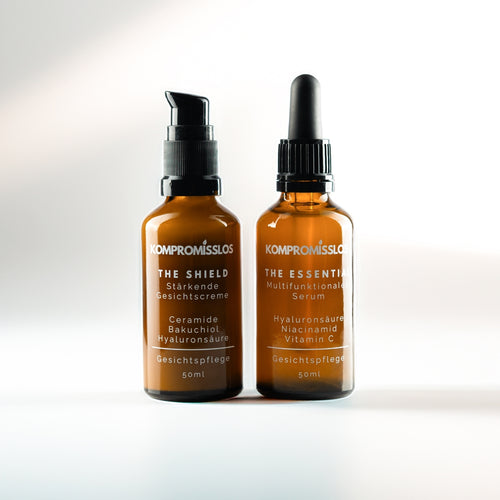
Around age warts, skincare can look after the surrounding skin, but it cannot remove, shrink or prevent the keratoses themselves. The reason is biological: skincare works on the surface of the skin, whereas a seborrhoeic keratosis is tissue growing out of the epidermis. What skincare can usefully take care of is the rest of your face. Mature skin loses moisture more easily and feels dry or tight more quickly, and having a keratosis removed does not change that. Two well-matched steps are enough for this: the serum in The Duo provides hyaluronic acid in three molecular sizes, and the cream provides ceramide NP and squalane, which support the skin barrier. A separate article explains what a lean skincare routine for mature skin looks like.
The third building block is daily sunscreen for your face, because UV light drives photoageing, which has been linked to age warts. That said, there is no evidence that sunscreen prevents new keratoses. After a removal, keep skincare away from the area until the skin there is fully intact again, unless your specialist recommends otherwise.
I deliberately did not add an exfoliant or a resurfacing acid product to our range, and I do not sell a cream that promises to make skin changes disappear. With age warts, that would simply not be honest: no cosmetic product removes a seborrhoeic keratosis, and anyone who claims otherwise is selling hope rather than skincare. That is why Kompromisslos offers two products for daily care, and I leave the diagnosis to the dermatologist. I am just as open about a second limit: the cream has no sun protection factor. During the day, you therefore need a separate sunscreen as the last step after serum and cream. How the two products build on each other morning and evening is deliberately kept simple.
Frequently asked questions
Are age warts contagious?
No, age warts are not contagious. Seborrhoeic keratoses develop from cells of your own epidermis, not from a viral infection like common warts. You cannot pass them on to other people or spread them to other parts of your body by touching them. If several often appear next to each other, that is down to age, genetic predisposition and the light exposure of that particular area of skin.
Are age warts dangerous?
Age warts themselves are benign; according to the specialist literature, the genetic changes found in them carry no risk of malignant transformation. The risk lies in mistaking something else for one, because some forms of skin cancer look similar to a dark keratosis. Any new, fast-growing, bleeding or unevenly coloured spot should therefore be seen by a specialist, even if it looks typical.
Can I remove or scratch off age warts myself?
That is not advisable. Scratching, cutting or tying them off can lead to bleeding, inflammation and scarring, and if remnants stay in the skin, the spot can grow back. More importantly, you would be removing a spot without a diagnosis. If it turns out not to have been an age wart after all, the specialist is then missing precisely the tissue they would need to assess.
Does apple cider vinegar or tea tree oil help with age warts?
There is no solid evidence that apple cider vinegar or tea tree oil removes age warts. Acetic acid can irritate facial skin and, in the worst case, cause chemical burns, and tea tree oil is one of the essential oils that can trigger contact allergies. Dabbing either of them onto a spot that has not been checked mainly delays the diagnosis.
Does health insurance pay for age wart removal?
If you have an age wart removed purely for cosmetic reasons, you will usually pay for it yourself. Things can be different if a spot needs medical assessment or is causing problems, for example because it keeps bleeding or rubs against your glasses. How your health insurer will decide in your individual case is best clarified with the insurer and the practice before your appointment.
Do age warts come back after removal?
The treated area often stays clear, but regrowth cannot be ruled out, especially if remnants are left behind. In a small comparative study, remnants were left behind more often after freezing than after scraping. Regardless of this, new keratoses can develop elsewhere, because age and genetic predisposition remain.
Can I use The Duo on skin with age warts?
Yes, you can use the serum and cream as usual on intact skin with age warts, but this will not change the keratoses. The skincare provides the surrounding skin with moisture and lipids. After a removal, leave out the treated area until the skin there is fully intact again, unless your specialist says otherwise. You can see how the two steps fit together on the page for The Duo with serum and cream.
Sources
- Barthelmann S, Butsch F, Lang BM, Stege H, Grossmann B, Schepler H, et al. Seborrheic keratosis. Journal der Deutschen Dermatologischen Gesellschaft, 2023. Source
- Wollina U. Recent advances in managing and understanding seborrheic keratosis. F1000Research, 2019. Source
- Wollina U. Seborrheic Keratoses – The Most Common Benign Skin Tumor of Humans. Clinical presentation and an update on pathogenesis and treatment options. Open Access Macedonian Journal of Medical Sciences, 2018. Source