Keratosis pilaris: what causes the rough bumps and what helps
SKIN CONDITION
Keratosis pilaris develops when keratin blocks the openings of the hair follicles and forms tiny, rough bumps there. In everyday language it is often called chicken skin. It usually affects the upper arms, thighs and buttocks, less often the cheeks. The condition is harmless, not contagious and cannot be cured. Consistent replenishing of lipids and mild keratolytic active ingredients visibly smooth the look of the skin.
What exactly is keratosis pilaris?
Keratosis pilaris is a keratinisation disorder around the hair follicles. Keratin collects in the opening of the follicle, closes off the canal and forms a bump roughly the size of a pinhead. There is often a fine, curled hair trapped inside. The bumps sit close together, which is why the area feels like very fine sandpaper. According to a review in Skin Appendage Disorders, the patches typically appear on the backs of the upper arms, the thighs and the buttocks, and occasionally on the cheeks and trunk. Slight redness around the individual follicles can occur but does not have to. Keratosis pilaris does not hurt, usually does not itch and has nothing to do with poor hygiene. It is a skin condition, not a skin type, so it changes with the season, your stage of life and your skincare. Why this distinction makes a difference day to day is explained in the article on skin condition rather than skin type.
Why does keratosis pilaris so often appear on the upper arms?
The upper arms are affected because the skin there is drier than on other parts of the body and the follicle density is high. Dry skin sheds less easily, skin cells do not come away cleanly from the edge of the follicle, and the material builds up. A literature review in Cureus describes exactly this connection: the keratinisation disorder often occurs alongside dry skin and impaired barrier function, with links to atopic skin and to ichthyosis vulgaris. That is why keratosis pilaris often becomes more pronounced in winter and flatter in summer. Hot showers, heavily foaming shower gels and dry heated air make it worse, because they strip lipids from the outer layer of the skin. If you are generally prone to dryness, you will know the pattern from other areas too, such as your lower legs. Tight sleeves that constantly rub against the backs of the arms make the bumps even more visible, because the redness around the follicles increases. What else a weakened protective layer can trigger is described in the article on the skin barrier and how to care for it.
Does keratosis pilaris go away on its own?
For many people, keratosis pilaris goes away on its own over the years, but rarely completely and rarely quickly. A review in Cureus puts its prevalence at around 40 per cent of adults and 50 to 80 per cent of adolescents, and describes how the bumps become more pronounced during puberty and tend to recede with age. For some people it stays for life, with calmer and more pronounced phases. That is the realistic expectation: keratosis pilaris can be smoothed, softened and made to look considerably better, but skincare will not make it disappear. If you are looking for a product that removes the bumps for good, you will be disappointed, whatever the price. It makes more sense to choose skincare that does not aim for a result in two weeks but for a state that lasts over months. If you stop, the old picture usually returns within a few weeks – and that is not a failure of the skincare but the nature of the condition.
What helps with keratosis pilaris, and what only irritates?
What helps most reliably is a combination of moisture, lipid replenishment and a mild keratolytic active ingredient – a substance that loosens the bonds between skin cells. The Cureus review mentioned above classes fruit acids, salicylic acid and urea as a sensible first choice, but also points out that the evidence comes from small groups and short observation periods. In plain terms: the approach is plausible and widely used, but it does not promise a guaranteed improvement. The timing matters as much as the active ingredient: applied to skin that is still slightly damp straight after a shower, considerably more moisture stays in the outer layer. What reliably does harm is mechanical force. Vigorous scrubbing with brushes, grainy scrubs and trying to squeeze out individual bumps leave redness and, in the worst case, dark marks, without touching the cause. Which group of acids is meant for what is explained in the article comparing AHA, BHA and PHA.
| Measure | What it does | What to watch out for |
|---|---|---|
| Urea in a body lotion | Binds moisture and loosens the outer layer | Apply to freshly towel-dried skin |
| Fruit acid or salicylic acid | Loosens the bonds between skin cells | Introduce gradually; do not start daily |
| Replenishing cleanser | Strips less lipid from the skin than shower gel | Shower lukewarm rather than hot |
| Grainy scrub | Smooths briefly, irritates the follicles | Leave it out entirely on reddened areas |
| Squeezing the bumps | Opens the skin with no benefit | Often leads to dark marks |
A customer wrote to tell us that for weeks she had also been applying the serum and cream to her upper arms because the rough patches there were not improving, and she wanted to know whether a larger amount would work faster. The honest answer was no. The serum and cream combination is formulated as facial skincare and does not contain urea at the concentration that would make sense on the upper arms. For that part of the body, a urea lotion from the pharmacy is the more suitable and considerably cheaper choice.
What should you do if the rough patches are on your face?
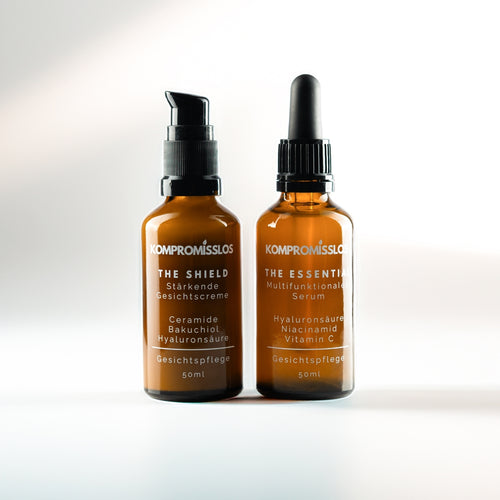
Rough patches on the face need different care from rough upper arms, because facial skin is thinner and reacts more quickly with redness. On the cheeks, strong acids and high-dose urea often cause more irritation than smoothing. A calm base makes more sense there: bind moisture, support the barrier, reduce sources of irritation and give the skin time. That is exactly what our Duo of The Essential serum and The Shield cream is designed for, with 2 per cent hyaluronic acid, 5 per cent niacinamide, ceramides, squalane and panthenol, all figures relative to the Duo as a whole. It does not smooth keratosis pilaris on the upper arms and does not claim to. It can, however, care for facial skin so that it feels less tight and looks more even. And if your facial skin is calm anyway and only your upper arms show rough patches, you do not need new facial skincare for that at all. Exactly which substances are included is set out on the page with the ingredients in detail.
When should you see a professional about rough patches?
See a dermatologist if the rough patches itch, weep, hurt, spread quickly or look clearly inflamed. It is also worth having them checked if only one side of the body is affected, if the patches appear suddenly in adulthood or if hair loss occurs in the affected areas. Cosmetics may care for the skin and improve how it looks. They do not provide a diagnosis and they do not replace treatment. This boundary is not small print; it is the point at which many months are lost with the wrong product. If you are unsure whether the patches really are keratosis pilaris, a single appointment is the quickest way to find out. A second reason for an appointment is how much it bothers you: if you have avoided wearing short sleeves in summer for years, that is a legitimate reason to discuss medical options. If you have persistent dryness without bumps, it is also worth reading about caring for very dry skin.
I am regularly asked why we do not have a urea body lotion in our range, even though there would be demand for it. The answer is an uncomfortable one: because I could not make a better product than what is already on the shelf in every pharmacy. For keratosis pilaris on the upper arms, what matters most is a sufficiently high concentration of urea, applied consistently, over months. That problem is solved, it is inexpensive and it works. I have deliberately limited myself to two facial products instead of adding a third that only carries my logo. If you buy from me, it should be because it is the better choice, not because you happen to be in the shop anyway. How to use the serum and cream on your face is explained on the page on everyday use.
Frequently asked questions
Is keratosis pilaris contagious?
No, keratosis pilaris is not contagious. It is caused by keratinisation around your own hair follicles and is not passed on through touch, shared towels or trips to the swimming pool. It does run in families, though, because the predisposition is inherited. From the outside that can look like contagion, but it is not.
Does exfoliating help with keratosis pilaris?
A chemical exfoliant with fruit acid or salicylic acid can smooth the look of the bumps, because it loosens the bonds between skin cells. A grainy scrub, on the other hand, does little and irritates the follicles further. The pace is what matters: start once a week, watch how your skin responds and only then increase.
Why does keratosis pilaris get worse in winter?
In winter, heated indoor air, cold outdoor air and hot showers dry the skin out more. A dry outer layer sheds less easily, so more skin cells build up at the edge of the follicle and the bumps become more pronounced. Many people therefore notice a seasonal pattern, with calmer summer months and more pronounced winter months.
What is the difference between keratosis pilaris and goosebumps?
Goosebumps are a brief muscle reaction and disappear again after seconds. Keratosis pilaris can be felt all the time, because the keratin sits firmly in the follicle opening. The two look similar, because in both cases the follicles stand out. The test is simple: whatever is still there once you have warmed up is not goosebumps.
Can I use the Duo for keratosis pilaris?
The Duo is facial skincare and not the right choice for keratosis pilaris on the upper arms or thighs. A lotion with urea works better there. On the face, the Duo can supply the skin with moisture and support the barrier, which can soften the look of rough patches on the cheeks.
How long does it take before anything changes?
Visible smoothing usually takes several weeks of consistent care, not days. Because the outer layer of the skin is constantly renewing itself, the old picture usually returns once you stop. Keratosis pilaris is therefore better thought of as ongoing care than as a course of treatment with a beginning and an end.
Sources
- Wang MA, Wilson A, Murrell DF, A Review of the Scoring and Assessment of Keratosis Pilaris, Skin Appendage Disorders, 2023. Source
- Dampa E, The Effectiveness of Topical Keratolytics (Alpha Hydroxy Acids/Beta Hydroxy Acids/Urea) in Treating Keratosis Pilaris: A Review of the Literature, Cureus, 2025. Source
- Reddy S, Brahmbhatt H, A Narrative Review on the Role of Acids, Steroids, and Kinase Inhibitors in the Treatment of Keratosis Pilaris, Cureus, 2021. Source