AHA, BHA and PHA: which acid suits which skin type
SINGLE INGREDIENT
AHA, BHA and PHA differ mainly in how they dissolve. AHAs such as glycolic acid and lactic acid are water-soluble and work on the surface of the skin. BHAs such as salicylic acid are oil-soluble and can also reach the inside of the pores. PHAs are much larger molecules, penetrate more slowly and are considered the mildest of the three groups. Which one to choose depends on the condition of your skin.
What is the difference between AHA, BHA and PHA?
The difference lies in solubility, molecule size and where they work. AHA stands for alpha hydroxy acids, the best known being glycolic acid and lactic acid. They are water-soluble and loosen the bonds between dead cells on the very top layer of the skin. BHA stands for beta hydroxy acids, which in practice almost always means salicylic acid. It is oil-soluble and can therefore get into the sebum-filled follicle, which is why it is the classic choice in products for blemish-prone skin. PHA stands for polyhydroxy acids, usually gluconolactone or lactobionic acid. Their molecules are heavier: gluconolactone comes in at around 178 g/mol, glycolic acid at only about 76 g/mol. Larger molecules penetrate more slowly and less deeply, which limits irritation. All three groups share the same basic principle. They briefly lower the pH on the surface of the skin and so speed up the natural shedding of the outermost layer of the stratum corneum. The three abbreviations therefore tell you nothing about how strong a product is – only which chemical family the active ingredient belongs to.
| Group | Typical examples | Solubility and where it works | Best suited to |
|---|---|---|---|
| AHA | Glycolic acid, lactic acid | Water-soluble, works on the skin’s surface | Dry, dull, more mature skin |
| BHA | Salicylic acid | Oil-soluble, also reaches the follicle | Oily skin with clogged pores |
| PHA | Gluconolactone, lactobionic acid | Large molecules, stay largely on the surface | Sensitive and reactive skin |
Which acid suits which skin type?
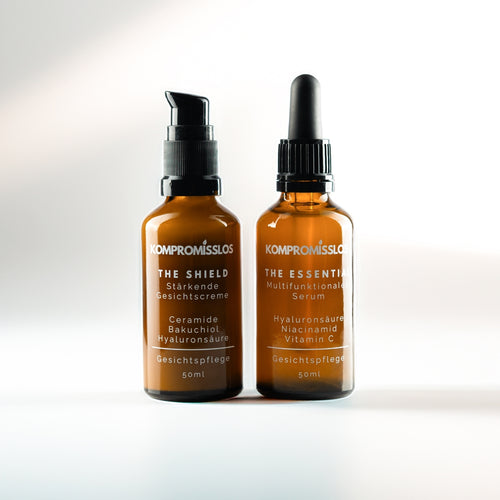
The choice follows the condition of your skin, not your age. Dry, dull or more mature skin is most likely to benefit from an AHA, because shedding has slowed down and lactic acid also binds moisture. Oily skin with clogged pores is the classic case for salicylic acid, because only an oil-soluble acid can reach the follicle at all. Sensitive skin that stings or reddens quickly does best with PHA – and often with no acid at all. Combination skin rarely needs two products: a mild acid applied just to the T-zone is usually enough. The honest first step matters most. If you currently have tightness, flaking or stinging, you do not have an exfoliation problem but a barrier problem. In that case every additional acid makes things worse, and rebuilding the skin barrier comes first, for example with The Duo as your daily base skincare. The season plays a part too, because dry heated air in winter noticeably lowers your skin’s tolerance.
What concentration makes sense, and what is permitted?
Products for daily use are subject to clear upper limits in Europe. The EU scientific committee SCCNFP classified glycolic acid up to 4 per cent at a pH of 3.8 or above, and lactic acid up to 2.5 per cent at a pH of 5.0 or above, as safe for cosmetics sold over the counter. Salicylic acid is regulated in Annex III of the EU Cosmetics Regulation and limited to 2 per cent in leave-on facial products. Switzerland adopts these lists of substances through the Swiss Ordinance on Foodstuffs and Utility Articles, so the same limits apply. Two things follow from this. First, a higher number on the pack is not a sign of quality – in many cases it simply would not be permitted. Second, the pH helps determine how strongly an acid works at all, and you will hardly ever find it on the packaging. A low percentage at a low pH can therefore be stronger than the reverse. Percentages on their own tell you less than the advertising suggests.
What should you not combine with an acid?
The most important rule: never two sources of irritation in the same step. Acid and retinol on the same evening are too much for most skin types, as are two different acids one after the other, or an acid straight after a mechanical scrub. Combining it with a strongly acidic vitamin C serum in the same routine also often leads to stinging. A gap in time makes more sense: acid on one evening, retinol or bakuchiol as a gentler alternative on another. Moisture and barrier care afterwards, on the other hand, are no problem – hyaluronic acid, panthenol, ceramides or squalane. If you want to know which active ingredients generally work well together, you will find the system laid out in our overview of combining active ingredients. Whichever acid you choose, AHAs make the skin more sensitive to light, so daytime sun protection is part of the deal. And if you are just starting out, change only one thing at a time and wait two to three weeks before adding the next.
Do you need an acid at all?
No, an acid is not a compulsory part of a good routine. Healthy skin renews itself, and the visible effect of an exfoliant only lasts as long as you keep using it. An acid makes sense for rough texture, clogged pores or a dull complexion that do not improve with moisture and barrier care alone. It is not necessary if your skin is calm, smooth and trouble-free, if you are going through an irritated phase, or if you already use retinoids. An acid is a tool for a specific problem, not a basic building block of every routine. Our Duo of serum and cream deliberately contains no exfoliating acid. It works through moisture, the barrier and active ingredients such as 5 per cent niacinamide and 0.3 per cent bakuchiol, each relative to the Duo as a whole. Exactly which ingredients it contains is set out openly in the overview of ingredients.
When a professional is the better choice
Cosmetics care for the skin; they do not replace a proper diagnosis. If your skin is permanently red, weeping, flaking or painful, or if its condition gets worse over several weeks, that belongs in the hands of a dermatologist, not a new acid product. The same applies to severe blemishes with nodules, a suspected skin condition, dark spots that change, and anything that goes beyond temporary irritation. Deeper chemical peels with higher concentrations are not something to do at home either; they belong in a practice with the appropriate training. A simple rule of thumb helps: anything you would describe as a complaint belongs with a professional. Anything you would describe as wanting smoother or more even skin is cosmetics. If in doubt, a single appointment is the cheaper decision than months of trial and error. We deliberately stick to this line, even if softer wording would sell more.
I am regularly asked why there is no acid in the Duo. The answer is a deliberate decision: I make products for skin that is already irritated, and exfoliating acids are the first thing to go wrong there. A product that is used every morning and evening cannot contain an acid at an effective dose without me having to add usage rules, rest days and warnings. Then we would be back at the complicated routine I set out to get rid of. If you want an acid, add it separately and deliberately. I would rather sell two products that work together than a third that gets in the way of the other two.
Frequently asked questions
Can I use AHA and BHA on the same day?
Better not in the same routine. Two acids one after the other significantly increase the risk of stinging and flaking without doubling the benefit. It makes more sense to use an acid on one evening and only moisture and barrier care on the other days. If you need both, alternate them on different days.
How often should you use an acid?
Once or twice a week is enough for most skin types to start with. Daily use only makes sense with very mild formulas and resilient skin. Only increase the frequency once your skin has stayed calm for two to three weeks. Stinging, tightness or redness are the signal to cut back straight away.
Do AHAs make your skin more sensitive to the sun?
Yes, AHAs increase the skin’s sensitivity to UV radiation. That is why daily sun protection belongs in every routine that includes an AHA, especially in summer. PHAs are considered less of a concern in this respect, because they barely reach the deeper layers. Sun protection still makes sense, whichever acid you use.
Is PHA really milder than AHA?
In direct comparisons, yes, although the data are limited. A twelve-week study compared a PHA regimen with an AHA regimen and found similar effects on the complexion with less irritation. The study was funded by a cosmetics manufacturer, which should be borne in mind when weighing it up. The difference in molecule size is not in dispute.
Does The Duo contain an acid?
No exfoliating acid. Among other things, it contains 2 per cent hyaluronic acid and 2 per cent vitamin C as 3-O-ethyl ascorbic acid, each relative to the Duo as a whole. Both are chemically classed as acids, but they do not act as an exfoliant. If you also want to exfoliate, you will need a separate product for that.
Can an acid replace your moisturiser?
No, an acid does not replace skincare. It loosens dead cells but puts back neither moisture nor lipids. After any acid, you should therefore apply a replenishing product. How to build a lean routine from serum and cream is explained in the guide on how to use it.
Sources
- SCCNFP, Position Paper concerning Alpha Hydroxy Acids, SCCNFP/0370/00. Source
- Federal Food Safety and Veterinary Office (FSVO), Geregelte Stoffe in kosmetischen Mitteln. Source
- Green BA et al., A polyhydroxy acid skin care regimen provides antiaging effects comparable to an alpha-hydroxyacid regimen, Cutis 2004. Source