Dry skin with age: the skincare that actually helps
SKIN CONDITION
Dry skin with age develops because, over the years, the skin produces fewer lipids and less sebum and is less able to hold on to moisture. What makes sense is skincare that provides both: water-binding ingredients such as hyaluronic acid and barrier-strengthening lipids such as ceramides and squalane, applied morning and evening. Rich on its own isn’t enough if your skin is also short of water.
For the cream that supplies the lipids: face cream for mature skin: the five criteria.
What causes dry skin with age?
Dry skin with age has several causes that reinforce one another. Over the years, the outermost layer of the skin (the stratum corneum) contains fewer lipids: a review in the journal Aging describes a reduction of more than 30% in total lipid content in aged stratum corneum compared with young skin. At the same time, sebum production falls and, according to the same paper, the pH of the skin’s surface starts to rise from around the age of 55. This disrupts the enzymes that complete the lipid film of the barrier in the first place. The moisture content of the stratum corneum peaks at around the age of forty and declines after that. On top of this, a disrupted barrier recovers more slowly than it did when you were younger. You can see which active ingredients make sense here in the overview of all ingredients. Above all, this means one thing for you: it isn’t a skincare mistake if the same cream that was enough at 35 no longer does the job at 55. Your skin’s starting point has changed, not your discipline.
What is the difference between dry and dehydrated skin?
Dry skin lacks oil; dehydrated skin lacks water. That may sound like splitting hairs, but it decides what you should apply. Dry skin is a skin type and usually permanent: it naturally produces little sebum, feels tight, flakes finely and looks dull or rough. Dehydrated skin is a condition and temporary: it can even look shiny and still feel tight, because the stratum corneum is short of water while the sebaceous glands work normally. With age, the two often occur together, because both lipid production and the ability to bind water decline. That is why a very rich cream on its own often achieves less than expected: it seals the surface but doesn’t replenish water. Conversely, a pure hydrating serum is wasted if nothing on top holds the moisture in. So the question is rarely dry or dehydrated skin, but usually how much of each. That is exactly what our two-product routine is designed for.
| Feature | Dry skin | Dehydrated skin |
|---|---|---|
| What is missing | Lipids and sebum | Water in the stratum corneum |
| Duration | Skin type, usually permanent | Condition, often temporary |
| Typical sign | Fine flaking, dull surface | Tightness despite shine |
| Sensible focus | Ceramides, squalane, plant oils | Hyaluronic acid, panthenol, glycerin |
What skincare does dry skin need after 50?
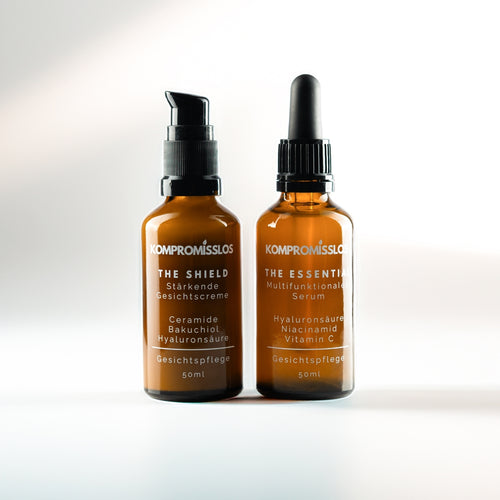
Skincare for dry skin rests on three building blocks: binding water, replenishing lipids and slowing evaporation. Binding water is the job of humectants such as hyaluronic acid, panthenol or glycerin. Lipids can be replenished by ceramides, squalane and gentle plant oils such as jojoba oil, which support the structure of the skin barrier. Finally, evaporation is slowed by a cream that stays on the skin as the last step. Our Duo of serum and cream contains hyaluronic acid at 2%, niacinamide at 5% and gentian root extract at 2%, plus ceramides, squalane, panthenol and jojoba oil with no percentage stated. All figures apply to the Duo as a whole, not to a single product. What you should rather avoid with dry skin is just as important: high-strength fruit acids used daily, alcohol-heavy toners and strongly foaming cleansers strip even more from a lipid layer that is already thin. Fewer products, used consistently, usually achieve more here than a long routine.
Why is a rich cream often not enough on its own?
Because a rich cream mainly seals, but replenishes little. It forms a film that reduces evaporation, and that is valuable for dry skin. But if there is no moisture underneath, you are sealing in skin that stays empty inside. That is exactly why many people over 50 keep buying thicker and thicker creams and still feel tight. The more sensible order is thin to thick: first a water-based serum on slightly damp skin, then the cream to finish. We recommend 3 to 6 drops of serum and 3 to 6 pumps of cream morning and evening, depending on how your skin feels and the time of year. We show what this layering looks like in practice in the how-to-use guide. And if you want to know whether the active ingredients get in each other’s way, the comparison vitamin C or niacinamide offers a level-headed overview.
Which habits dry your skin out even more?
Much of the dryness in winter is self-inflicted – and that is precisely the good news. Hot showers and long baths dissolve lipids from the stratum corneum; lukewarm water does so far less. Dry air from central heating often lowers indoor humidity considerably, drawing water from the skin before your skincare can even start to work. Cleansers with strongly foaming surfactants leave a squeaky feeling that many people mistake for cleanliness, although it is a sign of a stripped barrier. Frequent exfoliation belongs on the list too: as skin becomes thinner, one gentle exfoliation a week is enough, and sometimes none at all. Wind, cold and unprotected sun exposure are just as relevant. If you change two or three of these things and keep your skincare the same, you will often notice a difference in how your skin feels within two weeks, without buying a single new product.
When should dry skin be seen by a professional?
Skincare cares, dermatology treats. This line is particularly important with dry skin in older age, because severe dryness can also be a sign of something else. See a dermatologist if your skin weeps, is very red or cracked, itches so badly that your sleep suffers, if sharply defined patches appear or if the dryness gets significantly worse within a few weeks. It should also be checked by a doctor if you take medication that can dry out the skin, or if you have a known thyroid or metabolic condition. Skincare products such as The Duo are cosmetics: they support the skin barrier and can visibly soften the look of dry skin, but they do not replace a diagnosis or treatment. If you are unsure, getting it checked by a doctor is usually the quicker and cheaper route than reaching for the next product on the shelf.
I deliberately chose not to make a very thick cream that just covers. When I tested on my own dry skin, the effect was always the same: in the morning everything felt fine, by the evening it felt tight again. That’s why our serum and cream belong together, with hyaluronic acid for water and ceramides and squalane for lipids. I also chose not to use high-strength acids, because they are hardest on exactly the skin that already has too little of a protective film. I would rather have two products used consistently than seven that get in each other’s way.
Frequently asked questions
Is dry skin inevitable as you get older?
No, but the tendency towards it increases considerably. Because lipid production and the ability to bind water decline over the years, dry skin becomes more common: a meta-analysis of xerosis in older adults arrives at a pooled prevalence of around 53%. With suitable skincare and fewer drying habits, however, you can noticeably improve how your skin feels.
What is the difference between dry and dehydrated skin?
Dry skin lacks oil; dehydrated skin lacks water. Dry skin is a skin type and usually permanent; dehydrated skin is a temporary condition that also occurs in oily skin. With age, the two often occur together, which is why a combination of humectants and lipids makes more sense than a rich cream alone.
What skincare does dry skin need after 50?
Skincare that binds water, replenishes lipids and slows evaporation. In practice, that means humectants such as hyaluronic acid and panthenol, lipids such as ceramides and squalane, and a cream to finish. With dry skin, you should rather avoid harsh cleansing, alcohol-heavy toners and high-strength acids used every day.
Is a cream enough, or do I need a serum as well?
With dry skin in older age, usually both. The cream seals and slows evaporation but replenishes little water. The serum delivers moisture to the upper layers of the skin, which the cream then holds in place. Apply the serum first to slightly damp skin, then the cream.
How often should I apply skincare if I have dry skin?
Morning and evening, consistently at both times of day. If your skin is very dry, you can use a little more cream in the evening. We recommend 3 to 6 drops of serum and 3 to 6 pumps of cream per application. Depending on how often you use it, a bottle lasts two to four months.
Does drinking lots of water help with dry skin?
Drinking enough is sensible in principle, but it doesn’t replace skincare. Water loss in dry skin happens in the stratum corneum, where a weakened lipid barrier can no longer slow evaporation sufficiently. This barrier can be supported from the outside, not by extra glasses of water alone.
When should I see a professional about dry skin?
If your skin weeps, is very red or cracked, if severe itching disturbs your sleep or if the dryness gets significantly worse within a few weeks. If you have a known metabolic or thyroid condition, or take medication that dries out the skin, your skin should also be checked by a doctor rather than just cared for with cosmetics.
Sources
- Wang Z, Man MQ, Li T, Elias PM, Mauro TM. Aging-associated alterations in epidermal function and their clinical significance. Aging (Albany NY), 2020. Source
- Yao D, Gong X, Ma Y, Gong T, Wang G. The prevalence and interventions of xerosis cutis among older adults: A systematic review and meta-analysis. Geriatric Nursing, 2023. Source