Itchy face skin with age: why it happens and what calms it
SKIN OVER 40
Itchy face skin with no visible rash is, as you get older, most often down to dry skin that is less able to cushion irritants. Everyday triggers add to this: over-thorough cleansing, hard water, fragrance, a new product or heat. Calming it usually means doing less, not more: cleanse gently with lukewarm water, use low-irritation skincare and don’t scratch. If the itch lasts longer than two to three weeks despite gentle skincare, wakes you at night or comes with blisters or swelling, have it checked by a doctor.
Why does your face itch when there’s nothing to see?
Your face often itches without a rash because the nerve endings in your skin are reacting to stimuli they would normally not even register. Experts describe this pattern as sensitive skin. An expert group from the International Forum for the Study of Itch set out a definition for it in the journal Acta Dermato-Venereologica: unpleasant sensations such as stinging, burning or itching in response to stimuli that should not normally provoke such a reaction, with no skin disease to explain them. The skin can look completely normal or slightly red, and the face is the area most often affected. For you, this means that not being able to see anything doesn’t make the itch imaginary. It simply means the cause lies not on the surface but in skin that can tolerate less at the moment.
It is often a sign that the outermost layer of your skin has become more permeable. You can tell whether that applies to you from a few typical signs, such as products suddenly stinging that you have used without problems for years. How to recognise a damaged skin barrier is covered in a separate article. Here, the focus is on the itch itself and what sets it off.
Why does skin itch more often with age?
Skin itches more often with age because it becomes drier and holds on to water less well, and because the immune system and nerve fibres change too. A review by Kayla Fourzali and Gil Yosipovitch in the journal Dermatology and Therapy names dry skin as the most common cause of chronic itch in older age and puts it at over 50 per cent of older people. As the mechanism, the authors describe a weakening barrier function in the stratum corneum, less sebum and skin that replenishes fewer lipids as the years go by. In women, according to the same review, sebum production starts to decline with the menopause. On top of this comes an immune system that responds more weakly with age, and nerve damage that can cause an itch of its own, known as neuropathic itch.
Dryness is therefore the most common trigger, but not the only one. You can read why skin becomes drier with age and how to care for it in general in the article on dry skin. For itchy face skin, one insight is enough here: the drier your skin, the smaller the buffer before an irritant registers as an itch.
Which everyday triggers make your face itch?
The most common everyday triggers for an itchy face are dryness, the way you cleanse, fragrance, new products, heat and, in pollen season, pollen. It is usually not a single factor but the sum of several: skin that is already dry reacts more strongly to hard water, a harsh cleanser or a switch to a fragranced day cream. Central heating and hot showers belong on the list too, mainly because they make dryness worse. Many people know this as skin that feels tight and itchy after cleansing. It helps to sort the triggers by timing: does it itch straight after you apply cream, after washing, in the evening in a warm room or only in spring? The table helps you tackle the most likely culprit first.
| Trigger | How to recognise it | What to do first |
|---|---|---|
| Dryness | Tightness, fine flaking, worse in winter | Apply skincare straight after washing, moisture plus lipids |
| Cleansing and water | Itching shortly after washing, skin feels rough | Cleanse gently with lukewarm water; a single cleanse in the evening is often enough |
| New product | Starts a few days after the switch | Pause the product, then reintroduce only one |
| Fragrance | Itching where cream or perfume goes | Switch to fragrance-free skincare without essential oils |
| Heat and sweat | Itching after exercise, a sauna or in an overheated room | Keep the room cooler, rinse your face with lukewarm water |
| Pollen | Seasonal only, often with watery eyes or sneezing | Cleanse your face in the evening, have a possible allergy checked |
If it itches or burns immediately after application, it is worth reading up on when a face cream stings and when that is still harmless. If you use natural skincare, you should know about essential oils in skincare as a possible source of irritation. And if the itching returns every March, the article on skin in spring and itching in pollen season is the better place to start.
What calms itchy face skin, and what makes it worse?
Itchy face skin is most likely to calm down if you remove irritants and then care for your skin simply and consistently. As first steps for itch in older age, the review in Dermatology and Therapy names changes to how you wash, namely mild cleansers with a low pH and lukewarm water, along with frequent moisturising on skin that is still slightly damp. The European guideline on chronic itch also recommends keeping rooms on the cool side and supporting the skin with moisturising care. Anything that irritates the skin further makes it worse: scratching and rubbing, scrubs, frequently switching products and every extra layer you apply in the hope of relief.
- Cut back on cleansing: lukewarm water, a mild cleanser, pat dry instead of rubbing.
- Apply skincare straight afterwards, while your skin is not yet completely dry.
- Cool instead of scratching: a cool, damp cloth for a few minutes.
- Pause scrubs, acids and new active ingredients until your skin is calmer.
- Change only one product at a time, so you can tell what helps and what bothers your skin.
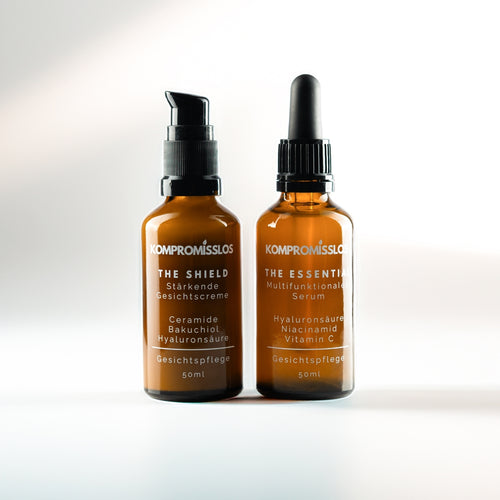
If the itch comes from dry, permeable skin, a short, low-irritation routine helps more than a long one. What makes sense is fragrance-free skincare without essential oils that delivers moisture and lipids in two layers. That is how The Duo of serum and cream is built: The Essential with hyaluronic acid in three molecular sizes, topped by The Shield with ceramide NP, squalane and jojoba oil, plus panthenol and aloe vera in the Duo. This supports the skin barrier, and your skin may feel calmer. It is not a remedy for itching.
Which ingredients are tricky for itchy skin, and which are well tolerated?
For itchy skin, the trickiest ingredients are above all fragrance, essential oils, a lot of ethanol and anything that exfoliates strongly. Fragrances are a well-known reason for intolerance reactions to cosmetics, and they serve no caring purpose for the skin. Alcohol denat. near the top of the ingredient list strips oil from the surface. Fruit acids, scrubs and high-strength retinoids can be useful on intact skin, but on itchy skin they are often one irritant too many. Substances that bind water or replenish lipids are generally well tolerated: glycerin, hyaluronic acid, ceramides, squalane and panthenol. The European guideline on chronic itch explicitly advises avoiding allergenic and irritating additives in moisturisers and names urea and glycerin as the humectants whose effect on itch has been studied most thoroughly. Urea can, however, sting briefly on facial skin that is already irritated.
More important than any single ingredient is the overall picture. A short list of a few clearly declared ingredients is easier to check than ten products with thirty ingredients each. If you are unsure whether a new cream is the trigger, apply it to a small area on your neck or behind your ear for a few days before it goes on your whole face.
For one week, jot down when it itches: after washing, after applying cream, in the evening, after exercise. The pattern often emerges sooner than you think, and you don’t have to overhaul your whole routine at once.
When should an itchy face be seen by a dermatologist or GP?
An itchy face should be checked if the itch persists despite gentle skincare, is very severe or comes with other symptoms. The European guideline on chronic itch, published in Acta Dermato-Venereologica, defines itch as chronic when it lasts six weeks or longer. Persistent itching can be caused by skin conditions such as atopic dermatitis, rosacea, psoriasis or contact dermatitis, but also by internal causes such as thyroid disease, liver or kidney disease or side effects of medication. No skincare can clarify that; it belongs in the hands of a professional. These warning signs are a reason not to wait any longer:
- The itching wakes you up at night.
- It itches not only on your face but all over your body.
- Blisters, weeping or crusted patches appear.
- Your face, eyelids or lips swell up.
- The itching continues for more than two to three weeks despite gentle, low-irritation skincare.
- You are losing weight without trying or feel unusually tired.
If it is more a case of isolated dry, flaky patches on your face, for example around the sides of your nose or on your eyebrows, the article on them explains when it is no longer ordinary dryness.
I made The Duo fragrance-free and without essential oils because, for irritated, itchy skin, fragrance is a risk that brings no benefit. For the same reason, we make two products instead of eight: every extra layer is another possible source of irritation, and the less that ends up on your skin, the easier it is to spot what doesn’t agree with you. To be honest, The Duo cannot make itching go away, and it is no substitute for getting checked if the itch persists. What I can give you is transparency. The full list of all ingredients is openly available on our website, so you can go through it with your dermatologist before you put anything new on your face.
Frequently asked questions
Does cooling help when your face itches?
Yes, cooling is often the quickest thing you can do. A cool, damp cloth for a few minutes eases the itch without damaging the skin. Ice cubes directly on the skin are too much. Afterwards, apply a low-irritation moisturiser so your skin doesn’t dry out further.
Is it OK to scratch when your face itches?
Better not. Scratching brings brief relief but irritates the skin further and can make the itch worse, because it causes tiny injuries. Instead, press gently on the spot with the flat of your hand or a cool cloth. Keeping your nails short helps if you scratch without noticing at night.
Can a new cream cause itching?
Yes, a new cream can cause itching, especially if it contains fragrance, essential oils or strong active ingredients. Stop using it and see whether your skin calms down within a few days. New products are best introduced one at a time. If there is swelling or blistering, have a doctor look at the reaction.
Does skin itch more during the menopause?
For many women, yes, because with the menopause the skin produces less sebum and becomes drier. You can read about other typical perimenopause skin changes and how to adapt your skincare in the article on the subject.
Can hard water make your face itch?
Hard water can contribute. A study in the Journal of Investigative Dermatology showed that more surfactant residue remained on the skin after washing with hard water, which put strain on the barrier and encouraged irritation, especially in people with atopic dermatitis and a particular genetic predisposition. Itching itself was not measured. Rinse off your cleanser thoroughly and apply skincare straight afterwards.
How long does it take for dry, itchy skin to calm down?
If dryness is the trigger, you will often notice a first improvement after a few days, once irritants are removed and you moisturise regularly. It tends to take a few weeks before your skin feels stable. If it hasn’t improved after two to three weeks, have it checked.
Can I use The Duo if my face is itchy?
If the itch comes from dry skin, you can use The Duo as fragrance-free skincare: moisture and lipids, without fragrance or essential oils. Introduce it when your skin is not acutely irritated, and don’t change anything else at the same time. Persistent or severe itching should be checked by a doctor; The Duo is no substitute for that.
Sources
- Fourzali KM, Yosipovitch G. Management of Itch in the Elderly: A Review. Dermatology and Therapy, 2019. Source
- Misery L, Ständer S, Szepietowski JC, Reich A, Wallengren J, Evers AWM et al. Definition of Sensitive Skin: An Expert Position Paper from the Special Interest Group on Sensitive Skin of the International Forum for the Study of Itch. Acta Dermato-Venereologica, 2017. Source
- Weisshaar E, Szepietowski JC, Dalgard FJ, Garcovich S, Gieler U, Giménez-Arnau AM et al. European S2k Guideline on Chronic Pruritus. Acta Dermato-Venereologica, 2019. Source
- Danby SG, Brown K, Wigley A, Chittock J, Pyae P, Flohr C et al. The Effect of Water Hardness on Surfactant Deposition after Washing and Subsequent Skin Irritation in Atopic Dermatitis Patients and Healthy Control Subjects. Journal of Investigative Dermatology, 2018. Source