Perimenopause skin changes: what’s typical from your early 40s and how to adapt your skincare
SKIN OVER 40
Perimenopause skin changes make skin less predictable for many women: drier on the cheeks, quicker to become irritated, sometimes itchy – and some see breakouts return that they have not had since their teens. The cause is fluctuating hormone levels, not a single drop in hormones. That is why a radical overhaul does not help. What does help is a calm routine that supports hydration and the barrier and balances the complexion without irritating it. Two well-matched products are usually enough.
What happens to your skin during perimenopause?
During perimenopause, your skin is responding to a hormonal system that does not wind down evenly but fluctuates – and it is precisely this instability that shows on your face. According to the internationally used STRAW+10 staging system, published in the journal Menopause, perimenopause covers the transition up to twelve months after the final menstrual period. It begins when the length of consecutive cycles repeatedly differs by seven days or more. For your skin, this means that phases with relatively high oestrogen alternate with phases in which it is clearly lacking. Oestrogen is no bit-part player for the skin. A review in Dermato-Endocrinology describes how it influences keratinocytes, fibroblasts, sebaceous glands and pigment cells, and helps determine how much moisture the epidermis holds. When it is lacking, the skin becomes drier, thinner and less elastic.
A review in Clinical and Experimental Dermatology shows how often this becomes noticeable: as many as 64 per cent of women attending a menopause clinic report skin problems. Because your skin can change from month to month, it is worth caring for your skin condition, not your skin type. The skin type you had at 30 says little about what your skin needs this week.
Which skin changes are typical from your early 40s?
From your early 40s, four changes are typical: dryness, new sensitivity, more visible pores and recurring breakouts, often several of them at once. Not every woman experiences all of them, and the order varies from person to person. The table shows how to recognise each one and what makes the difference in your skincare.
| Change | How you notice it | What helps in your skincare |
|---|---|---|
| Dryness | Tightness after washing, fine flakes on the cheeks and chin, make-up clinging to dry patches | Humectants in the serum, lipids such as ceramides and squalane in the cream |
| Sensitivity | Products that worked well for years suddenly burn, redness after showering | Fragrance-free skincare, fewer steps, no experimenting with several acids |
| More visible pores | Pores on the cheeks look more elongated, the skin less firm | Good hydration, niacinamide for a more even-looking complexion, sun protection |
| Breakouts | Spots on the chin and jawline, often unrelated to your cycle | Balancing ingredients such as niacinamide and zinc PCA instead of drying products |
Dryness develops because the skin holds on to less moisture and the barrier becomes more permeable. Sensitivity is often the direct result: a weakened barrier lets irritants through more easily. Breakouts follow a logic of their own, because the balance between oestrogen and androgens shifts. Why spots come back in your 40s and which moisturiser suits your skin then is covered in the article on breakouts in your 40s. The combination of both is particularly confusing: if your skin feels tight and breaks out at the same time, the guide to dry skin and breakouts will help. And if you have always had combination skin, you will often notice that your cheeks are now becoming noticeably drier, while your T-zone stays just as it was.
Why does your skin itch or burn during perimenopause?
During perimenopause, skin usually itches or burns because it is becoming drier and its barrier is less effective at keeping irritants out. The medical term for itching is pruritus. According to the review in Clinical and Experimental Dermatology, it is particularly common after menopause and often goes hand in hand with xerosis, meaning markedly dry skin. A second factor is hot flushes: the same paper reports flushing in around 75 per cent of perimenopausal and menopausal women. On sensitive skin, that sudden heat in the face can quickly feel like burning. Whether red cheeks are just a hot flush or more likely broken capillaries or rosacea is explained in our guide to red cheeks in menopause. Then there are habits that never used to be a problem: hot showers, harsh cleansing, products containing fragrance or alcohol. What calms the skin during these phases is usually unspectacular:
- Lukewarm rather than hot water, on your face and in the shower.
- A mild cleanser, or just water in the evening if there is no make-up or sunscreen to remove.
- Fragrance-free skincare, applied straight after washing, before your skin starts to feel tight.
- No new active ingredients while your skin is burning – calm the barrier first.
- Keep an eye on heat triggers: alcohol, spicy food and overheated rooms make flushing worse for many women.
How these changes feel in everyday life, and why suddenly no skincare seems quite right any more, is described in more detail in the article on menopause and your skin.
How can you adapt your skincare without needing two routines?
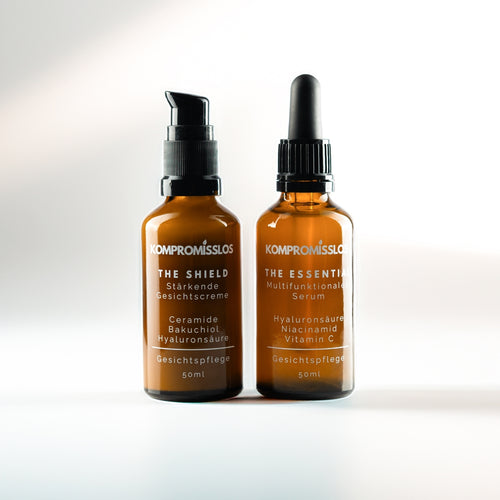
You adapt your skincare by choosing one routine that supports hydration and the barrier while also balancing the skin, rather than buying two product lines for dry days and blemish-prone days. Many women instinctively do the opposite: a rich product for the dryness, a clarifying one for the spots, and an exfoliant for the dull days. The result is six to eight steps that get in each other’s way. It makes more sense to have one base that covers both states. Niacinamide and zinc PCA support a more balanced complexion, while ceramides and squalane replenish the lipids a drier barrier is missing. The Duo is built in exactly this way: in total, it contains 5% niacinamide and 1% zinc PCA, plus ceramide NP and squalane in The Shield cream. On dry days, you use a little more cream; on unsettled days, everything stays as it is.
In her review on Judge.me, Nicole L. writes: ‘Great for my mature skin too, not shiny or greasy, just right, doesn’t feel tight and is still nourishing’ (review translated from German). Many women look for exactly this balance between nourishing and non-greasy, especially when their skin is dry and unsettled at the same time. The guide to skincare for mature skin explains step by step what a pared-back routine looks like day to day. During the day, you also need a separate sunscreen, because the skincare itself contains no SPF.
During this phase, do not switch products every time you have a bad week. Your skin fluctuates with your cycle, and switching in the middle of an unsettled phase makes it impossible to tell what is actually helping. Give a new routine four to six weeks before you judge it.
How long do the changes last, and what stays?
The unsettled phase usually lasts a few years: once perimenopause ends, the fluctuations stop, but the effects of lower oestrogen levels remain. According to the STRAW+10 staging system, the late transition alone – the phase in which your period stops for two months or longer – lasts one to three years on average. The early postmenopause that follows lasts around five to eight years. For your skin, this means the unpredictability eases and, for some women, breakouts become less frequent again, while dryness and declining firmness remain. The review in Dermato-Endocrinology states that type I and III collagen can decrease by as much as 30 per cent in the first five years after menopause. What that means for wrinkles is a topic in its own right, covered in the article on sudden wrinkles in menopause. For your skincare, it means that the barrier-supporting base you build now is one you will still need afterwards. What changes is more likely to be the amount of cream than the routine itself.
When should you see a doctor about what is behind the changes?
You should have skin changes checked by a doctor if they go beyond simple dryness and the occasional spot, or if they noticeably affect your daily life. Not everything that appears from 40 onwards has to do with hormones. Thyroid disorders, medication or the early stages of skin conditions such as rosacea can look similar. These signs call for a dermatologist – and, for questions about your cycle and hormones, a gynaecologist as well:
- Itching that persists despite consistent skincare, wakes you at night or affects your whole body.
- Persistent redness with small visible blood vessels, bumps or burning in the centre of the face.
- Deep, painful inflammation or spots that leave scars.
- New or changing pigmentation spots and moles.
- Marked changes in your cycle, hot flushes or sleep problems that are weighing on you. Here, gynaecological advice makes sense – something no cream can replace.
In all of these cases, skincare can play a supporting role, but it does not replace a diagnosis.
I deliberately limited Kompromisslos to two products, partly because skin that shows several changes at once, as it often does in perimenopause, rarely calms down with eight products. To me, a routine that covers dry and unsettled phases at the same time is more honest than a separate product for every skin condition. In the cream, I used bakuchiol instead of retinol, because retinol can be too irritating for many women, especially during reactive phases. That does not mean The Duo can cushion every change. A cream can do nothing about hot flushes, and if your skin needs considerably more oil, you can use more cream or add something else. I have disclosed which active ingredients it contains, and in what amounts, on the page covering all active ingredients and concentrations.
Frequently asked questions
At what age does perimenopause start?
For many women, perimenopause starts at some point in their forties – for some earlier, for others later. What matters is not your age but your cycle: according to the STRAW+10 staging system, the transition begins when the length of consecutive cycles repeatedly differs by seven days or more. Your skin sometimes reacts before you have consciously noticed any change in your cycle.
Does skin change in the same way for all women during perimenopause?
No, skin changes very differently from one woman to the next during perimenopause. Some mainly notice dryness, others mainly breakouts or new sensitivity, and some barely notice anything at all. Genetics, decades of sun exposure, smoking, stress and previous skincare all play a part. That is why your current skin condition is the best guide, not your friend’s experience.
Do phytoestrogens in face cream help?
Whether phytoestrogens in a cream have any hormonal effect on the skin has barely been studied; what sets menopause skincare, phytoestrogens and oestrogen creams apart is explained in the guide to menopause face cream without hormones. For context: The Duo contains no hormones, but it does contain bakuchiol, which has shown oestrogen-like activity in cell studies.
Does retinol make sense during perimenopause?
Retinol can make sense during perimenopause if your skin tolerates it, but in reactive phases it is often too much. In a randomised study in the British Journal of Dermatology with 44 participants, 0.5% bakuchiol (twice daily) and 0.5% retinol (once daily) reduced wrinkle surface area and hyperpigmentation with no statistical difference between them, but the retinol group reported more scaling and stinging.
Do pores get bigger during perimenopause?
Pores often look bigger at this stage of life, especially on the cheeks, because the skin loses firmness and the edges of the pores are less well supported. Why this happens and what skincare can visibly refine is explained in the article on enlarged pores with age.
Can stress make the skin changes worse?
Yes, stress can make skin changes during perimenopause worse. Poor sleep, hot flushes at night and everyday pressures often coincide at this stage of life, and many women notice it straight away in breakouts and irritated skin. A short, stable routine at least takes skincare out of the equation as a source of stress.
Is The Duo suitable for perimenopausal skin?
Yes, The Duo is designed for exactly this kind of mixed picture. In total, it contains 5% niacinamide and 1% zinc PCA for a more balanced complexion, plus ceramide NP and squalane in the cream for a barrier that is becoming drier. That way, one routine of serum and cream covers both dry and unsettled phases – fragrance-free and without hormones.
Sources
- Harlow SD, Gass M, Hall JE, Lobo R, Maki P, Rebar RW, et al. Executive summary of the Stages of Reproductive Aging Workshop + 10: addressing the unfinished agenda of staging reproductive aging. Menopause, 2012. Source
- Thornton MJ. Estrogens and aging skin. Dermato-Endocrinology, 2013. Source
- Kamp E, Ashraf M, Musbahi E, DeGiovanni C. Menopause, skin and common dermatoses. Part 2: skin disorders. Clinical and Experimental Dermatology, 2022. Source
- Dhaliwal S, Rybak I, Ellis SR, Notay M, Trivedi M, Burney W, et al. Prospective, randomized, double-blind assessment of topical bakuchiol and retinol for facial photoageing. British Journal of Dermatology, 2019. Source