Breakouts in your 40s: why spots come back and which moisturiser suits mature, blemish-prone skin
SKIN OVER 40
Breakouts in your 40s are not a blip – they are common. In a survey published in the Journal of the American Academy of Dermatology, around one in four women aged 40 to 49 said they had acne. The usual drivers are hormonal shifts, more sensitive skin and a skincare routine that no longer fits. That is why mature, acne-prone skin does not need a drying anti-spot routine, but a light moisturiser with barrier lipids and well-tolerated active ingredients such as niacinamide.
Why do you suddenly get spots again at 40?
Spots at 40 usually come from a combination of hormonal shifts, skin that renews itself more slowly and a routine that has been geared towards dryness and wrinkles for years. It is not unusual: in the survey by Collier and colleagues in the Journal of the American Academy of Dermatology, 26.3 per cent of women aged 40 to 49 reported having acne, compared with 12.0 per cent of men. Among women aged 50 and over, the figure was still 15.3 per cent. The figures are based on self-reporting rather than an examination by a professional, but they clearly show that spots are not just a teenage problem. A review in the Journal of the European Academy of Dermatology and Venereology distinguishes between two patterns: acne that has never fully cleared since adolescence, and acne that only begins in adulthood. Both forms occur in women.
According to the same review, acne in adult women typically shows up as inflamed spots on the chin, jawline and neck, and clogged pores more often stay closed – small, skin-coloured bumps without a visible head. Why spots on your chin and jawline are so stubborn is a topic in its own right. The general causes of blemish-prone skin, such as sebum, blocked pores and friction, still apply at 40 – they simply meet skin that now becomes irritated more quickly.
What role do hormones play in breakouts after 40?
Hormones play an important role in breakouts after 40 because the balance shifts between oestrogen and the male hormones that are also present in the female body. As oestrogen falls in the years before the menopause, androgens carry relatively more weight. Androgens stimulate the sebaceous glands. At the same time, the skin as a whole becomes drier and thinner. This explains why many women notice both at once from their mid-40s: a tight feeling on the cheeks and new blemishes on the chin or neck. We describe in detail how the skin changes overall during this phase in our article on perimenopause skin changes. For your skincare, one thing matters above all: a moisturiser does not change your hormone balance, but it can stop overly harsh products from putting extra strain on skin that is already more sensitive.
Hormones are not the only possible cause, however. New medication, coming off the pill, stress or lack of sleep can also play a part. Whether there is a hormonal cause in the medical sense is for a dermatologist or gynaecologist to establish, not your skincare routine.
Which moisturiser suits mature, acne-prone skin?
Mature, acne-prone skin is best suited to a light, fragrance-free moisturiser that provides hydration and barrier lipids without leaving a heavy, greasy layer on the skin. The typical anti-spot products of your teenage years, with alcohol, strong surfactants and high concentrations of acids, are usually too harsh for skin over 40. The classic anti-ageing cream with a thick texture, on the other hand, is often too occlusive for pores that tend to clog. The right moisturiser sits somewhere in between. The general criteria for the best face cream for mature skin apply here too, but blemishes add a few more points:
- Texture: the cream sinks in and does not leave a shiny film.
- Barrier: ceramides, squalane or similar lipids that resemble the skin’s own, rather than large amounts of heavy oils.
- Active ingredients: niacinamide and zinc for a more balanced complexion, with the concentration disclosed.
- Tolerance: no fragrance or essential oils, because irritated skin is quicker to react with redness.
- Number of products: two well-matched products are better than five that get in each other’s way.
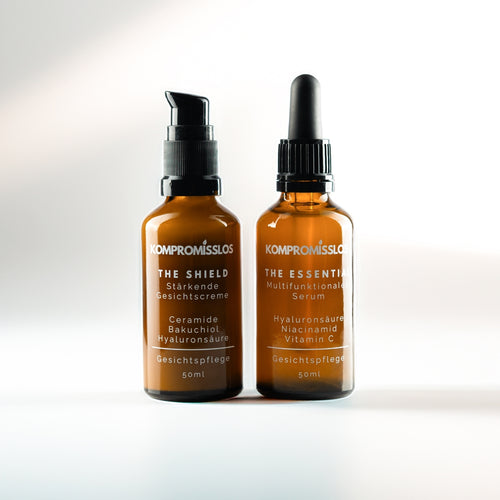
This combination of hydration, barrier lipids and disclosed active ingredients without fragrance is the reason we built The Duo of serum and cream for mature, sensitive skin that is also prone to blemishes. In her review on Judge.me, Nicole L. writes about the texture: ‘Great for my mature skin too, not shiny or greasy, just right, doesn’t feel tight and is still nourishing’ (review translated from German). That is one person’s experience, not a promise for every skin, but it describes well what matters when it comes to texture.
How do you care for spots and wrinkles at the same time without overwhelming your skin?
The best way to care for spots and wrinkles at the same time is with a few active ingredients that cover both, rather than running an anti-spot routine and an anti-ageing routine side by side. The review on acne in adult women explicitly points out that older skin tends to become irritated and recommends a simplified routine that fits into everyday life. That is the heart of the matter: every additional product containing acids, retinoids or drying ingredients increases the risk of your skin reacting with irritation. Irritated skin then looks both blotchier and more lined, because it lacks moisture. So the answer rarely lies in yet another product, but in active ingredients that play a part in both concerns.
| Concern | Typical reflex | Risk for skin over 40 | Gentler alternative |
|---|---|---|---|
| Shine and blemishes | Toner containing alcohol | Tightness, redness, more fine lines from dryness | Niacinamide and zinc PCA in one serum |
| Clogged pores | Daily acid exfoliation | Stinging, redness, more sensitive skin | Gentle exfoliation once or twice a week at most |
| Wrinkles and firmness | Rich, heavy night cream | Closed pores under a thick film | Light cream with ceramides and squalane |
| Wrinkles and blemishes | Retinol plus acid plus anti-spot gel | Flaking, stinging, irritated barrier | One active ingredient at a time, or bakuchiol as a gentler option |
Which active ingredients have evidence behind them for mature, blemish-prone skin?
For mature, blemish-prone skin, niacinamide is one of the best-researched cosmetic active ingredients, because in studies it has had an effect on both the signs of skin ageing and the skin’s oiliness. In a study in Dermatologic Surgery, 50 women with signs of sun-related skin ageing applied 5% niacinamide to one half of the face twice a day for twelve weeks. The researchers measured fewer fine lines and wrinkles, less pigmentation, fewer red blotches and improved elasticity. The study was carried out by researchers working for a cosmetics manufacturer, which is worth bearing in mind when you weigh it up. A second study in the Journal of Cosmetic and Laser Therapy tested 2% niacinamide: in Japanese participants, sebum excretion fell after two and four weeks; in Caucasian participants, the amount of sebum on the skin’s surface fell after six weeks, but sebum excretion itself did not fall significantly.
Zinc is the second building block. We explain separately how zinc PCA binds moisture and evens out a shiny complexion in our guide to the benefits of zinc PCA. On the wrinkle side, bakuchiol is considered a gentler alternative to retinol: in a randomised, double-blind study in the British Journal of Dermatology, 44 people applied either 0.5% bakuchiol twice a day or 0.5% retinol once a day for twelve weeks. Both reduced wrinkle surface area and pigmentation with no statistically significant difference, while the retinol group reported flaking and stinging more often. The limitation matters: the study looked at sun-related skin ageing, not spots.
Dark marks left behind by a spot often take months to fade. A separate sunscreen during the day protects these areas, and squeezing spots usually makes the marks take even longer to fade.
When should you see a dermatologist about breakouts after 40?
You should see a dermatologist about breakouts after 40 as soon as they are painful, deep or numerous, or if they do not improve over several months despite gentle skincare. Acne is a skin condition, even if in adulthood it is often mild to moderate. For diagnosis and treatment, there are effective prescription options that no cosmetic product can replace. There is a second reason, too: not everything that looks like spots is acne. Redness with small bumps around the nose and cheeks can point to rosacea, and small pustules around the mouth to perioral dermatitis. Both need different care from blemish-prone skin. So have your skin examined if at least one of these points applies:
- You have deep, painful lumps that last for weeks.
- Scars or dark marks are left behind.
- The spots come with increased facial hair growth, hair loss or changes to your cycle.
- The blemishes started after you began a new medication.
- Redness, stinging or pustules around the mouth and nose are the main issue.
In all of these cases, cosmetic skincare is useful alongside treatment, because treatment often dries the skin out further. But it does not replace a proper examination.
For the cream, I deliberately chose bakuchiol rather than retinol. Retinol is well researched, but for mature skin that is also prone to blemishes and quickly irritated, I did not want an ingredient that many people only get used to after a phase of flaking and stinging. The serum contains niacinamide and zinc PCA, and I disclose the concentrations: 5% niacinamide and 1% zinc PCA, calculated for The Duo as a whole. I am just as open about the limits: our products are skincare. If you have acne, it belongs with a dermatologist, and the Duo can at most support treatment alongside it. You can see what role each ingredient plays in our active ingredients and their concentrations.
Frequently asked questions
Is it normal to get spots at 50?
Yes, spots at 50 do happen, although less often than at 40. In the survey in the Journal of the American Academy of Dermatology, 15.3 per cent of women aged 50 and over said they had acne. If spots appear for the first time and in large numbers, it is worth having them checked by a dermatologist, because rosacea or medication can also be behind them.
Do anti-spot products dry out mature skin?
Many classic anti-spot products do dry out mature skin, especially those with a lot of alcohol, strong surfactants or high-strength acids. Skin over 40 has fewer reserves and reacts more quickly with tightness and redness. We explain separately how to care for dry skin and breakouts without making either worse.
Is retinol a good idea for spots and wrinkles?
Retinol can be useful for spots and wrinkles, but it calls for patience and a slow introduction. Mature, sensitive skin in particular often reacts with flaking and stinging at first. Start with a low strength, do not use it at the same time as acids and wear sunscreen during the day. Prescription-strength retinoids for acne are a matter for a dermatologist.
Which ingredients clog pores?
There is no simple answer, because the finished formula counts for more than any single raw material. Heavy, occlusive textures with a lot of fat can encourage closed pores in some people but not in others. We explain in detail what lies behind the lists and what comedogenic really means. The most reliable approach is to test a product yourself over several weeks.
Does niacinamide help mature, blemish-prone skin?
Niacinamide is a good choice for mature, blemish-prone skin, because in studies it has had an effect on both the signs of skin ageing and the sebum on the skin’s surface. It is considered well tolerated and can be combined with most other active ingredients. Allow several weeks before you see a difference in your complexion, and do not expect it to have any effect on deep, inflamed lumps.
Can a rich moisturiser cause breakouts?
Yes, a very rich cream can encourage spots on skin that is prone to blemishes, especially if it is applied thickly and leaves a greasy film. That does not mean mature skin has to do without lipids. A better option is a light cream with lipids similar to the skin’s own, such as ceramides and squalane, applied a little more generously to dry areas if needed.
Is The Duo suitable for mature, blemish-prone skin?
Yes, The Duo is made for mature, sensitive skin that is also prone to blemishes. The serum provides niacinamide and zinc PCA, the cream ceramides, squalane and bakuchiol – both without fragrance and in a routine of just two steps. It does not replace acne treatment. Morning and evening, after cleansing with water, apply the serum first and then the cream. Because the Duo of serum and cream contains no sun protection, add a separate sunscreen during the day.
Sources
- Collier CN, Harper JC, Cafardi JA, Cantrell WC, Wang W, Foster KW, et al. The prevalence of acne in adults 20 years and older. Journal of the American Academy of Dermatology, 2008. Source
- Dréno B, Layton A, Zouboulis CC, López-Estebaranz JL, Zalewska-Janowska A, Bagatin E, et al. Adult female acne: a new paradigm. Journal of the European Academy of Dermatology and Venereology, 2013. Source
- Bissett DL, Oblong JE, Berge CA. Niacinamide: A B vitamin that improves aging facial skin appearance. Dermatologic Surgery, 2005. Source
- Draelos ZD, Matsubara A, Smiles K. The effect of 2% niacinamide on facial sebum production. Journal of Cosmetic and Laser Therapy, 2006. Source
- Dhaliwal S, Rybak I, Ellis SR, Notay M, Trivedi M, Burney W, et al. Prospective, randomized, double-blind assessment of topical bakuchiol and retinol for facial photoageing. British Journal of Dermatology, 2019. Source