Chin breakouts: what causes spots on your chin and jawline
SKIN CONCERNS
Chin breakouts form the same way as spots anywhere else on your face: from sebum, narrowed pores and inflammation. Why they cluster on the chin and jawline usually comes down to two reasons. In adult women, inflammatory blemishes typically appear on the lower face, often with hormones playing a part. And the chin is the part of your face you touch, rest on your hand or rub under a mask or scarf most often. As a rule, there is no secret message from your organs behind them.
What causes chin breakouts?
Chin breakouts have the same basic causes as spots anywhere else on your face: sebum, skin cells that narrow the pore opening, bacteria from the skin’s own flora and an inflammatory reaction to all of this. The chin has no biology of its own, but it does have two peculiarities: it sits in the zone where blemishes tend to cluster in adult women, and it is exposed to more mechanical strain in everyday life than, say, your forehead. A review in the Journal of the European Academy of Dermatology and Venereology notes that inflammatory blemishes in adult women are generally more prominent on the lower chin, jawline and neck, which often makes the picture different from typical teenage acne. If you are wondering why it has to be there of all places, the honest answer is usually a mix of predisposition, hormones and habits – rarely a single cause. The general triggers, from genetics to skincare mistakes, are covered in the article on blemish-prone skin. This one is about what is specific to the chin.
If they are not spots with a head but deep, painful lumps that keep coming back in the same place, that is a form of its own. It is described in detail in the article on spots under the skin.
Are chin breakouts linked to hormones?
Yes, chin breakouts are often linked to hormones, but not necessarily to a hormone problem. Sebaceous glands respond to androgens – hormones found in both women and men that stimulate sebum production. Even normal fluctuations can be enough for inflammation to keep flaring up in a sensitive area such as the chin. How large the hormonal share is in an individual case cannot be seen from the outside, though, because the same spots can just as easily come from friction or residue. If you mainly notice spots on your chin in the week before your period, the connection is explained in the article on skincare by cycle phase. If the blemishes only come back around 40, there are separate reasons for that, covered in the article on breakouts in your 40s. What matters is where the line is drawn: neither a cream nor a blog article can tell whether your hormones are out of balance. Hormonal acne belongs in a doctor’s hands.
What do spots on your chin mean – and is there anything to face mapping?
Face mapping – the idea that each zone of the face stands for a particular organ – has no evidence behind it as a diagnostic method. The notion comes from traditional teachings and has hardened into rigid rules on social media: forehead equals digestion, cheeks equal lungs, chin equals hormones or gut. There are no robust studies to support these organ maps. For example, breakouts on your forehead are usually down to your hair, hair products or a headband rather than your digestion. In the case of the chin, the popular interpretation happens to come close to dermatology, as the clustering of blemishes on the lower face in adult women is well described. But it does not follow that every spot on your chin points to a hormonal disorder. Just as often, there is something mundane behind it: your phone, the hand you rest your chin on, or a sunscreen you spread down to your jawline and then do not wash off properly there. So if you are searching for what spots on your chin mean, the answer is a sober one: the location is a clue, not a diagnosis. Rather than consulting an organ map, it is more useful to look for patterns – when, exactly where and after which habits the spots appear. A few weeks of notes will tell you more than any chart online.
Which everyday habits encourage chin breakouts?
Friction, pressure and warmth are the most common culprits behind chin breakouts: a hand propped under your chin, a phone held against your face, a mask, scarf or chin strap. Skin responds to repeated mechanical irritation with clogged pores and inflammation, which specialists call mechanical acne. A review in the Journal of Clinical Medicine describes the mask-related form, maskne for short, as mechanical acne caused by continuous contact and friction between fabric and skin. The warmth under the mask also alters the skin flora and sebum production. The same principle applies on a smaller scale to anything that regularly rests against your chin. Then there is residue: if you apply sunscreen or make-up down to your jawline but get less thorough when washing it off there, you leave a film in exactly that spot. Regardless of location, smoking has also been linked to blemishes: in a study in the Journal of the American Academy of Dermatology involving 226 women aged 25 to 50, 72.9 per cent of the women with mainly blackheads were smokers, compared with 29.4 per cent of those with the inflammatory form. And chronic stress can make your complexion look visibly more unsettled – more on this in the article on stress and skin.
| Habit | What happens on your chin | What to change |
|---|---|---|
| Resting your chin on your hand | Pressure, friction, plus sebum and germs from your fingers | Consciously change how you sit at your desk |
| Phone against your face | Pressure and warmth on cheek and chin | Take calls with headphones, clean the screen regularly |
| Mask, scarf, chin strap | Friction and moist warmth | Wash or change them often, then rinse your face with water |
| Cleansing stops at the jawline | Traces of sunscreen and make-up are left behind | Cleanse down to under your chin and onto your neck |
| Constant touching | Inflamed areas are irritated even more | Hands off – use a patch as a barrier if needed |
How should you care for skin prone to chin breakouts?
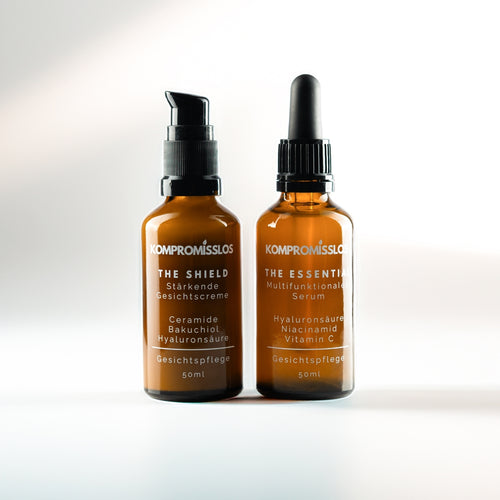
The best way to care for skin that is prone to breakouts on the chin is to keep things calm: gentle cleansing, light skincare and no drying-out regime. The urge to strip as much oil as possible from an area with spots is understandable, but it often does more harm than good. Harsh cleansing, toners containing alcohol and several acids at once irritate the skin barrier, and irritated skin tends to look more unsettled rather than calmer. On top of that, the skin on the chin is often dry and blemished at the same time, especially if you have combination skin. What makes sense are active ingredients that support a more balanced complexion without putting the skin under stress. Niacinamide is well researched for this and usually well tolerated, zinc PCA can help balance a shiny, unsettled-looking complexion, and ceramides support the barrier. The Duo contains 5% niacinamide and 1% zinc PCA in total, plus ceramides in the cream. That makes it basic skincare that does not work against your skin – but it is no substitute for seeing a doctor if you have hormonal acne.
- Cleanse your face gently but thoroughly, down to under your chin and along your jawline.
- Apply your skincare to your chin too, instead of leaving out the blemished area.
- Introduce new active ingredients one at a time and give them a few weeks before you judge.
- Use sunscreen during the day so that healing spots do not stay visible for longer.
- Leave spots alone rather than picking at them.
When should you see a doctor about chin breakouts?
You should have chin breakouts checked by a doctor if they are deep and painful, leave scars or dark marks, or do not improve over several months despite gentle skincare. At that point it is no longer about cosmetics but about acne, and there are effective medical options for that. A second reason to book an appointment is accompanying signs: irregular or absent periods, increased hair growth on the chin or upper lip, thinning hair on your head, or blemishes that suddenly appear severely in adulthood. Combinations like these can point to a hormonal cause such as polycystic ovary syndrome (PCOS). That is for a gynaecologist or dermatologist to assess, not your skincare routine. Small red bumps around the mouth and chin that burn or flake also need a specialist’s opinion. They may be a sign of perioral dermatitis, which often does not get better with more and more skincare. The same holds for all of these cases: good skincare can accompany medical treatment, but it cannot replace it.
I do not promise that The Duo will make chin breakouts disappear, and that is deliberate. Blemishes on the chin and jawline often have a hormonal component, and no cream regulates hormones. What I could decide was what goes into the two products and how openly I talk about it. That is why the concentrations are stated: 5% niacinamide and 1% zinc PCA, both figures for The Duo as a whole, plus ceramides for the barrier, all without fragrance. This gives blemish-prone skin a calm basic routine that does not dry it out. What it does not get is a promise I cannot keep. If your spots are deep, painful or stubborn, you need a specialist first and the right skincare only after that. I have set out openly what each active ingredient in The Duo does.
Frequently asked questions
Are chin breakouts linked to your gut?
A direct link between spots on your chin and your gut has not been proven. Research on the gut–skin axis does look at how diet and gut flora can affect the complexion as a whole, but not at whether gut problems show up on the chin specifically. That location rule comes from face mapping. If you have digestive problems, have them checked regardless of your skin.
Do spot patches help with chin breakouts?
For individual, superficial spots, hydrocolloid patches can be useful. In a small pilot study in the Journal of Cosmetic Science involving 20 people, mild to moderate inflammatory blemishes improved more markedly over three to seven days under hydrocolloid patches than under ordinary skin tape. There is also a simple advantage: you cannot get at a spot that is covered by a patch. They are not designed for deep lumps without a head.
Can your phone or a face mask cause chin breakouts?
Your phone and a mask can contribute if they regularly rest and rub against your skin. Pressure, friction and warmth encourage blemishes exactly where the contact happens. If your spots line up precisely with the contact area, a test is worthwhile: take calls with headphones or change your mask more often for two to three weeks and see what happens.
Does changing your pillowcase more often help?
A fresh pillowcase does no harm and costs little, but it is not a solution for chin breakouts. Sebum, traces of hair products and skin flakes collect on the pillowcase and end up on your cheek and chin at night. There are no studies on how often you should change it. If you always sleep on the same side and the spots appear exactly there, changing it more often is an easy thing to try.
Can I squeeze spots on my chin?
Better not. Many spots on the chin sit deep, and squeezing tends to push the inflammation further into the tissue rather than drawing it out. The result is redness and marks that stay visible for longer. What helps instead is explained in the article on why you should leave spots alone rather than squeezing them.
What gets rid of a spot on your chin quickly?
Nothing works truly fast – an inflamed spot usually needs a few days. What you can do is leave it alone, cool it briefly to bring the swelling down and skip home remedies such as toothpaste, which only irritate the skin further. If you want to get rid of chin breakouts for good, a calm routine kept up over weeks will get you further than an overnight emergency fix.
Is The Duo suitable for skin prone to chin breakouts?
Yes, as calm basic skincare. The Duo is fragrance-free and contains a total of 5% niacinamide and 1% zinc PCA for a more balanced complexion, plus ceramides for the barrier. It does not, however, replace a doctor’s assessment if your spots are deep, painful or hormonal. You can take your time reading up on how The Duo is made up and how to use it.
Sources
- Dréno B, Layton A, Zouboulis CC, López-Estebaranz JL, Zalewska-Janowska A, Bagatin E, et al. Adult female acne: a new paradigm. Journal of the European Academy of Dermatology and Venereology, 2013. Source
- Capitanio B, Sinagra JL, Bordignon V, Cordiali Fei P, Picardo M, Zouboulis CC. Underestimated clinical features of postadolescent acne. Journal of the American Academy of Dermatology, 2010. Source
- Spigariolo CB, Giacalone S, Nazzaro G. Maskne: The Epidemic within the Pandemic: From Diagnosis to Therapy. Journal of Clinical Medicine, 2022. Source
- Chao CM, Lai WY, Wu BY, Chang HC, Huang WS, Chen YF. A pilot study on efficacy treatment of acne vulgaris using a new method: results of a randomized double-blind trial with Acne Dressing. Journal of Cosmetic Science, 2006. Source