Forehead acne: how hair, hair products and headbands can cause it
SKIN CONCERNS
The causes of forehead acne often have little to do with your facial skincare and a lot to do with your hair and what is on it: residue from shampoo, conditioner and styling products, a fringe that keeps sebum and warmth on the skin, or friction under a headband, helmet or hat. The typical sign is lots of small, skin-coloured bumps along the hairline that you feel more than you see. So start at the hairline, and keep your facial skincare light and calm rather than drying your forehead out.
Why do you get spots on your forehead?
Forehead spots form the same way as spots elsewhere on the face – from sebum, skin cells that narrow the pore opening and the inflammation that can follow – but on the forehead, hair, hair products and anything covering it add typical triggers of their own. What sets the forehead apart is its location. It sits right next to your hair, and whatever you put in your hair ends up on your skin sooner or later, when you rinse it out or when you sweat. On top of that, the forehead is often covered, by a fringe, a headband, a hat or a helmet. Warmth and sweat build up underneath, and every movement rubs lightly against the skin. The American Academy of Dermatology (AAD) describes exactly this pattern: tiny blemishes along the hairline, on the upper forehead and on the back of the neck, triggered by hair care products. The general triggers, from genetics to skincare mistakes, are covered under the causes of blemish-prone skin. This article is about what is specific to the forehead.
A look in the mirror helps you narrow it down. If the spots sit mainly in a narrow strip just below the hairline, or exactly where your fringe falls, that points to a cause from above, in other words from your hair. If they are spread across your whole face, the forehead is just one part of a bigger picture. Stress can make existing blemishes worse, but it does not explain why they gather along the hairline in particular.
Can shampoo, conditioner and styling products cause forehead acne?
Yes, shampoo, conditioner and styling products can cause forehead acne, especially if they are rich in oils or leave residue on the skin. According to the AAD, oils from hair products get onto the skin, where they can clog pores. It names not only pomades and waxes but also shampoos, conditioners, gels, pastes and sprays. The phenomenon even has its own name: acne cosmetica, meaning breakouts caused by products applied to the skin or hair. A well-known form is pomade acne, named after heavy, greasy hair pomades. A small study in the Journal of Drugs in Dermatology looked at how much a switch can achieve: 27 people aged 16 to 45 with mild to moderate acne used a non-comedogenic hair care regimen for eight weeks. Among participants with facial acne, a dermatological assessment rated the skin as improved in 52 per cent. The study had no control group, so it shows a trend rather than proof. As a possible explanation, it suggests that even rinse-off products can leave residue on the skin.
Whether a hair product is a problem can rarely be pinned on a single ingredient. Why lists of comedogenic ratings are not very reliable is explained in the article on what ‘comedogenic’ really means and which oils are a problem. For the forehead, what matters most is the route a hair product takes: conditioner that you rinse forwards over your head runs down your forehead. Hairspray and dry shampoo settle on the skin as a fine mist. And hair oil on the lengths brushes against your hairline with every movement.
Does a fringe cause forehead spots, or is it greasy hair?
A fringe does not cause spots on its own, but it amplifies everything that is in your hair. It rests on your forehead all day and brings sebum from the scalp, styling residue and sweat straight onto the skin. At the same time, it traps warmth and rubs lightly over the same area every time you move your head. That is why ‘fringe or greasy hair’ is usually the wrong question. A freshly washed fringe with no products puts little strain on the forehead, whereas a fringe on day three after washing, with heat protectant, straightening spray and dry shampoo, puts on considerably more. Studies focusing on fringes alone are rare, so this assessment follows from what is known about hair products and friction. In practice, that means: wash your fringe more often than the rest of your hair if it gets greasy quickly, apply styling products to the lengths rather than the roots, and pin your hair back when you do not need it loose. The habit of constantly sweeping your fringe off your forehead with your hand also adds sebum and friction to exactly the spot that is already under strain.
| Possible cause | Typical pattern | What to change |
|---|---|---|
| Oil-rich styling products such as wax, pomade, hair oil | Small closed comedones right along the hairline | Stop using the product for a few weeks, or apply it only to the lengths |
| Conditioner, treatment, hair mask | Blemishes on the forehead and temples, where the water runs off | Tilt your head back when rinsing, then rinse your forehead |
| Hairspray, dry shampoo | Fine bumps at the roots, more after styling days | Shield your forehead while spraying, wash out residue in the evening |
| Fringe | Blemishes exactly in the area the fringe covers | Wash your fringe more often, use less product at the roots |
| Headband, helmet, hat, cap | Rough bumps along the edge, band or padding | Wash the contact surface regularly, choose a soft material |
Why do you get spots under a headband, helmet or hat?
You get spots under a headband, helmet or hat because pressure, friction, warmth and sweat all come together there. Specialists call this acne mechanica. The AAD describes the process like this: equipment or clothing holds warmth and sweat against the skin, rubs over the heated skin and irritates it. In skin that is prone to blemishes, this leads to new breakouts. Among its examples, the AAD lists cycling helmets and riding helmets. The researchers Mills and Kligman described the mechanism as early as 1975 in the Archives of Dermatology: when acne-prone skin was sealed under adhesive for two weeks, new inflammatory spots regularly appeared. They developed from microcomedones, clogged pores that are not yet visible to the naked eye. According to the AAD, the first signs are small bumps that feel rough before you can really see them.
That does not mean you have to give up your headband or helmet. Keeping the contact surface clean is often enough: wash headbands, hats and caps regularly, clean helmet padding from time to time, and choose a soft band over tight elastic. A clear giveaway is blemishes that keep appearing along the same line, such as the edge of a woolly hat or the sweatband of a cap.
Spots along the hairline are often half hidden under your hair, and that is exactly where people are most tempted to pick at them. Leave them alone, even if it is hard. The reasons are in the article on why you should leave spots alone rather than squeezing them.
What do lots of small, identical spots on your forehead mean?
Lots of small spots on your forehead that all look the same are often closed comedones, which are typical of breakouts caused by hair products. The AAD describes them as whiteheads and tiny skin-coloured bumps that sometimes only become noticeable when you run your fingers over them. In some people, they are numerous and closely packed together. If your forehead itches noticeably, though, and the dots are red bumps and pustules of the same size, something else may be going on. A review in the Journal of Fungi describes Malassezia folliculitis, informally known as ‘fungal acne’: yeasts that are part of the skin’s flora multiply in the hair follicles, the uniform, itchy bumps and pustules look very similar to acne, and the condition is frequently misdiagnosed. Also worth distinguishing: flaking and redness along the hairline and on the eyebrows can point to seborrhoeic dermatitis, while small bumps around the mouth and nose are more likely to suggest perioral dermatitis. Only a dermatologist can tell whether it is one of these, for example with a microscopic examination if Malassezia is suspected. Trying antifungal shampoos on a hunch is no substitute for that assessment.
How do you care for a blemish-prone forehead without drying it out?
The best way to care for a blemish-prone forehead is to keep things light, gentle and consistent while you tackle the cause at the hairline. The most common mistake is the opposite approach: the hair products stay, and the forehead is stripped of oil with ever stronger products. The tight feeling afterwards is not a sign of clean skin but a sign that the skin barrier is struggling, and irritated skin tends to look more troubled, not less. If your forehead is also shiny while your cheeks feel tight, it is about more than just your forehead. For that, see the article on skincare for combination skin with a shiny T-zone. For the forehead itself, this order makes sense:
- Cause first: stop using the suspect hair product for a few weeks, only one at a time.
- Remove residue: briefly rinse your forehead with water after washing and styling your hair.
- Keep it light: no thick, rich layers along the hairline, just a thin application.
- Give it time: rather than trying exfoliants, acids and spot treatments all at once, give one routine time to work.
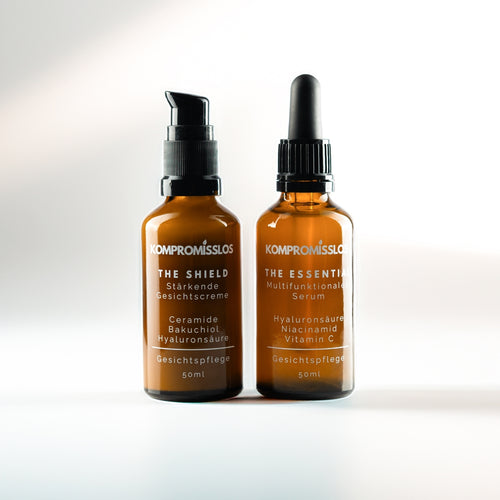
A short routine is all you need for skincare afterwards. The Duo with serum and cream has two steps: The Essential, a light serum with niacinamide and zinc PCA, and The Shield, a cream with ceramide NP and squalane that supports the skin barrier. The Duo as a whole lists 5% niacinamide and 1% zinc PCA, two active ingredients used for a more even-looking complexion. What zinc can and cannot do here is explained in the article on zinc PCA benefits. Both products are fragrance-free, silicone-free and free from mineral oil. But even well-made facial skincare cannot outweigh a cause at the hairline.
I made The Duo fragrance-free, without silicones or mineral oil, and disclosed the concentrations: 5% niacinamide, 1% zinc PCA and 2% vitamin C as 3-O-Ethyl Ascorbic Acid. When you know what is in your facial skincare, it is easier to rule it in or out as the cause of forehead spots. But to be honest: if your hair wax, your conditioner or your helmet is the cause, no facial skincare can make up for it, mine included. Then you do not need another anti-spot product, you need a change at your hairline. I would rather you dropped a hair product than bought a third face product. You can find the full list at any time in the overview of all ingredients from A to Z.
Frequently asked questions
Are forehead spots linked to digestion or the liver?
There is no solid evidence for that. The idea that the forehead reflects your digestion comes from face mapping, which has not been shown to work as a diagnostic method. Hair products, a fringe and friction are far more likely. What these organ maps are really worth is covered in the article on chin breakouts and what face mapping is really worth.
How can I tell whether my hair product is causing the spots?
The most reliable way is to leave it out: stop using the suspect product and watch your forehead over several weeks. Change only one thing at a time, otherwise you will not know in the end what made the difference. An early clue is spots that sit right along the hairline and increase after styling days.
Do I need to use silicone-free shampoo?
Not necessarily. The mechanism the AAD names is oils in hair products that get onto the skin and can clog pores, not silicones as a group. What matters more than any single label is whether a product is rich and leaves residue on your forehead and hairline. If you switch, the AAD recommends products labelled ‘non-comedogenic’ or ‘oil free’, even though these terms are not protected.
Do dry shampoo and hairspray help, or do they make it worse?
They can make it worse if they regularly land on your forehead. The AAD explicitly counts sprays among the hair products that can contain oil, and dry shampoo stays at the roots until your next wash. Hold your hand in front of your forehead while spraying and wash out the residue in the evening. As a permanent substitute for washing your hair, dry shampoo is of little use if your forehead is prone to blemishes.
How long does it take for forehead spots to clear after a change?
Expect several weeks. For breakouts caused by hair products, the AAD gives 4 to 6 weeks after you stop using the product responsible. If nothing improves after 6 weeks, it advises seeing a dermatologist. Clogged pores that have already formed need time, so a single week tells you little.
When should I see a doctor about forehead spots?
If they do not clear after 6 weeks without the suspect hair products, itch a lot, form painful lumps, leave scars or spread quickly. Flaking and redness along the hairline or uniform, itchy pustules also call for a dermatologist, because acne, Malassezia folliculitis or seborrhoeic dermatitis could be behind them.
Is The Duo suitable for skin that is prone to blemishes on the forehead?
Yes, as a light two-step routine that cares for the skin calmly rather than drying it out: fragrance-free, without silicones or mineral oil, with niacinamide and zinc PCA for a more even-looking complexion. But it does not replace a change at the hairline if that is where the cause lies, nor does it replace a dermatological assessment if you have acne. You can see what is inside on the page for The Duo with serum and cream.
Sources
- American Academy of Dermatology. Are your hair care products causing breakouts? AAD, accessed 2026. Source
- American Academy of Dermatology. Is sports equipment causing your acne? AAD, accessed 2026. Source
- Rubin IK. Efficacy of a Non-Comedogenic Hair Care Regimen for the Reduction of Mild-to-Moderate Truncal and Facial Acne: A Single-Arm 8-Week Study. Journal of Drugs in Dermatology, 2021. Source
- Mills OH, Kligman AM. Acne mechanica. Archives of Dermatology, 1975. Source
- Chalupczak NV, Lipner SR. Malassezia Folliculitis: An Underdiagnosed Mimicker of Acneiform Eruptions. Journal of Fungi, 2025. Source