Combination skin: how to recognise it and what skincare it really needs
SKIN CONDITION
Combination skin means that your forehead, nose and chin produce more sebum than your cheeks. The T-zone shines, while the cheeks feel tight or flake. Skincare for combination skin therefore doesn’t need two product lines, but a light, barrier-strengthening routine that works everywhere and doesn’t dry out the dry areas even further. Two products designed to work together are usually enough.
What is combination skin and how do you recognise it?
Combination skin is the condition in which different areas of the face produce different amounts of sebum. The forehead, nose and chin form the T-zone and often start shining again by midday, while the cheeks stay matte, feel tight or flake slightly after washing. You can recognise it with a simple test: wash your face in the morning with water only, wait two hours, then blot your forehead and a cheek separately, each with its own tissue. If the forehead tissue shows a grease mark and the cheek tissue does not, you have combination skin. That the T-zone produces more than the cheeks has been measured: a Korean study in Skin Research and Technology recorded sebum levels at five points on the face over a whole year and consistently found higher levels on the forehead, nose and chin than on either cheek, with clear differences between the seasons. That is exactly why it is worth thinking in terms of skin condition rather than skin type: combination skin is not a label for life but a snapshot that shifts with age, climate and skincare.
What skincare does combination skin need?
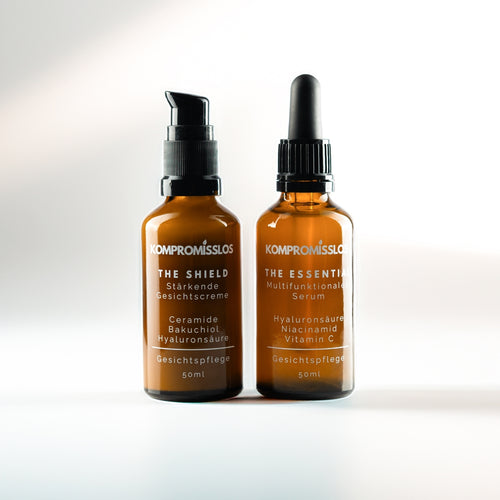
Combination skin needs moisture and a stable barrier, not mattifying at any cost. The most common mistake is fighting the shiny T-zone with strongly degreasing cleansers and toners containing alcohol. The skin loses lipids in the process, the cheeks become drier and the T-zone often makes up for the loss with even more sebum. It makes more sense to cleanse gently morning and evening, then apply a light, water-based layer of moisture, topped with a cream that protects without weighing the skin down. That is exactly how The Duo of Essential serum and Shield cream is designed: morning and evening, 3 to 6 drops of serum, followed by 3 to 6 pumps of cream, applied the same way all over the face. If your cheeks are dry, you can use one extra pump there. What matters is the order from light to rich, so that the moisture stays under the cream. You will find the exact sequence and amounts on the step-by-step how-to-use page.
Do you need two different products for your T-zone and cheeks?
In the vast majority of cases, no. Two separate skincare lines for a single face sound logical, but in practice they mainly create effort, cost and uncertainty at the transition zones. Where exactly does the T-zone end and the cheek begin? The boundary is fluid, and your skin mixes the two products anyway. A texture that works for both zones is far more reliable: light enough not to sit on your forehead, and hydrating enough that your cheeks don’t feel tight. Zone-by-zone skincare only really makes sense in one case, namely when one area reacts differently all the time and to a marked degree – very dry patches on the cheekbones in winter, for example. Then one extra pump applied locally is enough, and that is something different from a second product. Also bear in mind that the zones shift: if you have two creams in the bathroom in winter, you will usually only use one of them in summer. Whether you need both steps at all is covered in the article Serum and cream: do you really need both?
| Feature | T-zone (forehead, nose, chin) | Cheeks |
|---|---|---|
| Sebum output | Higher, with visible shine as the day goes on. | Lower, with a matte to dull surface. |
| Typical feel | Oily, sometimes with more visible pores. | Tight, rough or slightly flaky. |
| Common concern | An unsettled complexion and shine returning. | Dehydration lines and sensitivity. |
| What the zone needs | A light texture, no degreasing. | Moisture and barrier protection. |
Which active ingredients really help combination skin
For combination skin, the active ingredients that count are those that bind moisture and support the barrier rather than drying out the surface. Niacinamide is the most interesting candidate here: in a study in the Journal of Cosmetic and Laser Therapy, a 2% niacinamide preparation reduced measured facial sebum output compared with the control. What was tested there was a 2% preparation, not The Duo, and the finding applies to the substance, not to any individual product. You can read in detail what else niacinamide can do in niacinamide benefits. In total, the Duo contains 5% niacinamide, 2% hyaluronic acid to bind moisture, 1% zinc, plus squalane and ceramides for the barrier. All percentages refer to the Duo as a whole, not to the serum or cream individually. What you don’t need, on the other hand, are strongly astringent additives or mattifying silicates, which only mask the shine and do nothing about the cause. The full overview of all ingredients shows you what else is inside.
What to leave out if you have combination skin
Leave out anything that mattifies your skin in the short term and weakens it in the long term. That includes toners containing alcohol, daily exfoliation, very hot water and foaming cleansers with a high pH. These products remove not only excess sebum but also lipids from the uppermost layer of skin. The result is skin that feels tight on the cheeks and still shines in the T-zone, often accompanied by redness and a sudden feeling of sensitivity. How to recognise this is described in the article on the damaged skin barrier. Mattifying powder over a dry cheek is also unnecessary, as is the reflex to wash your face again every time it shines. Exfoliating once or twice a week is enough, and it belongs on the whole face, not just the forehead. And if your T-zone only shines again in high summer and nothing else bothers you, you don’t need to change anything about your routine.
When combination skin needs a dermatologist
Skincare cares for the appearance of your skin; it does not treat skin diseases. This boundary matters with combination skin, because a shiny, unsettled T-zone can also hide something else. The following belong with a professional: painful, deep or scarring inflammation, widespread redness with visible thread veins, weeping or heavily flaking patches, sudden changes with no obvious trigger and any condition that has been bothering you for months without improving. If you are taking medication that affects the skin, a dermatologist’s assessment also makes more sense than the next change of product. Cosmetic skincare can accompany treatment in these cases, but it does not replace a medical assessment. Time is a good guide: if nothing has changed after eight to twelve weeks of consistent, gentle skincare, the answer does not lie in the next jar. For an unsettled complexion that is not a medical condition, you will find the relevant context in the article on blemish-prone skin. Our complete range, serum and cream for CHF 109.90, deliberately remains skincare.
I deliberately chose not to create a separate third product for combination skin. When formulating, my question was never how to mattify the T-zone, but what a texture looks like that gives the cheek enough and doesn’t give the forehead too much. That was the reason for 5% niacinamide and 2% hyaluronic acid instead of an excess of heavy oil, and for two products instead of four. For me, combination skin is not a special case but the normal case, which a routine has to work for anyway. And I would rather tell you honestly when you don’t need anything: if your shine only appears in summer and your cheeks don’t feel tight, your skin is not a problem case – it is simply normal.
Frequently asked questions
Is combination skin a skin type or a skin condition?
Combination skin is usually sold as a skin type, but it behaves like a skin condition. The distribution of sebum is partly genetic, but it shifts with age, hormones, the season and your skincare products. If you treat the category as fixed, you may spend years caring for your skin according to a picture that is long out of date. It is better to reassess your skin’s condition twice a year.
Does combination skin change in summer and winter?
Yes. Facial sebum output varies with the seasons – it is higher in summer than in winter – and the T-zone reacts more strongly than the cheeks. In practice, this means the same routine can feel too rich in July and too light in January. Adjust the amount rather than the whole product.
Do I even need a face cream if I have combination skin?
Yes, even with a shiny T-zone. Shine indicates sebum, not moisture, and the two are not the same. If you leave out the cream, your skin loses water through its surface, your cheeks feel tight and your complexion becomes more unsettled overall. What matters is the texture: light enough for the forehead, nourishing enough for the cheek.
Does niacinamide help with a shiny T-zone?
For niacinamide, there is evidence from clinical studies that a 2% preparation can reduce measured facial sebum output. That is a statement about the substance, not about a specific product, and the effects are moderate. Expect a more even surface over several weeks, not an instantly matte complexion.
How often should I exfoliate combination skin?
Once or twice a week is enough – over the whole face, not just the T-zone. Exfoliating more often removes lipids and weakens the barrier, which tends to increase shine rather than reduce it. If your skin feels tight for more than an hour after exfoliating, it was too much or too aggressive.
Can combination skin disappear with age?
Yes, that is common. Over the years, sebum output usually decreases, the T-zone shines less and the cheeks become drier. Combination skin then often turns into mostly dry skin. If the mattifying skincare you are used to suddenly leaves your skin feeling uncomfortably tight, that is usually the reason for the change.
How long does The Duo last with combination skin?
Depending on how often you use it, a bottle lasts 2 to 4 months. With twice-daily use of 3 to 6 drops of serum and 3 to 6 pumps of cream, you will be at the lower end of that range. If you apply extra cream locally to dry cheeks, you will use up the cream a little faster than the serum.
Sources
- Youn SW, Na JI, Choi SY, Huh CH, Park KC. Regional and seasonal variations in facial sebum secretions: a proposal for the definition of combination skin type. Skin Research and Technology, 2005. Source
- Draelos ZD, Matsubara A, Smiles K. The effect of 2% niacinamide on facial sebum production. Journal of Cosmetic and Laser Therapy, 2006. Source