Zinc PCA benefits: what it does, how to use it and which skin it suits
ACTIVE INGREDIENTS
Zinc PCA is the zinc salt of pyrrolidone carboxylic acid – in other words, zinc bound to a building block of the skin’s natural moisturising factor – and its benefits in skincare are twofold: it helps hold on to moisture and helps balance a shiny, uneven-looking complexion. It makes most sense for combination skin and skin that quickly turns shiny, not for every skin condition.
What does zinc PCA do in skincare?
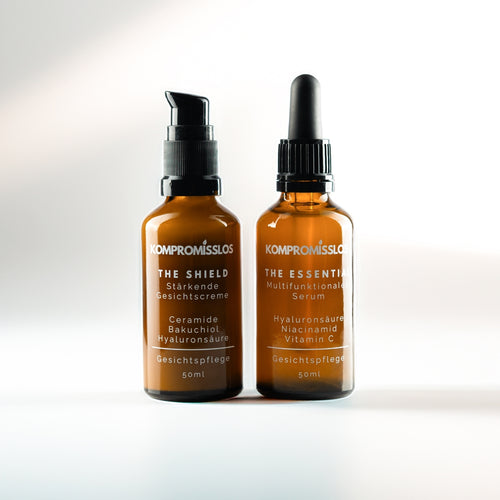
Zinc PCA brings two building blocks together in a single compound: zinc as a trace element and PCA as a humectant the skin makes itself. The PCA half, pyrrolidone carboxylic acid in full, is formed in the skin when the structural protein filaggrin is broken down, and it is one of the most important components of the natural moisturising factor in the stratum corneum, the skin’s outermost layer. According to a study in Clinical, Cosmetic and Investigational Dermatology, the PCA content of the stratum corneum is directly linked to the slightly acidic pH of the skin’s surface. The zinc half is the reason the ingredient turns up in formulas for skin that quickly gets shiny in the first place. In CosIng, the EU’s cosmetic ingredient database, zinc PCA is listed with the functions humectant and skin conditioning, not as a sebum regulator. You should be aware of this gap between advertising claims and the official classification before you buy. That is why, at Kompromisslos, zinc is part of the Duo of serum and cream rather than a separate add-on product.
The sebum story in advertising comes from general research on zinc. A laboratory study in the British Journal of Dermatology showed in 1988 that zinc sulphate inhibits the enzyme 5-alpha reductase in the test tube. That points to a mechanism; it says nothing about a finished product.
How much zinc PCA should a product contain?
There is no binding minimum amount for zinc PCA, either in cosmetics legislation or in any recognised professional recommendation. That is precisely why the percentage question is harder to answer for this ingredient than, say, for vitamin C. What you can check instead is its position in the INCI list. If zinc PCA sits far down among the preservatives and fragrances, the proportion is very small. If it is in the top third, there is more of it. A second check: does the brand state a figure at all? Many don’t, and that isn’t fraud, but it makes any comparison between two products impossible. A high figure on its own says little anyway, unless the rest of the formula fits. In the Kompromisslos Duo, zinc PCA is declared at 1 per cent. All figures are listed openly in the full overview of active ingredients.
Which skin conditions benefit from zinc PCA?
Zinc PCA is worth it above all if your skin gets shiny over the course of the day, your pores are clearly visible in the T-zone or your complexion looks uneven. For very dry, tight skin, on the other hand, it does not solve a problem you actually have, because what is missing there is lipids and moisture, not excess sebum. The distinction between skin type and skin condition matters here: shine can be a permanent tendency or a temporary reaction to harsh cleansing. In the second case, a gentler routine achieves more than an extra active ingredient, and you save the money for a product that would only be fighting a home-made problem. An uneven complexion also has many possible triggers, from hormones to how clean your pillowcase is. If you find yourself with a shiny forehead and dry cheeks at the same time, start by reading our guide to combination skin.
| Skin condition | Is zinc PCA worthwhile? | What else matters |
|---|---|---|
| Shine in the T-zone, visible pores | Yes, as part of your routine | Gentle cleansing instead of alcohol |
| Combination skin with dry cheeks | Yes, if the cream provides moisture | Two different textures are rarely necessary |
| Dry, tight skin | Not necessary | Ceramides, squalane and panthenol |
| Skin prone to redness that reacts quickly | Usually well tolerated, but not the main reason to choose a product | A short ingredient list without fragrance |
| Mature skin without a shine problem | Not the decisive active ingredient | Moisture, barrier and sun protection |
How often should you use zinc PCA, and what can you combine it with?
You can use zinc PCA twice a day, morning and evening, with no adjustment phase and no rest days. It is not an acid exfoliant or a retinoid, so it does not build up irritation that you would have to increase gradually. With the Duo, that means in practice: 3 to 6 drops of serum, followed by 3 to 6 pumps of cream, morning and evening. Depending on how often you use it, a bottle lasts 2 to 4 months. When it comes to combining, zinc PCA is considered uncomplicated, because it neither shifts the pH of a formula significantly nor makes the skin peel. It works with niacinamide, hyaluronic acid, ceramides and squalane, and there is no known reason to avoid it with vitamin C either. If you are wondering more generally which active ingredients work together, you will find the full overview there. The order on your face stays simple: the thinner texture first, then the thicker one, as described in our step-by-step guide to using the products.
Can you use zinc PCA on sensitive skin?
Zinc PCA is considered well tolerated by sensitive skin, because it is water-soluble, works within the skin’s normal pH range and does not cause peeling. That clearly sets it apart from fruit acids or retinoids, which need a genuine adjustment period on reactive skin. Even so, tolerability rarely depends on a single ingredient; it depends on the whole formula. Fragrances, essential oils, certain preservatives and some emulsifiers trigger reactions in sensitive skin far more often than zinc PCA itself. If your skin is currently irritated, don’t introduce anything new until it has calmed down – not even something supposedly mild. A three-day test in the crook of your elbow or along your jawline is the simplest safeguard. And if you are unsure whether your skin is genuinely sensitive or just over-treated, looking at your skin barrier will help more than any ingredient list.
What should you do if your skin doesn’t tolerate zinc PCA?
If your skin stings, itches or stays red after a new product containing zinc PCA, stop using the product and stick to a mild, familiar basic routine for around two weeks. Then reintroduce the products one at a time, at least five days apart, so you can see what your skin is really reacting to. This matters more than it sounds, because a cream can easily contain thirty ingredients, and statistically zinc PCA is rarely the most likely trigger. Also distinguish between a genuine reaction and a period of adjustment: slight tightness in the first two to three days usually settles on its own; persistent stinging does not. If the reaction lasts longer than two weeks or keeps spreading, it needs to be checked by a professional rather than simply covered up with the next product.
One point that comes up in many enquiries: zinc in skincare and zinc as a capsule are two different subjects. This article deals only with application to the skin.
When zinc PCA is not enough and it’s time to see a professional
Zinc PCA is a cosmetic ingredient, which means it is there for how your skin looks, not for diagnosis or treatment. There are situations in which no skincare routine is the right tool. These include painful, deep-seated inflammation that leaves scars, sudden skin changes with no obvious trigger, weeping or bleeding areas, and symptoms that affect your daily life or get worse over several weeks. In these cases, seeing a dermatologist is the quicker and, in the end, cheaper route, because it saves you trying out five products. Skincare can accompany medical treatment, but it does not replace it, and no active ingredient in a cream changes that. If you are already being treated, check new skincare products briefly with your doctor before you introduce them. That is not a formality; it stops two approaches from working against each other.
I deliberately made zinc a supporting ingredient in the Duo rather than the star of its own product. The reason is an uncomfortable one: for zinc PCA on its own, there is no solid body of evidence on finished cosmetic products, mainly older laboratory studies on zinc in general. Building a zinc serum out of that and marketing it as a sebum regulator would be a claim I could not back up. So zinc is in the Duo for CHF 109.90 at 1 per cent, together with niacinamide and hyaluronic acid, and does its part without me declaring it a miracle ingredient.
Frequently asked questions
Is zinc PCA the same as zinc oxide?
No. Zinc PCA is a water-soluble zinc salt of pyrrolidone carboxylic acid and is used in serums and creams as a skin-conditioning active ingredient. Zinc oxide is a white mineral powder that serves as a UV filter and an opaque protective layer. The two only share the word zinc in their names.
Does zinc PCA dry out your skin?
No, at the usual concentrations zinc PCA does not dry out the skin. The PCA half is part of the natural moisturising factor of the stratum corneum and binds water. A dry feeling after a new product is more often down to alcohol, harsh cleansing or too few lipids in the cream.
Can you combine zinc PCA with vitamin C?
Yes, there is no known reason not to combine zinc PCA with vitamin C. The two are found together in routines and even in the same formula. The Kompromisslos Duo contains both zinc and vitamin C as 3-O-ethyl ascorbic acid, each figure based on the Duo as a whole.
How long does zinc PCA take to show results?
Allow four to six weeks before you judge whether a product with zinc PCA is doing anything. There is hardly any reliable timing data specifically for zinc PCA, so this timeframe is based on experience rather than on a figure from a study. If you judge earlier, you will almost always come to the wrong conclusion.
Is zinc PCA vegan?
Yes, zinc PCA is vegan. It is made synthetically from a zinc salt and pyrrolidone carboxylic acid, without any animal-derived raw materials. Whether a whole product is vegan still depends on the complete formula, because beeswax, lanolin or carmine can appear elsewhere on the list.
Sources
- Li R, Rodrigues M, Li L et al., Association Between Skin Acid Mantle, Natural Moisturizing Factors, and Antibacterial Activity Against S. aureus in the Stratum Corneum, Clinical, Cosmetic and Investigational Dermatology, 2023. Source
- Stamatiadis D, Bulteau-Portois MC, Mowszowicz I, Inhibition of 5 alpha-reductase activity in human skin by zinc and azelaic acid, British Journal of Dermatology, 1988. Source