Comedogenic: what it means and which oils really are a problem
INGREDIENTS & TRUST
Comedogenic means that an ingredient can clog pores and so encourage blackheads and whiteheads. The term comes from tests in the 1970s in which individual raw materials were tested undiluted. It tells you little about finished skincare products, because the concentration, the rest of the formula and your own skin are what decide the outcome. A number on a scale is therefore no substitute for testing a product on your own skin.
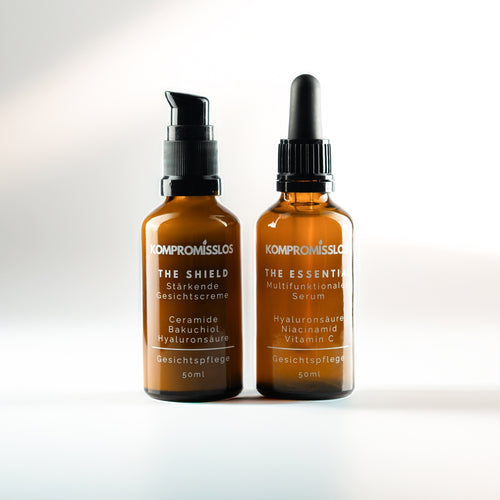
Because the finished formula is what counts: The Duo – Serum & Face Cream is fragrance-free and dermatologically tested, with a 100-day right of return so you can try it out.
What does comedogenic mean exactly?
Comedogenic means that a substance can contribute to the opening of a sebaceous gland becoming blocked with sebum and dead skin cells. When this plug forms, dermatologists call it a comedo – in everyday language, a blackhead or whitehead. It shows up either as a small dark dot or as a closed, whitish bump. The opposite term, non-comedogenic, claims that a product does not trigger this process. The order matters: a comedo is the precursor, not the inflammation itself. If your skin tends to be blemish-prone, you often have both at the same time, but the causes go deeper than a single oil. Sebum production, how quickly the skin sheds its cells, hormones and mechanical friction all play a part. So the term comedogenic describes nothing more than a risk that a single raw material has shown under laboratory conditions. It does not describe what a finished serum or cream will do to your face, and it says nothing about how much of the substance the formula actually contains.
What is a comedo, and where does the word comedogenic come from?
A comedo is the medical term for a blackhead or whitehead: a hair follicle whose opening is clogged with sebum and dead skin cells. The plural is comedones. The word comes from the Latin comedo, which once meant a glutton. The ending -genic goes back to the Greek -genḗs, meaning producing or causing. So comedogenic literally means ‘causing comedones’ – in plain English, pore-clogging. Its opposite, non-comedogenic, describes a product that is not supposed to clog pores. There are two forms. Open comedones are blackheads; closed comedones are small skin-coloured to whitish bumps in which the follicle is completely blocked. According to DermNet, a dermatology reference site, blackheads are dark because of the skin pigment melanin, not because of dirt. Scrubbing harder will therefore not wash them away. Whether what you see on your nose really is blackheads or just harmless sebaceous filaments is explained in our guide to sebaceous filaments vs blackheads.
How reliable are comedogenic scales?
The usual comedogenic scales are a rough guide, not a measurement. They rate a raw material from 0 to 5, with scores of 3 and above historically regarded as highly comedogenic. The original data come from the rabbit ear test, in which concentrated substances were applied to the very sensitive inner side of a rabbit’s ear. A review in JAAD Reviews notes that this model produced contradictory results on human skin, and that to this day there is neither a standardised test method nor any oversight of the non-comedogenic label. In other words, manufacturers can use the term more or less as they please. On top of that, most of the figures circulating online go back to raw-material lists from the 1970s and 1980s and have never been re-checked against modern formulas. They get passed on regardless, from blog to blog, without any source. How to judge the quality of a product without relying on labels like these is covered in our article on natural skincare without certification labels.
Which oils are considered problematic, and which are not?
The oils considered problematic are mainly heavy, highly saturated plant oils and butters: coconut oil, cocoa butter, wheat germ oil and raw shea butter sit near the top of almost every list. Thin, skin-like oils such as squalane, jojoba oil, safflower oil and hemp seed oil are considered unproblematic. This classification is plausible, because thick oils stay on the surface for longer and are more likely to cover the opening of the follicle. But it is no guarantee in either direction. Coconut oil on your face does not cause blemishes in everyone, and an oil listed as harmless can still cause trouble if you apply too much of it or if your skin is already irritated. What matters is how much of the oil is in the formula and how heavy the finished product feels on your skin. So treat a list like this as a starting point for choosing products, not as a verdict on a raw material. The table below shows what to actually look out for with the most common candidates.
| Raw material | Reputation on the scales | What actually counts |
|---|---|---|
| Coconut oil | Rated highly comedogenic on almost every list. | More critical applied neat than in a small amount within a light emulsion. |
| Shea butter | Rated moderate to problematic. | The amount and its position in the ingredient list determine how heavy the texture is. |
| Jojoba oil | Rated low in comedogenicity. | A liquid wax ester that absorbs quickly and rarely leaves a film. |
| Squalane | Consistently rated harmless. | A very light texture that usually goes unnoticed even on oily skin. |
| Mineral oil | Ratings contradict each other from list to list. | Cosmetic grades are highly refined; the texture determines how well it is tolerated. |
Why the finished formula matters more than the individual raw material
It is the finished formula that decides, not the individual raw material on a list. A study by Draelos and DiNardo in the Journal of the American Academy of Dermatology tested finished cosmetic products containing ingredients considered comedogenic on people with a marked tendency to develop comedones. The result: these products were not necessarily comedogenic. The reason lies in the concentration and the rest of the formula. An oil that clogs pores when undiluted can go completely unnoticed in a small amount within a light emulsion. Conversely, a formula made up entirely of harmless raw materials can be too rich for you. In practice, this means two things. First, check where an ingredient appears in the full ingredient list, because far down the list means a small proportion. Second, give a product two to three weeks on your skin before you write it off because of a single name on the list.
Is jojoba oil comedogenic?
Jojoba oil is rated low in comedogenicity on most scales and is unproblematic for the vast majority of people. Chemically, it is not a classic oil but a liquid wax ester whose structure is close to the skin’s own sebum. It absorbs quickly and does not leave a thick film. That is exactly why jojoba oil for the face is part of our formula, together with squalane, which is also light and supports the skin barrier. Even so, some people react to jojoba oil with small blemishes. That is not a contradiction; it is simply how individual skin reactions work. If you know from experience that jojoba oil does not agree with you, that is valid information, even if no scale confirms it. In that case, check the oil’s position in the ingredient list and choose formulas that list it further down. You can find out which active ingredients and oils we use, and in what amounts, on the product page for the Duo.
One customer wrote to tell us that she avoided every product containing plant oil on principle, because a comedogenic list had said oils were unsuitable for her skin type. Instead, she used only a gel and described a constant feeling of tightness. Our answer was not to sell her something, but to suggest that rather than ruling out the whole group of ingredients, she first test a light formula on a small area and then decide for herself.
When you don’t need to worry about comedogenic ratings at all
If your skin is dry or normal and you are not prone to blackheads, comedogenicity is simply not a relevant criterion when you buy skincare. The whole discussion comes from advice for people with oily or blemish-prone skin. With mature, thin or dry-prone skin, the bigger risk is that fear of clogged pores leads you to use products that are too light, leaving you with a feeling of tightness. With combination skin, too, looking at a product’s texture is far more useful than looking at a scale: a light emulsion on the face is almost always a better answer than cutting out lipids altogether. And if you have inflamed, painful or widespread skin changes, that is not a matter for skincare advice but for a dermatologist. Skincare looks after the appearance of your skin; it is no substitute for a diagnosis or treatment.
For the Duo of serum and cream, I deliberately left out heavy plant oils and chose jojoba oil and squalane instead. The reason was not a comedogenic table but a decision about texture: both products should spread quickly and not sit on the skin as a film. Coconut oil or shea butter would have made the cream richer, but also heavier. What I do not claim is that our formula will go unnoticed on everyone’s skin. No label can do that test for you; you do it on your own skin. That is why we disclose every concentration, for example 5% niacinamide and 0.3% bakuchiol in the Duo as a whole, and give you 100 days to try it.
Frequently asked questions
What does comedogenic mean exactly?
Comedogenic means that a substance can contribute to the opening of a sebaceous gland becoming blocked with sebum and dead skin cells. The result is a comedo, in everyday language a blackhead or whitehead. The term describes a risk under test conditions, not a reliable prediction for your skin or for a finished product.
Is there such a thing as comedogenic skin?
No, not strictly speaking. Comedogenic describes an ingredient or product that can clog pores, not a skin type. When people talk about comedogenic skin, they usually mean skin that is prone to blackheads and whiteheads, often oily or blemish-prone skin. For that skin, a product’s texture matters more than the non-comedogenic label. What another common packaging claim really tells you is covered in our article on what dermatologically tested means.
Is non-comedogenic a protected term?
No. According to a review in JAAD Reviews, there is still no standardised test method and no oversight of the non-comedogenic label. Manufacturers can therefore use it more or less as they please. The full ingredient list and how a product feels on your skin are more useful than the label.
Which oils are considered the most comedogenic?
Heavy, highly saturated oils and butters sit near the top of the usual lists, above all coconut oil, cocoa butter, wheat germ oil and raw shea butter. These ratings are based on tests with undiluted raw materials. In a finished formula containing only a small proportion, the same raw material can go unnoticed.
Is squalane comedogenic?
Squalane is consistently rated harmless on the usual scales. It is very light, absorbs quickly and usually goes unnoticed even on oily skin. As with any raw material, though, a scale tells you nothing about how your skin will react to the specific formula that contains the squalane.
How do I find out whether a product clogs my pores?
Apply the product every day for two to three weeks to a limited area, such as one half of one cheek, and compare it with the other side. Change nothing else in your routine during that time. New closed bumps in the test area are a clearer signal than any scale.
Are comedogenic lists on the internet reliable?
Only to a limited extent. Most of the figures go back to rabbit ear tests and to raw-material lists from the 1970s and 1980s. A review in JAAD Reviews notes that these results were contradictory on human skin. Use the lists as a rough starting point, not as a basis for your decision.
Sources
- Draelos ZD, DiNardo JC. A re-evaluation of the comedogenicity concept. Journal of the American Academy of Dermatology, 2006. Source
- Starzyk et al. Comedogenicity in cosmeceuticals: A review of clinical relevance, regulatory gaps, and future directions. JAAD Reviews, 2025. Source
- Oakley A, Ngan V, Morrison C. Comedonal acne. DermNet, 2014. Source
- Duden online. Komedo. Bibliographisches Institut, accessed 2026. Source
- Duden online. -gen. Bibliographisches Institut, accessed 2026. Source