Sebaceous filaments vs blackheads: what you really see on your nose and what helps
SKIN CONCERNS
Sebaceous filaments are the fine, light grey to yellowish dots in the pores of your nose. They are made of sebum and skin cells, line the opening of each pore and are part of normal skin. Blackheads, by contrast, are firm plugs that block the pore and turn dark when exposed to air. Sebaceous filaments cannot be removed for good, because your skin keeps forming new ones. Squeezing them or using pore strips frequently is more likely to irritate your skin. What makes sense is gentle cleansing, light skincare and patience.
What are sebaceous filaments?
Sebaceous filaments are small, cylindrical collections of sebum and dead skin cells that line the opening of a hair follicle and channel sebum to the surface of the skin. Every pore on your face is the opening of one of these follicles, each with a sebaceous gland attached. The sebum does not simply flow out; together with the skin cells of the pore wall, it forms a soft filament that is slowly pushed upwards. From the outside, you only see its tip: a light, grey or slightly yellowish dot, flat in the skin. A case report in Dermatology Practical & Conceptual describes sebaceous filaments as uniform, cylindrical, whitish deposits around normal hair follicles and notes that they mostly occur in healthy people, above all on the nose. So they are not a skin problem in the strict sense, but a visible part of normal sebum flow.
They become noticeable where many follicles sit close together and a lot of sebum arrives. A study in the British Journal of Dermatology measured the density of follicles on the forehead, cheeks, chin and nose of twelve healthy women and recorded their sebum output at the same time. Both decreased from the centre of the face outwards. That is why sebaceous filaments almost always show up first on the nose and around the nostrils, and sometimes on the chin and inner cheeks too. If you are prone to oily skin, you will usually see them more clearly, because more sebum fills the pores and makes the tips shine.
How can you tell sebaceous filaments from blackheads?
Sebaceous filaments are flat, pale and spread evenly across the nose, whereas blackheads are individual, dark and often slightly raised plugs. The difference lies in what is inside. A sebaceous filament is soft and lets sebum keep flowing out. A blackhead, or open comedone in medical terms, is a firm plug of keratinised cells and sebum that blocks the pore and gradually widens it. This is also where the term comedogenic comes from. The dark colour does not come from dirt. An article on comedonal acne in the HCA Healthcare Journal of Medicine explains that the material in the open pore is exposed to air, oxidises and takes up melanin granules, which is why open comedones look brownish to black. Sebaceous filaments can also turn slightly grey at the tip, but they stay noticeably paler and look more like a fine, regular grid of dots. Blackheads belong to the acne spectrum; sebaceous filaments do not.
| Feature | Sebaceous filament | Blackhead (open comedone) |
|---|---|---|
| Colour | Light grey, beige or yellowish | Dark brown to black |
| Distribution | Even, lots of small dots side by side | Individual, irregularly scattered |
| Surface | Flat, barely palpable | Often slightly raised, firm plug |
| What comes out when squeezed | A soft, pale, waxy strand | A firm plug, dark at the tip |
| What it is | Normal skin function | Part of acne (comedonal acne) |
Why shouldn’t you squeeze sebaceous filaments?
You should not squeeze sebaceous filaments, because they soon fill up again and, for a short-lived effect, you put strain on the pore wall and the surrounding skin. The filament is not a blockage that stays gone once it has been removed, but the route by which sebum reaches the surface anyway. If you squeeze it out, you see a pale, waxy strand, and your nose looks smoother for a while. After that, things are back to how they were, because the sebaceous gland keeps working. Pressing with your fingers or nails, on the other hand, irritates the skin, can leave tiny wounds and redness, and carries germs from your fingers into the opened pore. Squeezing regularly turns a healthy area into an irritated one. With real spots, the risk is greater, because inflammatory material can be pushed deeper into the tissue. Why that often leaves marks is explained in detail in the article on squeezing spots. For sebaceous filaments, the rule is simpler: leave them alone – they are part of your skin.
What helps with visible sebaceous filaments on your nose?
No one-off fix helps with visible sebaceous filaments; what helps is a routine that does not ramp up sebum production and does not irritate your pores any further. You cannot get rid of them, but you can make them less noticeable. What you leave out matters at least as much as what you do: harsh oil stripping, hot water, rough scrubs and daily squeezing.
- Cleanse gently: in the evening, use a mild cleanser that removes sunscreen, make-up and excess sebum without stripping your skin. Lukewarm water is enough; hot water strips away even more oil.
- Moisturise lightly rather than drying your skin out: skin that has been dried out does not become any less oily. A light moisturiser keeps the surface supple without weighing down the pores.
- Include niacinamide: in a study in the Journal of Cosmetic and Laser Therapy, a moisturiser with 2% niacinamide significantly reduced sebum excretion in Japanese participants after two and four weeks. In Caucasian participants, the amount of sebum on the skin fell after six weeks, but the excretion rate did not. Sebaceous filaments were not counted in the study.
- Use salicylic acid in a targeted way rather than every day: it is oil-soluble and works inside the pore. Whether it suits your skin, and how often to use it, is covered in the article on salicylic acid.
- Consider retinoids if your sebaceous filaments are very pronounced: in a case report in Cureus, a teenage girl’s face with prominent sebaceous filaments was clear of them after six weeks of a prescription tretinoin cream. That is a single case and a matter for your dermatologist, not for experimenting on yourself.
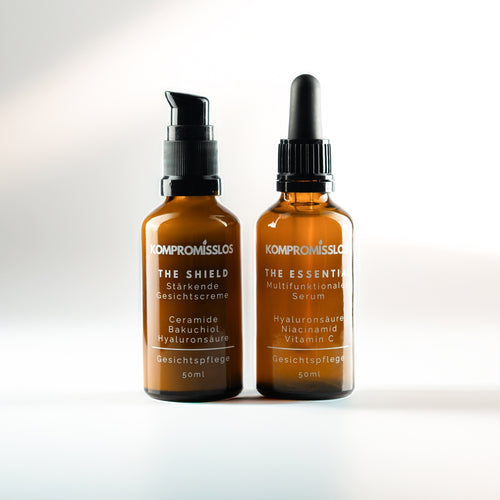
In daily skincare, niacinamide and zinc PCA are the active ingredients that suit skin with visible sebaceous filaments, because they do not dry the skin out and can contribute to a visibly calmer, more balanced complexion. Both are in the Duo of serum and cream, alongside humectants that give the skin water rather than oil. With a shiny nose in particular, texture matters too. In a review on Judge.me, D.Sch writes: ‘The product feels pleasantly light on the skin, absorbs quickly and leaves no greasy or heavy feeling’ (review translated from German). If your pores seem to grow larger over the years, mainly on your cheeks, that is a separate topic: enlarged pores with age have more to do with skin losing firmness than with sebaceous filaments.
Take a photo of your nose in daylight today and again in four weeks, in the same position and the same light. In a magnifying mirror at ten centimetres, every pore looks conspicuous; at normal conversation distance, hardly anyone notices them.
Do pore strips work?
Pore strips mainly remove the top part of sebaceous filaments and loose flakes of skin, but the effect only lasts until the pores have filled up again. On the peeled-off strip, it looks impressive: lots of tiny spikes, seemingly proof that your pores were clogged. In fact, what you have pulled out is mostly sebaceous filaments, which your skin simply forms again. Deeper blackheads are often only partly removed by the strips. The adhesive also sticks to the outermost layer of skin and takes some of it away when you pull the strip off. For sensitive, dry or reddened skin, after sunburn or if you are using acids or retinoids at the same time, that is a strain you can do without. On resilient skin, an occasional strip does little harm, but it does not improve anything in the long run either. If you want to help things along mechanically at all, deciding whether you need to exfoliate your face at all is a better place to start than reaching for the next strip.
When should you see a beautician or dermatologist about blackheads?
Blackheads are a job for a beautician when individual stubborn plugs need to be removed cleanly. They are a matter for a dermatologist when there are a lot of them, when they become inflamed or when they appear together with spots. A professional extraction works with prepared skin, sterile tools and controlled pressure – exactly what is usually missing at home. For sebaceous filaments, on the other hand, the appointment is hardly worth it, because they form again even after an extraction. Lots of blackheads together with inflamed spots are acne, and acne belongs with a dermatologist, who can prescribe active ingredients such as retinoids. Cosmetic skincare supports this but does not replace it. If your skin feels tight and breaks out at the same time, the article on dry skin and breakouts will help you adjust your skincare so that you do not make one worse while tackling the other. You should also have bumps checked that do not look like blackheads, such as yellowish, slightly raised spots with a small dip in the middle. They may be sebaceous hyperplasia, an enlargement of the sebaceous glands which, according to the article in the HCA Healthcare Journal of Medicine, mainly appears from middle age onwards and is often mistaken for blackheads. It is harmless, but it is managed differently. Small, hard white bumps that cannot be squeezed out, on the other hand, are usually milia, which you should not open yourself either.
I have neither an exfoliant nor a salicylic acid product in our range, and on this topic that is a genuine limit. If you have lots of real blackheads and heavily clogged pores, a well-formulated BHA product or a dermatologist will do more for you than two products can. For sebaceous filaments, there is no solution in a bottle anyway, because they are part of your skin. What I can influence is the skincare around them: The Duo contains 5% niacinamide and 1% zinc PCA, openly declared, in a light serum and a fragrance-free cream. The aim is not to strip your skin of oil, but to care for it in a balanced way so that it looks calmer. Which active ingredients are in it, and in what amounts, is set out in our overview of all active ingredients. I do not promise any more than that.
Frequently asked questions
Do sebaceous filaments keep coming back?
Yes, sebaceous filaments keep coming back, because the sebaceous gland is constantly producing more and the filament is the normal route by which sebum reaches the surface. After squeezing or using a pore strip, they are usually visible again within a short time. That is not a sign that you are doing something wrong; it is simply how skin works.
Does salicylic acid help with sebaceous filaments?
Salicylic acid can make sebaceous filaments less noticeable, but it does not remove them for good. Because it is oil-soluble, it loosens skin cells and sebum inside the pore, so the tips look flatter and paler. For dry or sensitive skin, using it on a few evenings a week is often enough. Once you stop, the old picture gradually returns.
Are sebaceous filaments a sign of poor cleansing?
No, people who cleanse thoroughly have sebaceous filaments too. According to the specialist literature, they mostly occur in healthy people, above all on the nose. Washing more often or more harshly will not make them disappear; instead, it dries out and irritates the skin. A gentle cleanse in the evening is enough.
Does niacinamide help with blackheads?
Niacinamide can reduce the amount of sebum on the skin, but it will not dissolve existing blackheads. In a study in the Journal of Cosmetic and Laser Therapy, 2% niacinamide reduced either sebum excretion or the amount of sebum on the skin, depending on the group. For firm plugs, salicylic acid or retinoids are a better fit; niacinamide makes a well-tolerated addition.
Do sebaceous filaments become more visible with age?
Not necessarily. Sebum production peaks during puberty and tends to decline over the years in many women, so sebaceous filaments often become less noticeable. What tends to stand out later are the pore openings themselves, because the skin loses firmness – and that is a separate topic.
Does clay help with blackheads?
Clay absorbs excess sebum on the surface and makes your nose look more matt for a few hours, but it does not dissolve firm plugs inside the pore. The niacinamide study in the Journal of Cosmetic and Laser Therapy mentioned above notes that most sebum-control products absorb sebum rather than influence how much is produced. Clay is fine as an occasional mask, but used too often it tends to dry the skin out.
Is The Duo suitable for skin with visible sebaceous filaments?
Yes, as light daily skincare, The Duo suits skin with visible sebaceous filaments well, but it will not remove them. Niacinamide and zinc PCA can contribute to a visibly calmer complexion without stripping the skin of oil. If you want to work specifically inside the pore, add salicylic acid in a targeted way. What is in the Duo of serum and cream is openly declared.
Sources
- Singh Y, Neema S, Bahuguna A, Dabbas D. Sebaceous Filaments. Dermatology Practical & Conceptual, 2021. Source
- Pagnoni A, Kligman AM, el Gammal S, Stoudemayer T. Determination of density of follicles on various regions of the face by cyanoacrylate biopsy: correlation with sebum output. British Journal of Dermatology, 1994. Source
- Wong CM, Guo C, Scheufele CJ, Nguyen DA, Charles JEM, Carletti M, et al. Presentations of Cutaneous Disease in Various Skin Pigmentations: Acne Vulgaris – Comedonal Acne. HCA Healthcare Journal of Medicine, 2024. Source
- Draelos ZD, Matsubara A, Smiles K. The effect of 2% niacinamide on facial sebum production. Journal of Cosmetic and Laser Therapy, 2006. Source
- Mineroff JP, Hyde JT, Hsu S. A Case Report of Sebaceous Filaments. Cureus, 2023. Source