Enlarged pores with age: why they look bigger on your cheeks and what skincare can refine
SKIN OVER 40
Enlarged pores with age are mainly the result of the tissue around each pore losing firmness. Over the years, collagen and elastic fibres hold the pore opening less tightly, the skin gives way, and on the cheeks round pores turn into oval, teardrop-shaped openings. Skincare with niacinamide, moisture and daily sun protection can make your pores look visibly finer. But pores that have grown larger because the skin has lost firmness will not disappear with any cream.
Why do pores get bigger with age?
Pores get bigger with age because the supporting structure around the pore opening weakens, not because your skin suddenly produces more sebum. A review in Dermatologic Surgery names three main clinical causes of enlarged facial pores: high sebum production, reduced elasticity around the pores and a larger hair follicle volume. Recurring acne, sex hormones and your skincare routine can also affect pore size. In young skin, sebum is usually the main factor; from 40 onwards, elasticity takes over. Collagen and elastic fibres decline over the years and become less well organised, and years of UV exposure speed this up. The wall of the pore becomes softer and the opening holds its shape less well. An analysis of 434 facial images in Skin Research and Technology found that the number of enlarged pores increases with age, with a significant rise between the 30s and the 40s. The same study also found a link between the number of enlarged pores and the severity of wrinkles.
This explains why many women only really notice enlarged pores around 40, often alongside other changes that begin in perimenopause. If, on the other hand, you have always had a shiny T-zone with visible pores, the issue is more likely to be sebum, and the article on oily skin is the better place to start. If spots are coming back alongside the pores, it is worth reading about breakouts in your 40s.
Why do the pores on your cheeks look teardrop-shaped?
Pores on your cheeks look teardrop-shaped because sagging skin stretches them and distorts the round opening into an oval. A study in Skin Research and Technology looked at this by analysing facial photographs of the cheeks of 116 Korean women aged 20 to 60. Pore area increased up to the 40s and then decreased again. Pore elongation, by contrast, rose in stages: a first jump from the 30s to the 40s and a second from the 50s to the 60s. The study interprets this as a change from a round to an elongated elliptical shape. The usual explanation for why this pattern shows up on the cheeks in particular is that declining firmness, lost volume and gravity all come together there. According to the analysis of the 434 facial images, enlarged pores on the nose and forehead are more noticeable overall than on the cheeks, but those areas also have a particularly high number of sebaceous glands. Oval cheek pores are therefore less a sign of clogged skin than a sign of declining firmness. What happens in the tissue is explained in the article on sagging skin on the face.
| Feature | Sebum-related pores | Pores caused by loss of firmness |
|---|---|---|
| Shape | Round, often with a dark dot | Oval to teardrop-shaped, pulled in one direction |
| Typical area | Nose, forehead, chin | Cheeks |
| When they become noticeable | Often from a young age | Increasingly from around 40 |
| Accompanying signs | Shine, blackheads | Fine lines, softer contours |
| What skincare can do | Balance sebum, keep pores clear | Make skin look plumper and more even |
| Where skincare stops | Your predisposition stays the same | Lost firmness does not come back |
Can enlarged pores get smaller again?
Enlarged pores can look visibly finer, but they cannot become permanently smaller if the cause is declining firmness. A pore is the opening of a hair follicle and has neither a muscle nor anything that closes it. What you can change is its surroundings. Well-hydrated skin is plumper, so the edges of the pore look less sunken. Less sebum and fewer dead skin cells in the opening make it appear flatter and lighter. And a more even skin surface reflects light more uniformly, so individual pores catch the eye less. These effects are real, but they only last as long as you keep up your skincare.
The biggest lever for the years ahead is, of all things, the least exciting product: daily sun protection. UV radiation plays a major part in breaking down the fibres that keep pores in shape. What is already oval today will stay oval. But consistent protection can slow down the rate at which other pores go the same way. To be honest, in the long run that will do more for you than any product with ‘pore-refining’ on the label.
Always judge your pores in the same light, ideally daylight from the front. A magnifying mirror with light from the side makes every pore look bigger than it does in everyday life. One photo a month at the same window shows changes more honestly than a daily look in the mirror.
Which ingredients make pores look visibly finer?
Niacinamide is well researched for making pores look finer, and humectants, zinc PCA and, for oily skin, salicylic acid also play a part. In a randomised, placebo-controlled split-face study in the Journal of Cosmetic Dermatology with 52 participants from Taiwan, one group applied 4% niacinamide to one half of the face, while the other half received a placebo. On the niacinamide side, the number of measured pores fell significantly after 8 weeks and the skin surface became more even; after 12 weeks, the number of counted wrinkles also went down. It is a small study, but an honest indication that niacinamide works over weeks, not overnight. More on what niacinamide can do and where its limits lie is in the dedicated ingredient article.
- Niacinamide: can visibly refine the look of pores over eight to twelve weeks and supports the skin barrier.
- Humectants such as hyaluronic acid: plump up the top layer of the skin so that pore edges look less sunken.
- Zinc PCA: balances shine and is particularly useful for combination skin.
- Salicylic acid: loosens dead skin cells inside the pore, is better suited to oily skin and is often too much for dry, mature skin.
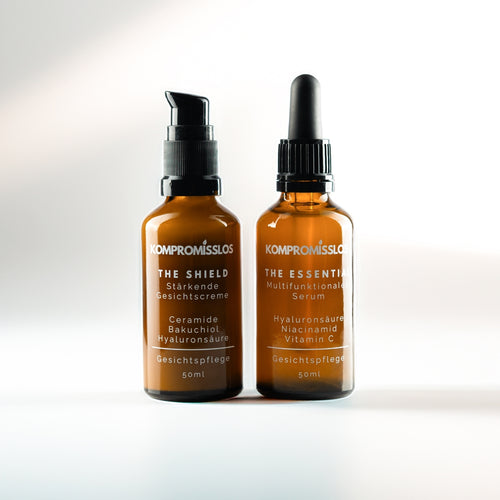
The Duo contains 5% niacinamide and 1% zinc PCA, plus hyaluronic acid in three molecular sizes. This can soften the appearance of pores and make the skin look more even. It will not turn an oval cheek pore into a round one. In her review on Judge.me, Gabriela K. writes: ‘I think my complexion has become more refined and it feels much smoother’ (review translated from German). That is her personal impression, not a pore measurement.
Which pore tips are a myth?
Most pore tips promise an opening and closing that does not actually happen, because pores have no muscle that could contract. What these tips really do is usually brief and superficial:
- Cold water closes your pores: cold tightens the skin for a few minutes, but the pore opening stays the same size.
- Steam opens your pores: warmth softens sebum and makes the skin more hydrated, but that does not open a pore. What facial steaming does offer, and when to skip it, is covered in a separate guide.
- Pore strips and squeezing make pores smaller: they empty the opening for a few days, but its size stays the same. Frequent squeezing also irritates the skin.
- An alcohol-based toner tightens your pores: the astringent effect wears off quickly and tends to dry out mature skin.
- The more often you exfoliate, the finer your pores: in mature skin, too much exfoliation is more likely to lead to redness and a stressed barrier than to smaller pores.
Another myth concerns rich skincare. A cream does not enlarge your pores just because it contains oils. If you think of comedogenic ingredients whenever you look at a face cream, you underestimate how much depends on the finished formula and on your own skin. Mature, dry skin needs lipids, and well-cared-for skin tends to make pores less noticeable.
When is it time to see a dermatologist about enlarged pores?
In-clinic treatments from a dermatologist are worth considering if your pores really bother you and nothing is changing any more after three months of consistent skincare. Because in mature skin the cause usually lies in the deeper layers of the skin, the more effective methods target that level. Fractional lasers, microneedling or radiofrequency are intended to stimulate the formation of new collagen fibres, while prescription retinoids change skin renewal over months. Chemical peels at higher concentrations also belong in professional hands. The review in Dermatologic Surgery stresses that treatment has to be chosen individually, because enlarged pores have different causes. A good practice will therefore first establish whether sebum, loss of firmness or both are behind them before suggesting a method. Even there, do not expect pore-free skin, but a visible refinement that usually takes several sessions and that you need to maintain with sun protection.
Quite apart from appearance, see a doctor if a single pore suddenly becomes much larger, hardens, bleeds or does not heal, or if the skin on your nose thickens and stays permanently red. These are no longer skincare questions.
I disclosed the 5% niacinamide and 1% zinc PCA in the Duo because with a topic like pores you otherwise mostly get marketing words. Niacinamide is one of the well-researched ingredients for finer-looking pores, and you should be able to check how much of it is in there. I am just as open about the limit: pores that have turned oval on the cheeks because the skin has lost firmness will not disappear with any serum or cream. Skincare can make your skin look plumper and more even, nothing more. You will not find an exfoliant or a pore toner in our range that promises anything else. Over the years, the bigger difference comes from a good sunscreen, which you need separately because the Duo contains no SPF. You can find all the concentrations on our active ingredients page.
Frequently asked questions
Does niacinamide help with enlarged pores?
Niacinamide can make enlarged pores look visibly finer, but it does not shrink them for good. In a split-face study in the Journal of Cosmetic Dermatology, the number of measured pores on the side treated with 4% niacinamide fell significantly after 8 weeks. With pores that have turned oval through loss of firmness, you can expect less, because niacinamide does not reverse that cause.
Does menopause make your pores bigger?
Indirectly, yes. The review in Dermatologic Surgery lists sex hormones among the factors that can affect pore size. As oestrogen levels fall, the skin loses collagen and firmness – exactly the support that keeps a pore in shape. At the same time, the hormonal balance shifts, so some women notice more sebum and blemishes again.
Does cold water close your pores?
No, pores have no muscle and cannot be opened or closed. Cold water tightens the skin’s surface for a few minutes and makes your face look fresher for a short while. The pore opening stays the same size. Lukewarm water is the more comfortable choice for washing, because very hot water strips even more oil from dry skin.
Does exfoliating help with enlarged pores as you age?
An exfoliant can make pores look flatter and less dark for a while, because it loosens dead skin cells from the opening. It does nothing about the most common cause in mature skin, which is declining firmness. For dry or sensitive skin over 40, the rule is: rarely and gently rather than often. Whether you need one at all is covered in the article on whether you need to exfoliate your face.
Are enlarged pores a sign of poor skincare?
No. Enlarged pores depend mainly on your predisposition, sebum production and age, not on how carefully you look after your skin. The review in Dermatologic Surgery does mention the skincare routine as a possible influence, but alongside sebum, elasticity, follicle size, hormones and acne. If your skin produces a lot of sebum or is losing firmness, your pores will show even with the best routine.
How long does it take for pores to look finer?
Allow eight to twelve weeks. In the niacinamide study in the Journal of Cosmetic Dermatology, the significant differences in pores showed up after 8 weeks. Moisture works faster, because well-hydrated skin looks plumper within just a few days. But that effect disappears just as quickly once you stop your skincare.
Can The Duo refine the look of pores?
The Duo can soften the appearance of pores and make the skin look more even, but it does not make pores permanently smaller. It contains 5% niacinamide and 1% zinc PCA, plus humectants such as hyaluronic acid. Pores that have turned oval through loss of firmness remain visible. You can see how the serum-and-cream routine works on the page for The Duo.
Sources
- Lee SJ, Seok J, Jeong SY, Park KY, Li K, Seo SJ. Facial Pores: Definition, Causes, and Treatment Options. Dermatologic Surgery, 2016. Source
- Jung HJ, Ahn JY, Lee JI, Bae JY, Kim HL, Suh HY et al. Analysis of the number of enlarged pores according to site, age, and sex. Skin Research and Technology, 2018. Source
- Jang SI, Kim EJ, Lee HK. A method of evaluating facial pores using optical 2D images and analysis of age-dependent changes in facial pores in Koreans. Skin Research and Technology, 2018. Source
- Chiu PC, Chan CC, Lin HM, Chiu HC. The clinical anti-aging effects of topical kinetin and niacinamide in Asians: a randomized, double-blind, placebo-controlled, split-face comparative trial. Journal of Cosmetic Dermatology, 2007. Source