Sagging skin on the face: what skincare can and can’t do when firmness fades
SKIN OVER 40
Sagging skin on the face develops on several levels at once: within the skin, collagen and elastic fibres decline, UV light speeds up this breakdown, and underneath, fat pads and bone lose volume. Skincare only reaches the top level. Moisture, an intact skin barrier and well-researched active ingredients make the skin look plumper and smoother. But no cream can tighten skin the way a treatment can. Your biggest lever for firmness is daily sunscreen.
Why does the skin on your face start to sag?
The skin on your face sags because, over the years, the supporting framework in the dermis grows thinner while the foundation beneath it shrinks. In the dermis, collagen fibres hold the skin firm and elastic fibres let it spring back after it has been stretched. Both are renewed more slowly with age, and UV light breaks them down further. But that is only part of the story. Beneath the skin lie fat pads which, according to an anatomical study in Plastic and Reconstructive Surgery, do not age as a single mass but as separate compartments that change in different ways. Deeper still, the facial bone recedes: a review in Aesthetic Plastic Surgery names the midface with the upper jaw, parts of the eye socket rim and the lower jaw in front of the jowls as areas that recede most noticeably with age. Once this foundation is lost, the skin on top slides downwards, even if the skin itself is still well cared for. How the ageing process works as a whole, and which part of it you can influence, is covered in detail in the article how to slow down skin ageing.
| Level | What changes | What skincare can do |
|---|---|---|
| Skin surface | Less moisture, a weaker barrier | A lot: skin looks plumper and smoother |
| Dermis | Less collagen, fewer elastic fibres | Limited: individual active ingredients, sunscreen above all |
| Fat pads | Compartments shrink and shift | Nothing |
| Bone | Loss in the midface and along the lower jaw | Nothing |
How can you tell your skin is losing firmness?
You can tell your skin is losing firmness when it takes longer to return to shape after being pressed or pulled, and the contours of your lower face become softer. Unlike fine lines, which you mainly notice up close, a loss of firmness tends to show in profile and when light falls at an angle. Many people first spot it in photos where their jawline looks less defined than they remember. Typical signs are:
- After a gentle pinch on the back of your hand or on your cheek, the skin springs back more slowly than it used to.
- Your jawline looks softer, and small jowls form near the corners of your mouth.
- The fold between your nose and the corners of your mouth deepens because the tissue above it sinks.
- Your cheeks look flatter and the area under your eyes more hollow.
- Pores on your cheeks can look more elongated than before.
Loss of moisture and a dull complexion usually come earlier. How these quieter signals show up is described in the article on the first signs of skin ageing. What is worth doing for your neck, where a loss of firmness often shows even more clearly, is covered in the article on neck and décolleté care.
What can a cream do for sagging skin?
A cream can improve the surface of sagging skin, but it cannot bring back lost volume or lift the skin. What it can realistically achieve is this: humectants such as hyaluronic acid bind water in the skin’s outermost layer, which makes the skin look plumper and fine lines caused by dryness less visible. Lipids such as ceramides and squalane support the skin barrier so that this moisture does not evaporate straight away. Both work quickly and visibly, but only for as long as you keep using them. Beyond that, there are active ingredients with studies on skin structure – retinoids above all, along with vitamin C and niacinamide. Which of these are well supported, and where their limits lie, is set out in the article on whether anti-wrinkle creams actually work. Peptides in skincare are also often marketed as firming, but the evidence there is thinner than the advertising suggests.
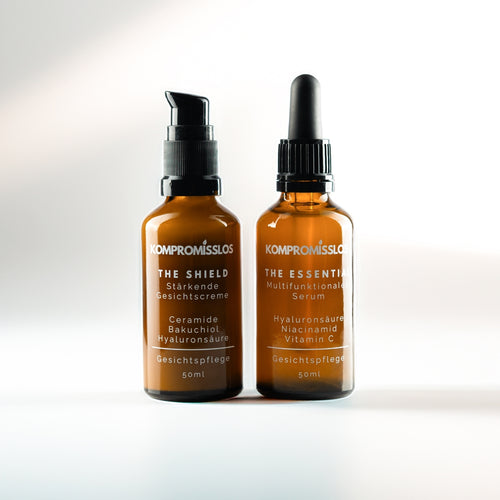
If your skin does not tolerate retinol, bakuchiol is a gentler alternative with its own body of research. The honest caveat still applies: a product said to ‘firm’ or ‘lift’ usually describes a short-term film or moisture effect. The Duo of serum and cream focuses on exactly this surface, with moisture, barrier care and bakuchiol in the cream, and promises nothing more. In her review on Judge.me, Nicole B. writes: ‘The fine lines don’t go away, which isn’t the idea anyway […], but the overall expression becomes softer!’ (review translated from German). That is a realistic expectation.
Why does sunscreen protect firmness better than any firming cream?
Sunscreen protects your skin’s firmness better than any firming cream because UV light breaks down precisely the collagen that gives skin its support – and preventing that breakdown is easier than making up for it with skincare. A study in The New England Journal of Medicine explicitly describes light-induced skin ageing as including a loss of skin tension. Even a single UV exposure increased the production of collagen-degrading enzymes in the participants’ skin. Breakdown of type I collagen was 58 per cent higher in irradiated skin than in non-irradiated skin. With four exposures two days apart, the activity of two of these enzymes stayed at its peak for seven days. In everyday terms, a lot of unprotected sun sets off a breakdown in the skin that lasts for days, not just hours. A moisturising cream does nothing to change that. Which product is suitable and how to combine it with your skincare is covered in the article on daily sunscreen for your face.
How much sunscreen does for visible skin ageing overall is assessed in the section on how much sunscreen really helps in the article how to slow down skin ageing and what the evidence shows.
Why do your cheeks hollow and sag, and what can’t skincare do about it?
Your cheeks hollow and sag because the fat pads in the midface shrink and shift while the upper jawbone beneath them recedes – and no cream can change that. Where this loss of volume comes from, when it is not a sign of ageing and what skincare can even out visually is covered in the article on sunken cheeks; if you want to change your facial contours, you need a consultation at a dermatology or aesthetic medicine practice.
Significant or repeated weight loss can make your cheeks look visibly hollow at any age, because facial fat shrinks too. If you are currently losing weight, that is a reason to be patient, not to buy a more expensive cream. What happens to your face after rapid weight loss, for example with weight-loss injections, is explained in the article on Ozempic face.
Which habits preserve firmness for longest?
Daily sunscreen, not smoking and a consistent, simple skincare routine preserve firmness for longest – not constantly switching to the next firming product. That may sound unspectacular, but it covers the two factors you can influence most: UV light and smoking both take their toll on collagen, and both are in your own hands. Next comes consistency. A routine of cleansing, serum, cream and sunscreen in the morning that you stick to for years achieves more than an elaborate one that ends up back in the cupboard after three weeks. It also makes sense to treat your skin gently: no rubbing when you remove make-up, no daily exfoliation, no products that sting. Irritated skin looks tired and dull more quickly. Keeping your body weight as stable as possible is no substitute for sunscreen, but it does spare what lies beneath the skin: large fluctuations leave their mark on facial fat too. And if you decide consciously what skincare should do and what is a job for a professional, you will spend less money on promises no cream can keep.
For The Shield, I deliberately chose bakuchiol instead of retinol, because a cream meant for use twice a day should, as far as possible, not irritate even sensitive skin. Even so, I am not going to promise you firmer skin. The reason is simple: when cheeks hollow, volume is missing in fat and bone, and no cream can make up for that – not even mine. What I can offer is transparency. The concentrations in The Duo are disclosed – 5% niacinamide, 2% vitamin C as stable 3-O-Ethyl Ascorbic Acid and 1% zinc PCA – so that you can judge for yourself what you are buying. And because the cream has no SPF, I will say it plainly: during the day, you need a separate sunscreen as well. What each active ingredient in The Duo does is explained on the page our active ingredients in detail.
Frequently asked questions
Can you tighten sagging skin without surgery?
To some extent, yes, but not with skincare alone. Skincare improves the surface, so skin looks plumper and smoother. For visibly more definition, there are non-surgical procedures such as fillers or energy-based devices (for example an ultrasound HIFU treatment), which belong in a dermatology or aesthetic medicine practice. That is also where you can find out whether the result is worth the effort and cost for you.
Does face yoga help with sagging skin?
Possibly a little, but the evidence is limited: in a small study in JAMA Dermatology, the cheeks looked somewhat fuller after 20 weeks of exercises. What the study shows and where its limits lie is covered in the article on face yoga for wrinkles.
At what age does skin start to lose firmness?
The breakdown begins gradually in early adulthood, but for many people it only becomes visible in their forties. How early depends heavily on how much sun your skin has had, whether you smoke, how your weight has changed and how your face is naturally built. There is no fixed age.
Do collagen creams make skin firmer?
Hardly, because collagen in a cream is too large to reach the dermis and does not arrive there as a building block. On the surface, it acts as a humectant, much like other conditioning ingredients. What is really behind it is explained in the article on whether collagen from a cream can actually get into your skin.
Does cold water or an ice roller tighten skin?
Cold makes skin look tighter and less puffy for a short while because the blood vessels contract and swelling goes down. The effect soon wears off, and it does not lead to any lasting firming. Whether gua sha and face rollers do anything beyond this short-term effect is covered in a separate article.
How quickly will I see results?
That depends on which result you mean. Moisture makes skin look plumper within days. In studies, active ingredients such as retinoids or bakuchiol usually take several months before the complexion changes. And the effect of sunscreen shows over years, as breakdown that never happens in the first place.
What can The Duo do for skin that is losing firmness?
The Duo cares for the skin’s surface: hyaluronic acid in three molecular sizes provides moisture, ceramides and squalane support the skin barrier, and bakuchiol in the cream is the gentle alternative to retinol. This can make skin look plumper and more supple. The Duo of serum and cream cannot replace volume or firm the skin, and because it contains no SPF, you also need sunscreen during the day.
Sources
- Fisher GJ, Wang ZQ, Datta SC, Varani J, Kang S, Voorhees JJ. Pathophysiology of premature skin aging induced by ultraviolet light. The New England Journal of Medicine, 1997. Source
- Rohrich RJ, Pessa JE. The fat compartments of the face: anatomy and clinical implications for cosmetic surgery. Plastic and Reconstructive Surgery, 2007. Source
- Mendelson B, Wong CH. Changes in the facial skeleton with aging: implications and clinical applications in facial rejuvenation. Aesthetic Plastic Surgery, 2012. Source
- Alam M, Walter AJ, Geisler A, Roongpisuthipong W, Sikorski G, Tung R, et al. Association of Facial Exercise With the Appearance of Aging. JAMA Dermatology, 2018. Source