Does gua sha work? What gua sha and face rollers can and can’t do for your skin
ROUTINE
Gua sha does work on the face, but mainly in the short term: the massage moves fluid through the tissue, boosts blood flow to the skin for a while, and your face looks less puffy and more relaxed afterwards. There is no evidence for lasting firming, wrinkles disappearing or any kind of ‘detox’. Face rollers work in a similar way. The research is thin, but it does exist. As a ritual, both are pleasant and practically risk-free; as a substitute for skincare or sun protection, they are no use.
What does gua sha really do for your face?
On the face, gua sha provides a gentle mechanical massage that shifts fluid in the tissue, briefly stimulates blood flow and can relax tense jaw muscles. As far as we know today, there is nothing more to it. Gua sha was originally an East Asian technique used on the body, in which the skin is scraped so firmly that small red dots and patches appear on purpose. The facial version, which has been on the shelves of many chemists for a few years now, has little in common with it: it uses light to medium pressure, glides over a layer of skincare and is meant precisely not to leave any marks. What you see afterwards is mainly a fresher, less puffy face, especially in the morning, when fluid has built up overnight. This effect is temporary and does not add up to a lasting change.
What gua sha cannot do is break down fat, permanently lift slackened connective tissue or flush out toxins. Your skin has no build-up of waste for a stone to push out. Why the face loses firmness over the years and what skincare can and can’t do for sagging skin is a topic of its own, and one in which a massage tool plays a minor role at most.
What do studies show about gua sha and face rollers?
Studies show measurable but small changes after regular facial massage, though from very small groups and mostly without a comparison group that did no massage at all. The most meaningful study is a randomised trial published in the Journal of Cosmetic Dermatology in 2025. Thirty-four women aged between 20 and 50 were split into two groups and massaged their faces for ten minutes, five times a week, for eight weeks – one half with the roller end, the other with the gua sha edge of the same device, in both cases over a little facial oil. In both groups, measured facial distances decreased slightly: by 2.23 to 2.40 millimetres with gua sha and by 2.75 to 3.26 millimetres with the roller. The gua sha group also showed lower muscle tone, and the roller group higher measured skin elasticity (8.6 and 7.5 per cent on two parameters).
It is worth being honest about what these figures mean. There were around 17 women per group, there was no group without any massage at all, standardised photos were missing, and nobody checked whether the values hold once you stop. Two to three millimetres on a 3D scan is also not the same as a visibly firmer face. A second study, in Complementary Therapies in Medicine, found in 12 people that five minutes of roller massage increased blood flow in the massaged cheek for at least ten minutes. After five weeks of daily use, the blood vessels in that cheek responded more strongly to heat. One co-author worked in the research department of a roller manufacturer. With traditional gua sha on the back, microcirculation rose fourfold in the first 7.5 minutes, according to a pilot study in Explore – but with vigorous scraping until red marks appeared, which the facial version deliberately avoids.
Gua sha or face roller: what is the difference?
The difference lies mainly in the shape and therefore in the pressure: a gua sha is a flat stone or metal plate with edges that you draw across the skin, while a face roller runs over it on one or two rolling heads. With the edge, you can work in a more targeted way and slightly more firmly, for example along the jawline. The roller spreads the pressure more widely and is easier to handle, even if you don’t want to spend much time on technique. Which tool is better depends less on the research than on which one you will actually pick up regularly. Don’t confuse either of them with a dermaroller: it has fine needles, deliberately injures the skin and belongs in a completely different category.
| Criterion | Gua sha | Face roller |
|---|---|---|
| Shape | Flat plate with straight, curved and notched edges | Handle with one large and often one small rolling head |
| Pressure | More targeted; the edge also allows firmer pressure | Spread more widely, fairly gentle |
| Measured effects | In one small study, lower muscle tone and slightly changed facial measurements | Briefly increased blood flow; in one small study, higher elasticity values |
| Glide layer | Essential, otherwise the edge drags on the skin | Recommended, but less essential |
| Cleaning | Easy, one smooth surface | More effort; residue collects around the axle and frame |
How do you use gua sha on your face correctly, and how often?
You are using gua sha correctly if you keep the tool flat on a layer of skincare and stroke with light pressure from the centre of your face outwards and from the bottom upwards. Slight redness is fine, but it should fade within a few minutes. The study in the Journal of Cosmetic Dermatology used a similar sequence: first the neck and shoulders, then from the chin to the ears, from the cheeks to the temples and across the forehead outwards. Each session lasted ten minutes; whether shorter sessions achieve less was not investigated.
- Cleanse your face, then apply serum and cream so the tool can glide.
- Hold the gua sha almost flat against the skin – don’t scrape with the edge held upright.
- Stroke from the chin along the jawline to the ear, several times along each line.
- Work from the nose across the cheeks to the temples, then from the centre of the forehead outwards.
- Skip the delicate skin directly under the eye, or use only very light pressure there.
When it comes to frequency, no rule is better supported by evidence than what fits into your day. The study used five sessions a week, but nobody has tested whether three or seven would do better or worse. The de-puffing effect comes immediately and fades again anyway; more sessions do not build it up into something lasting. If you want to know how long skincare takes to work, that will help you more than a stricter massage routine.
Bruising, burning or redness that does not fade soon are signs of too much pressure. The rule for your face: the skin should move, but not fight back.
Do you need an oil, or are serum and cream enough?
You need something for the tool to glide on, but not a special gua sha oil: a cream containing nourishing oils does the job. Without it, the edge drags on the skin – and that pulling is exactly what you want to avoid on your face. The study used a little facial oil, explicitly so that the tool would glide, not as additional skincare. In a routine with serum and cream, the cream is the last and richest layer anyway, which makes it the logical base for the tool. The order stays the same: first the lighter serum, then the cream, then the massage. You can read more about which step goes where in the morning and evening in a separate article.
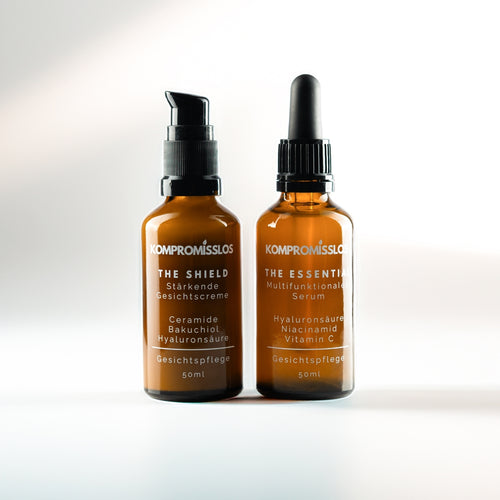
With The Duo of serum and cream, that means The Essential first, then The Shield with squalane and jojoba oil, and you massage on top of that layer. If the cream sinks in before you have finished, add another pump rather than an extra product. To be honest: the tool does not make the active ingredients any stronger, and the skincare works without a tool too. Our how-to-use page already recommends massaging serum and cream in from the centre of the face outwards and down over the neck. Whether an oil has a place in your routine otherwise is covered in the comparison serum or face oil.
When should you avoid gua sha and rollers?
You should avoid gua sha and rollers wherever the skin is broken, inflamed or currently very irritated. That includes open wounds, inflamed spots, sunburn, acute eczema flare-ups and skin shortly after a peel, a laser session or an aesthetic procedure. With redness, visible broken veins or rosacea, pressure and friction are not a good idea, because they can heat up and irritate the skin even more. If you take blood-thinning medication or bruise easily, check with your doctor before massaging. And if you suspect a condition such as rosacea, acne or atopic eczema, it needs to be assessed by a dermatologist, not tackled in the bathroom with a stone. For everyone else, the risk of a gentle facial massage is low, as long as the tool is clean and you don’t try to work against swelling by force.
I don’t sell gua sha tools, rollers or facial oil, and that is a deliberate decision in favour of two products instead of eight. A massage tool would be easy to add to the range, but it would not change anything about the skincare itself. If you enjoy massaging, use the cream as your glide layer – you don’t need a third bottle for that. If you don’t massage, you are not missing out on anything, because serum and cream still work when you spread them with your fingers. I think gua sha is a lovely ritual if it does you good, but not a skincare step you have to have. That is why I describe how serum and cream are applied and massaged in without any accessories: your hands are all you need.
Frequently asked questions
Does gua sha help with wrinkles?
No, gua sha does not get rid of wrinkles. Right after the massage, your skin can look smoother and fresher because blood flow has increased and it is less puffy. This effect is temporary. For deeper wrinkles caused by collagen loss, sun exposure and facial expressions, there is no evidence that a massage tool softens them permanently.
Does gua sha help with a puffy face in the morning?
Yes, in the short term: the massage moves along fluid that has built up overnight, but the effect wears off about as quickly as with cold, as the guide to sagging skin on the face and ice rollers shows. For the eye area, it is worth reading what helps with dark circles under the eyes, because the skin there is thinner.
Is rose quartz better than jade or stainless steel?
The material makes no proven difference to your skin. It mainly changes three things: how cool the tool feels, how heavy it is in your hand and how easily it breaks. Stones such as rose quartz and jade are heavier and break if you drop them. Stainless steel is unbreakable, easy to clean and stays cool for a long time. There is no evidence that stones have any energetic effects.
Can gua sha make couperose or spots worse?
Yes, that is possible. Pressure and friction on inflamed spots can spread bacteria and aggravate the inflammation, so leave those areas out. With couperose and broken capillaries or with rosacea, massage with pressure tends to do more harm than good. If you suspect a skin condition, have it checked by a dermatologist.
How do I clean a gua sha and a face roller?
After each use, wash it with warm water and a mild soap and leave it to air-dry. With a roller, also clean the axle and frame, because cream builds up there. Don’t put stones in the dishwasher or immerse them in hot water. And don’t share your tool with anyone, just as you wouldn’t share a face towel.
Does a roller make serum and cream work better?
There is no evidence for that. The massage briefly increases blood flow, but that does not mean active ingredients get deeper into the skin or in larger amounts. A smooth roller does not open up any channels in the skin. Skincare works because it goes on your skin regularly, not because of the tool.
Can I use gua sha with The Duo?
Yes. Apply the serum first, then the cream, and massage on top of that layer. The Shield contains squalane and jojoba oil, which gives you the glide you need, so there is no need for an extra facial oil. The tool does not make The Duo any more effective – it simply turns applying it into a ritual.
Sources
- Ahn SH, Hwang UJ, Han HS, Kim JH, Lee HJ, Jeon YR et al. Comparative Effects of Facial Roller and Gua Sha Massage on Facial Contour, Muscle Tone, and Skin Elasticity: Randomized Controlled Trial. Journal of Cosmetic Dermatology, 2025. Source
- Miyaji A, Sugimori K, Hayashi N. Short- and long-term effects of using a facial massage roller on facial skin blood flow and vascular reactivity. Complementary Therapies in Medicine, 2018. Source
- Nielsen A, Knoblauch NT, Dobos GJ, Michalsen A, Kaptchuk TJ. The effect of Gua Sha treatment on the microcirculation of surface tissue: a pilot study in healthy subjects. Explore (NY), 2007. Source