Dark circles under the eyes: what helps and what doesn’t
SKIN CONDITION
What helps with dark circles under the eyes depends on which component is dominant in your case. Cooling and sleep soften swelling and the colour of the blood vessels in the short term. Sun protection and skincare with niacinamide or vitamin C work on the pigment component over months. Shadows caused by your anatomy can only be concealed or addressed with a medical procedure.
What helps with dark circles in the short term?
In the short term, the things that help most with dark circles are cooling, sleeping with your head slightly raised and getting enough sleep. All three work on the same component: swelling and blood flow. Cold constricts the blood vessels for a few minutes, the tissue goes down and the area looks brighter. If you sleep with your head raised, less fluid collects overnight in the lower eyelid, where the skin barrier is thinner than on the rest of the face anyway. Sleep itself leaves a measurable mark: in a study in the journal Sleep, ten people were photographed once after eight hours of sleep and once after 31 hours without sleep. Forty observers rated the pictures without knowing the background and judged the faces after the sleepless night as, among other things, darker under the eyes. Short-term measures, however, only change the fluid and blood-vessel component. Pigment and shadows stay as they are.
| Measure | Works on | Visible after | Lasts |
|---|---|---|---|
| Cooling and home remedies | Swelling and blood-vessel colour | A few minutes | About half an hour |
| Sleep and a raised head | Fluid and blood-vessel colour | One night | As long as the habit continues |
| Eye patch | Dehydration lines and swelling | About twenty minutes | One to two hours |
| Sun protection and sunglasses | New pigment forming | Nothing – it is preventive | Permanently, with consistent use |
| Skincare with niacinamide and vitamin C | Existing pigment component | Weeks to months | As long as you keep up the routine |
| Concealer | Shadow and colour, optically | Immediately | Until you take your make-up off |
What helps with dark circles in the long term?
In the long term, what helps with dark circles is consistent sun protection around the eyes, less rubbing and skincare that softens the pigment component over months. Sun protection comes first, because UV radiation drives pigment formation, just as it causes age spots to form elsewhere on the skin. A review in the Journal of Clinical and Aesthetic Dermatology lists sun protection as the basis of any treatment for dark circles, but points out that chemical filters should be used with caution on the thin skin of the lower eyelid and that sunglasses with UV protection are a sensible addition. The second point is mechanical: repeated rubbing can encourage pigment, and many people rub out of habit or because of hay fever. The third point is skincare. Active ingredients used in cosmetics for a more even complexion need weeks to months, because that is the pace at which the skin renews itself. If you stop after two weeks, you have not waited long enough.
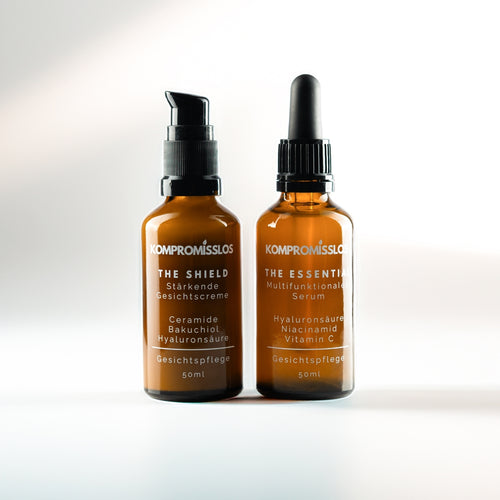
The active ingredients mentioned most often in this context include niacinamide and stable forms of vitamin C such as 3-O-ethyl ascorbic acid. The Duo, made up of The Essential serum and The Shield cream, contains 5 per cent niacinamide, 2 per cent vitamin C as 3-O-ethyl ascorbic acid and 2 per cent hyaluronic acid, plus ceramides, squalane and panthenol. The percentages refer to the Duo as a whole. Moisture is not a side issue here: dry skin under the eyes shows more fine lines, and every fine line swallows light.
How realistic is it to get rid of dark circles completely?
Very few people get rid of dark circles completely, and that applies to dermatological procedures too. A comparative study in the Indian Journal of Dermatology treated 50 people for twelve weeks with either 4 per cent hydroquinone or 30 per cent salicylic acid – considerably stronger agents than cosmetics are allowed to contain. After twelve weeks, most participants showed a mild improvement in the region of 10 to 30 per cent. The authors attribute the limited effect to the fact that several causes are involved at the same time and that melanin is deposited both in the epidermis and deeper down. If even prescription-only active ingredients stay within this range, your expectations of a cream should be smaller, not bigger. A more even, more awake overall look is realistic. A result in which the area under your eyes has simply disappeared is not.
A simple test helps you work out what you are dealing with: stand so that the light falls on your face from the front rather than from above. If the dark area almost completely disappears, it is a shadow. If it stays, there is colour in the skin.
Do eye patches, rollers and home remedies do anything?
Eye patches, chilled rollers and home remedies do work, but only briefly and through two mechanisms that rarely appear on the packaging: cold and occlusion. A patch sits damp on the skin, slows evaporation and plumps up the top layer of the skin for one to two hours. Fine dehydration lines recede and the area casts fewer shadows. If the patch also comes out of the fridge, the cold briefly constricts the blood vessels. Cucumber slices, cold tea bags, chilled spoons and quark compresses essentially do the same thing: they lower the temperature on the surface of the skin. Cucumber is mostly water, black tea contains caffeine, which barely gets into the skin when applied this way, and quark cools well mainly because it releases moisture slowly. None of this changes pigment, none of it fills a shadow, and none of these remedies lasts longer than the state it has created.
A customer wrote to me that she had been buying eye patches regularly for months and wanted to know whether the Duo could replace that item. I asked her when she saw the effect most clearly. Her answer: straight after taking them off, in the morning before work, and by the afternoon there was nothing left of it. That is exactly what occlusion and cooling look like, not work on pigment. For an important appointment, patches are a useful tool. As a fixed monthly expense they rarely pay off, because a cream that is already in your bathroom provides the same occlusion. We did not talk her out of patches; we simply put her expectations in order.
When is concealing the only thing that helps?
Concealing is the most sensible solution if your dark area is a shadow rather than colour in the skin. If the discolouration almost completely disappears as soon as the light comes from the front, it is the hollow between the lower eyelid and the cheek that is casting the shadow, and no skincare will change how deep it is. Over the years, this component tends to become larger for many people, because the cheek loses volume. Make-up works with the same tool as light here: a concealer just a shade lighter than your skin optically lifts the hollow. Use a little product, blend it well and apply it in thin layers, otherwise it settles into the fine lines. The medical alternative is fillers, which restore volume. That is a decision for a professional, not a question of daily skincare, and not something a cosmetic product should advise you on either.
I am often asked why our products do not promise an instant effect. That is a deliberate decision. Every instant effect around the eyes comes from cooling or occlusion and is over after one to two hours. I could print it on the pack and it would not even be wrong. It would just create an expectation that disappoints on the second day. That is why we state which active ingredient is included at what concentration, and you can always look up exactly what is inside. What happens over weeks can be promised more honestly than what happens in ten minutes.
When should you see a professional about dark circles?
Dark circles are a matter for a professional if they appear suddenly, affect only one side, come with swelling, itching or changes in your vision, or become noticeably worse within a short time. These are questions for a dermatologist or your GP, not for cosmetics. Persistent rubbing is also worth having checked, because an allergy or ongoing irritation may be behind it and because the irritation itself encourages pigment. Cosmetics work on the surface: they care for the skin, support the skin barrier and can change how it looks. They do not provide a diagnosis and they do not replace a medical assessment. If your skin also reacts quickly, burns or feels tight, gentle skincare for sensitive skin is the better route than a product with strong active ingredients right at the edge of the eyelid. How serum and cream work together day to day is explained in the how-to-use guide.
Frequently asked questions
What gets rid of dark circles fastest?
Cold works fastest. A chilled spoon, a cold cloth or a patch from the fridge constricts the blood vessels within a few minutes and lets swelling go down. The effect lasts about half an hour. Cold has no effect on pigment or shadows, however long you keep cooling.
Can dark circles be removed permanently?
Dark circles can only very rarely be removed permanently. Even in studies with prescription-only active ingredients, the improvement after twelve weeks remained mild for most participants. What is realistic is a more even overall look over months, achieved through a combination of sun protection, less rubbing and skincare you actually stick with.
Does drinking lots of water help with dark circles?
Drinking lots of water helps only to a limited extent. Getting enough fluids makes sense, but it will not turn a pigment or shadow component into brighter skin. If you are badly dehydrated, you look more tired overall, and that improves with water. For most people with dark circles, though, the cause lies elsewhere.
What is the best remedy for dark circles?
There is no single best remedy for dark circles, because different causes need different tools. Cold works on swelling, sun protection and skincare over months work on pigment, and only concealing or a medical procedure works on shadows. Anyone who promises one product for all three is promising too much.
Do eye creams with caffeine help?
Caffeine is in many eye products because it briefly constricts blood vessels and makes swelling less visible. The effect concerns swelling rather than colour, and it does not last long. Caffeine does nothing against a pigment component or an anatomical shadow. That is rarely enough of an argument for an extra product.
Can The Duo do anything for dark circles?
The Duo is formulated as facial skincare and is not marketed as an eye product. Keep a little distance from the edge of the eyelid when you apply it. The active ingredients it contains work on the look of the skin as a whole, not specifically on the eye area. What is inside and at what concentration is set out in the overview of serum and cream.
Sources
- Sundelin T, Lekander M, Kecklund G, Van Someren EJW, Olsson A, Axelsson J. Cues of Fatigue: Effects of Sleep Deprivation on Facial Appearance. Sleep, 2013. Source
- Sarkar R, Ranjan R, Garg S, Garg VK, Sonthalia S, Bansal S. Periorbital Hyperpigmentation: A Comprehensive Review. The Journal of Clinical and Aesthetic Dermatology, 2016. Source
- Ranjan R, Sarkar R, Garg VK, Gupta T. A comparative study of two modalities, 4% hydroquinone versus 30% salicylic acid in periorbital hyperpigmentation and assessment of quality of life before and after treatment. Indian Journal of Dermatology, 2016. Source