Ice cubes on your face: the real benefits for puffiness and when icing harms your skin
ROUTINE
Putting ice cubes on your face constricts the tiny blood vessels in your skin, so your face briefly looks less puffy, firmer and more awake. That is the full extent of the benefits: the trend does nothing lasting for pores or wrinkles, and the effect wears off as soon as your skin warms up again. Done properly, it is harmless for most people. Pressed directly onto the skin, held there too long, or used with cold urticaria, visible thread veins or irritated skin, it can do harm.
What do ice cubes on your face really do?
Above all, ice cubes on your face do one thing: the blood vessels just beneath the skin’s surface contract, blood flow drops, and the tissue looks flatter and firmer for a short while. A review in the Journal of Applied Physiology describes how local changes in temperature can constrict or dilate the skin’s blood vessels to their maximum, and how cooling the skin triggers vasoconstriction through several mechanisms. The same review, however, also describes an early, temporary widening of the vessels during cooling, the extent of which depends on how quickly the skin is cooled. That may explain why some faces turn blotchy red rather than pale when iced. Then there is the sensation: cold wakes you up, your skin tingles and you feel fresher. That is real, but it is an effect on blood flow and perception, not a skincare effect. Ice does not hydrate, does not strengthen the skin barrier and does not build anything up. For a few minutes, it shifts how much blood and fluid sits visibly beneath the surface. Once you know that, you can use the trend honestly: as a quick wake-up on a puffy morning, not as skincare.
Why is your face puffy in the morning, and how quickly does cold help?
Your face is puffy in the morning because, while you lie down overnight, tissue fluid collects around your head and only drains away during the day with gravity and movement. A salty or boozy evening, a night spent sleeping on your front and, above all, too little sleep make it worse. In a study in the journal Sleep, observers rated photos of ten people, once after normal sleep and once after 31 hours without sleep that followed a night of only 5 hours. After sleep deprivation, their faces were perceived as having, among other things, more droopy eyelids, more swollen eyes, darker circles under the eyes and paler skin. Cold works quickly against this kind of puffiness because the vessels already constrict while you are cooling your skin. The visible difference usually shows within a few minutes. At the same time, harmless morning puffiness also goes down without ice once you are upright and moving. So ice simply speeds up something that would happen anyway. If dark shadows are your main concern, read about what really helps with dark circles under the eyes. Persistent puffiness under the eyes, on the other hand, is usually down to eye bags, a separate topic where cold makes hardly any difference.
How long does the effect of ice on your skin last?
The effect of ice on your skin only lasts until your skin is back at its normal temperature, so in practice minutes rather than hours. As soon as the cold is gone, your body brings blood flow back to normal and the vessels open up again. As it warms up, your skin may even look temporarily redder than before. What remains after icing is the part of the morning puffiness that would have drained away during that time anyway. Ice does not give you a permanently firmer face, finer pores or fewer wrinkles, not even with daily use. The popular claim that cold tightens pores describes, at most, a brief visual effect caused by the constricted vessels and the cooled surface. If you want to know why pores look bigger with age and what actually makes a difference, you will find the longer answer there. For everyday life, this means ice is a tool for a specific moment, such as before a morning appointment, not a ritual whose effects add up over weeks.
How do you ice your face without irritating your skin?
The gentlest way to cool your face is with a flannel dipped in cold water, or with an ice cube wrapped in a thin cotton cloth and kept moving all the time. The most common mistake with skin icing is direct, prolonged contact with bare ice. Frozen water can stick to damp skin, and when held in one spot it cools the tissue more than a refreshing effect requires. These points keep icing harmless:
- Always keep a layer in between: a cloth, a flannel or a bag, never bare ice directly on your skin.
- Keep moving: work in small circles from the centre of your face outwards, without lingering in one spot.
- Keep it short: a few brief rounds are better than one long session. If your skin burns, stings or goes numb, stop.
- Only on intact skin: not straight after an exfoliant, an acid treatment, shaving or sunburn.
- Follow with skincare: let your skin dry briefly, then apply serum and cream as usual.
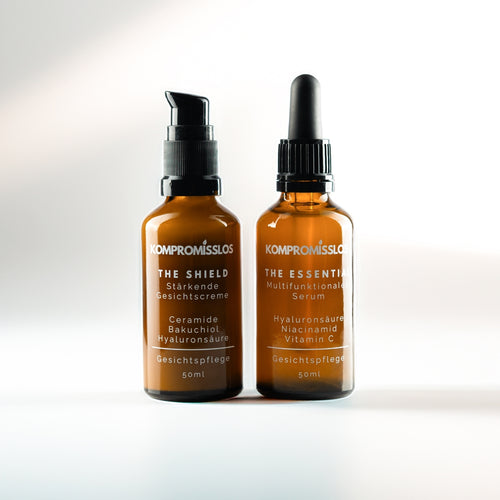
There is a reason behind the fourth point. A study in the Journal of Investigative Dermatology kept previously damaged mouse and human skin at different temperatures. At 36 to 40 degrees, the skin barrier recovered faster than at 34 degrees. Ice was not tested in that study, so it is only a pointer: a compromised barrier seems to recover better at normal skin temperature than in cooled skin. After icing, a calm, fragrance-free routine is therefore all you need. The Duo consists of The Essential, with hyaluronic acid in three molecular sizes and niacinamide, and The Shield, with Ceramide NP, squalane and jojoba oil, both without fragrance. You can save yourself ice-cooling gadgets or gua sha stones from the fridge for this purpose; a cold flannel does the same job. Whether to keep skincare in the fridge is a separate question, and it is not necessary to benefit from cooling.
Who should not put ice on their face?
Ice on your face is not a good idea if you have cold urticaria, visible thread veins and persistent redness, rosacea or freshly irritated skin. According to a review in the journal Allergy, cold urticaria is a common form of chronic inducible urticaria (hives), in which cold triggers weals, deeper swelling or both. The weals typically appear as the skin warms up again and usually subside within an hour, but anaphylaxis can also occur. So if your skin develops itchy weals or swells up after exposure to cold, that is a matter for your doctor, not for your morning routine. With couperose and broken capillaries, the rapid switch from ice-cold to warm is exactly the kind of temperature stimulus that many people with the condition avoid anyway. The same applies to facial redness that flares up at the slightest trigger. If you have been diagnosed with rosacea, it is best to check with your dermatologist before using cold treatments.
With an ice water dip, which means plunging your whole face into a bowl of iced water, there is one more point to consider: cold water on the face can trigger what is known as the diving reflex. A review in the Scandinavian Journal of Medicine and Science in Sports describes the typical responses as a slower heart rate, vasoconstriction and an increased release of stress hormones from the adrenal glands. In healthy people, this is a normal bodily response. If you have a heart rhythm disorder or heart disease, talk to your doctor before you dip. And one more distinction: facial skin that is exposed to cold and wind outdoors for hours in sub-zero temperatures does not need an ice treatment at home, but rather protection. When a cold weather face cream makes sense for that is covered in a separate article.
Ice cubes, iced water or cold water: what is the difference?
The difference lies in temperature and surface area: cold tap water cools gently over a large area, iced water cools the whole face strongly and quickly, and an ice cube cools one spot most intensely. For reducing puffiness in the morning, the mildest option is enough in most cases. Going colder and longer does not increase the benefit, only the risk of irritation and redness afterwards.
| Method | How it feels | Suitable if | Take care with |
|---|---|---|---|
| Cold water or a cold flannel | Refreshing, mild | You simply want to look more awake and less puffy in the morning | Hardly any restrictions |
| Ice cube wrapped in a cloth | Intense, targeted | You want to reduce swelling in individual spots briefly | Visible thread veins, irritated skin, cold urticaria |
| Ice cube directly on the skin | Very cold, can burn | Hardly advisable | All skin types, risk of cold injury with prolonged contact |
| Ice water dip | A shock to the system, whole face | You are healthy and deliberately want the kick | Heart rhythm disorders, rosacea, cold urticaria |
Try a simple test: for one week, cool your face only with cold water and a flannel. If you see no difference compared with ice, you can do without the ice cube tray in your freezer.
Kompromisslos sells neither ice rollers nor cooling masks, and you do not need either. For a wake-up in the morning, a flannel and cold water do the same job as any gadget. What I did decide deliberately: two products instead of eight, and both without fragrance. Skin that has just been through a cold shock and may still be a little flushed should not have to cope with perfume on top. I cannot promise you that skincare will make morning puffiness disappear; no cream can do that. But it can provide moisture every day and support the skin barrier, and that stays when the cold effect has faded after a few minutes. How serum and cream are then applied in two steps is deliberately kept simple.
Frequently asked questions
How long should you leave an ice cube on your skin?
An ice cube should never stay in one spot for long. Keep it wrapped in a cloth and moving, and do several short rounds rather than one long session. As soon as your skin burns, stings or goes numb, stop. To reduce puffiness, a few minutes for your whole face is plenty anyway.
Can ice on your face burst blood vessels?
There is no evidence that a single ice cube bursts healthy blood vessels. But if you already have dilated vessels or couperose, rapid switches from ice-cold to warm expose your skin to exactly the kind of temperature stimulus that can make redness more visible. With visible thread veins, it is better to skip the ice and, at most, cool your skin with cool rather than ice-cold water.
Do ice cubes close your pores?
No, ice cubes do not close your pores. Pores are the openings of the sebaceous glands and have no muscle that could contract permanently in the cold. Straight after icing, they may look slightly finer for a short time because your skin is cooled and receives less blood flow. As soon as it warms up again, they look just as they did before.
Do ice cubes help with spots?
Ice can make a single swollen spot look flatter and less red for a short while, but it does nothing about the cause. It is important not to squeeze and to apply the ice only briefly, wrapped in a cloth. Recurring, painful or deep inflammation is not a case for home remedies, but for a dermatologist.
Should I ice my face before applying make-up?
You can, but you do not have to. If you ice your face before putting on make-up, let your skin dry completely afterwards and apply your skincare first, then your make-up, otherwise it will not adhere well. Leftover moisture on freshly iced skin can make make-up look patchy. For more on which skincare to use before make-up, see the separate article.
Can I make ice cubes from green tea or coffee?
You can, but there is no evidence of any added benefit for your skin compared with frozen water. The de-puffing effect comes from the cold, not from what is in the cube. If you still want to try it, use a freshly brewed infusion and a clean tray of its own, and wrap these cubes in a cloth too. On irritated skin, it is better to skip such experiments.
When do I apply The Duo after icing?
Apply The Duo as soon as your skin has dried briefly after icing and no longer feels ice-cold. Then follow with 3 to 6 drops of serum and 3 to 6 pumps of cream as usual, working from the centre of your face outwards and down over your neck. Both products are fragrance-free, which makes them a calm base after a cold shock. Serum and cream are available together as The Duo with serum and face cream.
Sources
- Johnson JM, Kellogg DL Jr. Local thermal control of the human cutaneous circulation. Journal of Applied Physiology, 2010. Source
- Sundelin T, Lekander M, Kecklund G, Van Someren EJ, Olsson A, Axelsson J. Cues of fatigue: effects of sleep deprivation on facial appearance. Sleep, 2013. Source
- Denda M, Sokabe T, Fukumi-Tominaga T, Tominaga M. Effects of skin surface temperature on epidermal permeability barrier homeostasis. Journal of Investigative Dermatology, 2007. Source
- Maltseva N, Borzova E, Fomina D, Bizjak M, Terhorst-Molawi D, Košnik M, et al. Cold urticaria – What we know and what we do not know. Allergy, 2021. Source
- Foster GE, Sheel AW. The human diving response, its function, and its control. Scandinavian Journal of Medicine and Science in Sports, 2005. Source