Cold weather face cream: when you need one and when your usual moisturiser is enough
ROUTINE
You only need a cold weather face cream if you spend several hours outdoors in sub-zero temperatures, biting wind or the rush of air from your own speed – on the slopes, on a ski tour or on your bike, for example. For your commute or a walk, your usual face cream is enough, as long as it provides lipids and you apply it in good time. One thing matters here: a layer of grease does not keep you warm. Hats, scarves and helmets protect you from frostbite; a balm only protects the surface of your skin from being dried out by the wind.
Do you need a cold weather face cream, or is your usual face cream enough?
On most winter days, your usual face cream is enough, as long as it provides lipids similar to the skin’s own and you do not wait until you are at the bus stop to put it on. In everyday city life, you are usually only outside for short stretches at a time. Besides the cold, what really takes its toll on skin in winter is dry air, both outdoors and in heated rooms. A review in the Journal of the European Academy of Dermatology and Venereology concludes that low humidity and low temperatures generally weaken the skin’s barrier function and make it more susceptible to mechanical stress. What helps is skincare that binds moisture and replenishes lipids, morning and evening. An anhydrous cold protection balm only starts to make sense when you are outside for a long time, the wind is blowing straight into your face or you are moving fast. If your face already feels tight and flaky at the office, a balm is the wrong place to start. In that case, it is worth finding out what very dry skin on the face is really missing.
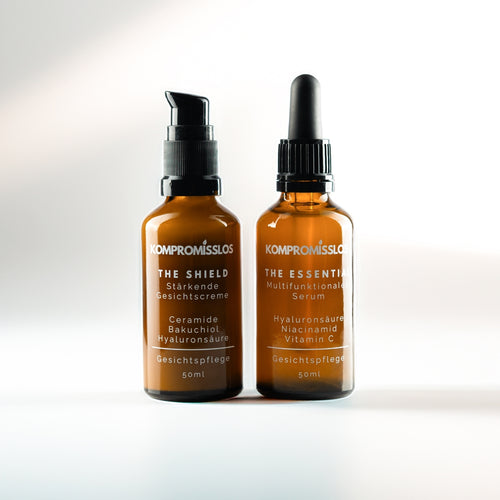
For everyday life, this is exactly what The Duo, made up of The Essential serum and The Shield cream, is designed for: the serum in the morning after washing, followed by the cream with ceramide NP, squalane and jojoba oil. That supports the skin barrier on your way to work, but it does not replace a balm for a day at 2,500 metres. And not every skin finds it enough in winter. In her review on Judge.me, Daniela B. writes: “In winter, however, the cream does not give my mature, dry skin enough moisture. That is why I combine it with a natural facial oil in the evening […]” (review translated from German). How mature, dry skin gets through the whole season is covered in the article on what mature, dry skin really needs in the cold.
What is the difference between a cold weather cream and a moisturiser?
The key difference is the water content: a cold weather cream contains little or no water, whereas a moisturiser is largely made up of it. Classic cold protection products are balms or ointments made from oils, waxes, butters or petroleum jelly. They leave a film of fat on the skin that slows down water loss and keeps the wind off the surface. A moisturiser is usually an oil-in-water emulsion: water and humectants such as glycerin or hyaluronic acid supply the outermost layer of the skin, and the lipids seal it in. Somewhere in between are rich water-in-oil creams, which feel greasier and are often sold as winter creams or cold creams. None of these products is better than the others; they simply do different jobs. A moisturiser cares for your skin every day and supports the skin barrier. A balm is a protective film for the hours you spend outdoors and does not replace the skincare underneath.
| Product | Water content | What it does | Makes sense for |
|---|---|---|---|
| Moisturiser (oil-in-water) | High | Binds moisture, provides lipids | Everyday use, morning and evening |
| Rich cream (water-in-oil, often sold as “cold cream”) | Usually lower | Greasier film, slows water loss | Very dry skin, long walks |
| Cold protection balm | No water | Film of fat against wind and drying out | Slopes, ski tours, cycling in sub-zero temperatures |
| Pure petroleum jelly | No water | Strongly occlusive film | Targeted use on nose, lips and cheekbones |
Is it true that the water in your cream freezes on your skin?
There is no evidence that the water in a cream freezes into a layer of ice on your skin, but the idea does contain a grain of truth: freshly applied water-based cream cools the skin while its water evaporates. A research team from the Finnish armed forces measured this on a skin model with a heated, sweating plate and published the results in Acta Dermato-Venereologica. Evaporation from an oil-in-water cream cooled the surface significantly for 40 minutes after application. At the same time, the thermal insulation provided by the ointments tested on a dry surface was minimal. The authors concluded that, against the cold, ointments have at best a negligible and at worst a detrimental physical effect.
For you, this means two things. First, do not apply your usual cream just before you head out, but well in advance, ideally straight after you get up. That way, the water has evaporated before you step out into the cold. Second, do not expect any cream or balm to keep you warm. When skin actually freezes, it is mainly down to a lack of covering and too much time in the cold. No cream can make up for that.
How do you protect your face from cold and wind when skiing?
When skiing, you protect your face mainly with fabric, goggles and a helmet; cream comes second. That may sound unspectacular, but it is the lesson of a large study in the British Medical Journal. In it, Finnish researchers compared 913 conscripts with frostbite on the face or ears with 2,478 conscripts without such injuries. Those who did not wear a hat with ear flaps had an odds ratio of 18.5 for frostbite of the ear – a statistical measure of how strongly a factor is linked to risk. Those who used protective ointments had odds ratios of 3.3, 4.5 and 5.6 for frostbite of the cheeks, ears and nose, meaning a higher rather than a lower risk. A follow-up study in Acta Dermato-Venereologica offers a possible explanation: the ointments tested objectively cooled the facial skin more often than they warmed it, yet white petroleum jelly often felt warm. The researchers suspect that this false sense of security leads people to neglect other protective measures. A balm is still useful on the slopes – just against dried-out skin, not against frostbite.
- Apply your usual skincare in the morning, well in advance, so that it has sunk in before you get into the gondola.
- Put a thin layer of anhydrous balm on your nose, cheekbones and chin – wherever the wind hits as you ski.
- Wear a neck gaiter you can pull up over your nose in an icy wind, plus a helmet and well-fitting ski goggles.
- Sunscreen is always part of a ski day, even if you are wearing a balm.
Why UV on snow and in the mountains is a separate matter is explained in the article on sunscreen for your face when your skincare has no SPF.
What does your skin need when running or cycling in winter?
When running or cycling in winter, your skin mainly needs protection from the wind and some calm after sweating, rather than a thick layer of grease. As you run, you warm up, your face sweats and the sweat evaporates in the wind. That cools the skin even more and dries out its surface. On a bike, the wind from your own speed is even stronger while you move less, which is why your cheeks and nose cool down faster. For an hour-long run, your usual cream applied in good time before you set off is generally enough. In sub-zero temperatures and on longer rides, a touch of balm on your nose and cheeks is worthwhile, along with a headband or neck gaiter you can pull up when riding into a headwind. Extra layers do little during exercise, because a thick film mixed with sweat tends to become unpleasant. After training, take a lukewarm rather than a hot shower and apply your skincare straight afterwards. If your face stings and feels tight after every session, it is worth reading up on sensitive skin and its most common causes.
How should you care for your skin after a long day in the cold?
After a long day in the cold, the best skincare is simple: cleanse gently, apply moisture and lipids, and save experiments with strong active ingredients for another time. On a day like that, your skin has been exposed to wind, dry air and usually sun as well. As a result, it often reacts more sensitively in the evening to products it normally tolerates well. Hot water feels good after a day on the slopes, but it strips even more oil from the skin. Leftover balm and sunscreen should still come off, though, so that nothing stays on your skin overnight that you did not put there on purpose.
- Remove leftover balm and sunscreen with a gentle cleanser, using lukewarm rather than hot water.
- Pat your skin dry instead of rubbing it, especially on reddened cheeks.
- Apply serum and cream as usual, with a little more cream if needed.
- Skip exfoliants, acids and retinoids that evening.
- Cover very dry patches with a thin layer overnight.
For the last point, some people turn to slugging with petroleum jelly overnight; for most, a slightly more generous layer of cream is enough. If your face stays red for days, it is no longer a matter for one evening’s skincare, but a topic for facial redness and what skincare can do about it and, if necessary, for a dermatologist.
White, hard or numb patches on your nose, cheeks or ears after a day in the cold are not a skincare issue. Do not rub them or warm them up with hot water; have them checked by a doctor instead.
I deliberately left both a cold weather balm and an SPF out of our range. The Shield is an everyday cream with ceramide NP, squalane and jojoba oil, designed for your way to work and the evening that follows. On the slopes, you need two things it cannot provide: an anhydrous balm against the wind and a sunscreen. Packing both into an everyday cream would have produced a product that is too heavy for the city and too weak for the mountains. So I would rather say it openly: for a ski day, buy these two things separately; in everyday life, you do not need them. How serum and cream build on each other morning and evening is explained in how to apply the serum and cream.
Frequently asked questions
At what temperature is a cold weather face cream worth using?
There is no fixed temperature; what matters is how long you are out, the wind and your speed. A short trip at minus five degrees puts less strain on your skin than two hours on a bike at zero degrees with a headwind. As a rule of thumb, if you are out for several hours at a stretch in sub-zero temperatures or in the wind from your own speed, a thin layer of balm on exposed areas is worthwhile.
Can I use petroleum jelly to protect my face from the cold?
Yes, as a thin layer of protection against wind and drying out, petroleum jelly works on your nose, lips and cheekbones. It does not keep you warm, though. In a study in Acta Dermato-Venereologica, white petroleum jelly often felt warm, while the ointments tested objectively cooled the facial skin more often than they warmed it. A hat and a neck gaiter therefore remain your real protection against the cold.
How thickly should you apply a cold weather cream?
Thinly, so that a light film remains. A thick layer will not keep you any warmer: in the skin model, the thermal insulation of the ointments tested was minimal. Focus on your nose, cheeks, chin and lips. Your forehead is usually covered by your helmet or hat, and you generally do not need anything extra under your ski goggles.
Does a cold weather cream clog your pores?
On the odd ski day, this is rarely a problem; with thick daily use on blemish-prone skin, it is more likely. Anhydrous balms sit heavily on the skin and trap sebum and sweat under the film. If you are prone to blemishes, apply them only to exposed areas and gently remove what is left in the evening.
Is cold cream the same as a cold weather cream?
Not quite. Cold cream is a traditional type of cream made from water, oil and wax, and its name comes from the cooling feeling when you apply it, not from protection against the cold. Today, many rich winter creams go by this name. A cold weather cream in the stricter sense is usually anhydrous. If water (aqua) is right at the top of the ingredient list, it is more likely to be a regular moisturiser.
What should you do if your face burns after being out in the cold?
Start with nothing active: rinse with lukewarm water, do not rub, and apply a mild, fragrance-free cream without acids or retinoids. A brief burning sensation as your skin warms up is common and usually subsides quickly. If the skin turns white, hard or numb, or if blisters form, have it checked by a doctor rather than reaching for cosmetics.
Is The Duo enough for a winter day outdoors?
For a normal winter day in town, yes; for a day on the slopes, not on its own. The Duo provides moisture and, through The Shield cream, ceramide NP and squalane, but it contains neither an anhydrous protective film nor sun protection. For a ski day, add a thin balm and a sunscreen, and apply The Duo in the morning, well before you head out.
Sources
- Engebretsen KA, Johansen JD, Kezic S, Linneberg A, Thyssen JP. The effect of environmental humidity and temperature on skin barrier function and dermatitis. Journal of the European Academy of Dermatology and Venereology, 2016. Source
- Lehmuskallio E, Anttonen H. Thermophysical effects of ointments in cold: an experimental study with a skin model. Acta Dermato-Venereologica, 1999. Source
- Lehmuskallio E, Lindholm H, Koskenvuo K, Sarna S, Friberg O, Viljanen A. Frostbite of the face and ears: epidemiological study of risk factors in Finnish conscripts. BMJ, 1995. Source
- Lehmuskallio E, Rintamäki H, Anttonen H. Thermal effects of emollients on facial skin in the cold. Acta Dermato-Venereologica, 2000. Source