Slugging skincare: what a petroleum jelly layer does overnight and who it isn’t for
ROUTINE
Slugging in skincare means applying a thin layer of petroleum jelly over your skincare as the last step of your evening routine, so that less water evaporates from your skin overnight. It works because petroleum jelly is one of the most effective occlusive ingredients there is. It makes sense for very dry, tight skin, especially in winter and ideally only on specific areas. For blemish-prone or oily skin, and on top of strong active ingredients, it is usually the wrong choice. For many people, a cream with lipids similar to the skin’s own makes it unnecessary.
What is slugging and how does it work?
Slugging is an evening routine in which you apply a thin layer of petroleum jelly or a similar ointment as the last step, so that the moisture underneath stays in your skin overnight. The name comes from the slug, because your face then shines like a slug’s trail. The principle is nothing new: dermatology has been working with occlusion – ointments that seal the skin’s surface – for decades. Only the term is new, and it spread via social media. An analysis in Clinics in Dermatology looked at the top 50 TikTok results for the term and rated only 18 videos (36.7 per cent of those analysed) as educational, meaning posts that discuss benefits or risks. The authors state explicitly that slugging can also do harm because of its occlusive effect.
Petroleum jelly brings no water of its own. It only stops the water that is already there from evaporating. That is why the layer always goes over a hydrating product, never onto dry, bare skin. In practice, it looks like this:
- Cleanse your face gently, without drying out your skin.
- Apply hydration, for example a serum followed by your cream.
- Warm a pea-sized amount of petroleum jelly between your fingertips and dab on a thin layer, either all over or only on the driest areas.
- In the morning, remove any residue with lukewarm water or your cleanser.
What does petroleum jelly do overnight for dry skin?
Petroleum jelly slows the skin’s water loss overnight more than almost any other skincare ingredient, and that is its real benefit for dry skin. A review in the Indian Journal of Dermatology states that petroleum jelly at a concentration of 5 per cent or more reduces water loss through the skin by more than 98 per cent, whereas lanolin, mineral oil and silicones only reduce it by 20 to 30 per cent. According to the same paper, its resistance to water vapour loss is 170 times that of olive oil. On top of that, there is a finding that contradicts the image of a simple plastic film: in a study in the Journal of the American Academy of Dermatology, after deliberate disruption, the barrier recovered faster under petroleum jelly than without it. The petroleum jelly did not just sit on the surface, but spread into the spaces within the stratum corneum, the skin’s outermost layer.
A study in the Journal of Allergy and Clinical Immunology involving 36 healthy people and 13 people with moderate atopic dermatitis also found more barrier proteins such as filaggrin and loricrin under petroleum jelly, as well as a thicker stratum corneum. This fits with the fact that occlusion noticeably helps very dry skin on the face. But the limit is just as clear: petroleum jelly does not replenish missing ceramides, and it does not replace skincare that gives a damaged skin barrier the lipids it needs. It holds in place what you applied beforehand.
Who should skip slugging?
Slugging is not for skin that isn’t actually dry, nor for anyone who is prone to spots or uses strong active ingredients in the evening. The reason lies in the principle itself: a layer that holds water in also holds in everything else underneath it. On normal or oily skin, this brings no benefit, just a heavy film on your pillow. With blemishes, sebum and product residue stay trapped under a closed cover, which many people experience as a change for the worse. This list shows where you fit in:
- Oily or blemish-prone skin, blackheads or regular spots: better to leave it out, or use it only on clearly dry areas outside the T-zone.
- Retinoids, acids or high-strength active ingredients on the same evening: the layer on top can make irritation worse.
- Rosacea, perioral dermatitis or acute eczema: this question belongs with a dermatologist, not in a trend routine.
- Normal skin that does not feel tight in the morning: there is simply nothing missing that needs sealing in.
- Warm, humid summer nights: your skin loses less water anyway, and the layer tends to feel like a nuisance.
Is slugging a good idea for mature skin?
For mature skin, slugging makes sense if it is dry and feels tight, but it does not replace skincare with lipids and it does not get rid of wrinkles. For many people, skin becomes drier over the years, and that is exactly when an occlusive layer overnight feels good: your skin feels softer in the morning, and fine dryness lines are less noticeable as long as the stratum corneum is well hydrated. That is an effect on appearance, not a change in the skin itself. Deeper wrinkles stay as they are. With mature skin, the more useful question is often not the petroleum jelly but what goes underneath it. Once you understand what ceramides do for the skin, it quickly becomes clear why a cream with lipids similar to the skin’s own is the foundation, and occlusion at most the lid.
That some mature skin needs more than a cream is not just theory. In her review on Judge.me, Daniela B. writes: ‘As I have rather dry, mature skin, I would have liked the face cream to be a little richer, so I supplement it with a facial oil from another brand’ (review translated from German). That is the same principle as slugging, just in a lighter form: if you need more of a seal, you add a layer on top rather than overhauling your whole routine.
How often should you slug?
For most people, slugging now and then is enough: two or three times a week during phases of very dry skin, or every evening but only on the driest areas. There are no robust studies on a fixed frequency; recommendations are based on the well-known principle of occlusion. That is why it pays to use your own skin as the yardstick. Start with two evenings a week and watch for two to three weeks to see whether your skin feels less tight in the morning. If it does, you can stick with that rhythm. If blackheads or small spots appear, cut back to individual areas or stop. Many people end up with a version you could call partial slugging: petroleum jelly only on the cheeks, the corners of the mouth or the sides of the nose, where skin is the first to crack in winter. Once the heating season is over and your skin feels comfortable again in the morning, you usually no longer need the layer at all.
What are the alternatives to petroleum jelly?
The most important alternative to petroleum jelly is not another ointment, but a cream that brings enough lipids for your skin not to lose so much water in the first place. Beyond that, there are occlusive layers of varying strength. None of them seals as strongly as petroleum jelly, but most of them feel lighter. Whether a rich or a light moisturiser suits you better is the first decision; the layer on top only comes second.
| Alternative | How strongly it seals | Suits you if | Drawback |
|---|---|---|---|
| Cream with ceramides and squalane | Moderately | Your skin feels tight but is not cracked | Sometimes not enough on its own for very dry skin |
| A few drops of facial oil as the last step | Lightly to moderately | You want a little more suppleness without a shiny layer | Much weaker protection against evaporation than petroleum jelly |
| Balm with plant butters or plant waxes | Moderately to strongly | You are looking for a richer, vegan layer | Often too heavy for blemish-prone skin |
| Ointment with lanolin | Moderately | Individual cracked patches, lips | According to the specialist literature, seals far less than petroleum jelly; not vegan; can trigger allergies |
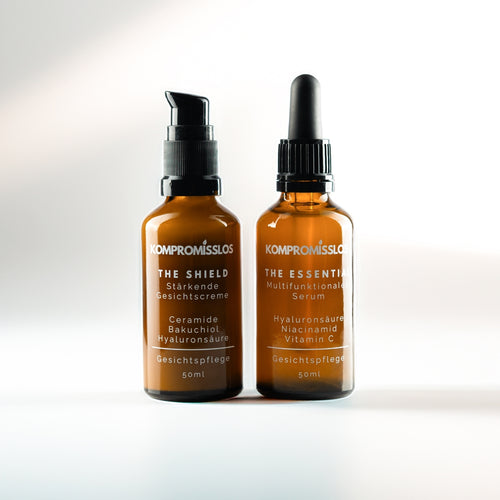
Kitchen staples such as coconut oil, olive oil or butter are a separate discussion, covered in the article on home remedies for dry facial skin. If you use the Duo of serum and face cream, the cream is the lipid layer in your routine. For most people, that is enough. For very dry skin, a thin layer of petroleum jelly on the driest areas can make sense – but on top of the cream, not instead of it.
I deliberately did not design The Shield for maximum occlusion, but around lipids similar to the skin’s own: ceramide NP, squalane and jojoba oil. According to our full ingredient list, The Duo contains no mineral oil, no paraffin and no petroleum jelly. That has a limit, and I will say so openly: The Shield cannot seal as strongly as pure petroleum jelly, and it is not meant to. A cream you use morning and evening has to absorb and must not sit on the skin like an ointment. For most skin types, that is enough. If your skin still feels tight in a few places in winter, a thin layer on top is a sensible addition. You do not need another product from us for that.
Frequently asked questions
Does petroleum jelly clog pores?
Pure petroleum jelly is not considered a typical pore-clogger. A 2024 review in the Journal of the American Academy of Dermatology explicitly dispels the idea that petroleum jelly causes acne. The trickier part is what lies underneath: sebum, make-up residue or heavy products stay trapped under the layer. What the term comedogenic really means is a topic of its own.
Can I slug after retinol?
Better not over your whole face on the same evening. Under an occlusive layer, a retinoid can work more intensely, which increases the risk of redness and flaking. It makes more sense to keep retinol evenings and slugging evenings separate. If you do combine them, on retinol evenings the petroleum jelly only goes on areas without retinol, such as the corners of your mouth and the sides of your nose, to protect these sensitive spots.
Is petroleum jelly bad for your skin?
Cosmetic petroleum jelly is a purified mineral oil product and is generally well tolerated by the skin. The article on mineral oil in skincare takes a detailed look at what is behind the criticism of paraffin and mineral oil components.
Can I combine slugging with active serums?
With hydrating serums, yes – that is actually the classic combination. A serum with humectants supplies the water, and the petroleum jelly on top holds it in. I would be careful with acids, retinoids or high-strength vitamin C, because the layer on top can intensify their effect and with it any irritation. Better to use these serums on evenings without slugging.
Does slugging help with wrinkles?
No, not in the true sense. Slugging can make fine dryness lines less visible overnight, because well-hydrated skin looks plumper. This effect disappears again as soon as your skin dries out. A layer of petroleum jelly does nothing for deeper wrinkles; it protects against evaporation and is not an anti-ageing active ingredient.
Is slugging more useful in winter?
Yes, for dry skin slugging makes much more sense in winter than in summer. Cold air outside and dry heated air indoors cause more water to evaporate from the skin, and that is exactly what an occlusive layer counters. That is why many people only need slugging during the heating season, and even then often only on the areas that feel tight first.
Do I need to slug if I use The Duo?
In most cases, no. The serum supplies moisture, and the cream on top supplies lipids such as ceramide NP, squalane and jojoba oil. If your skin still feels tight in places, for example in winter, you can apply a thin layer of petroleum jelly over the cream in the evening. The order stays the same as intended for The Duo: serum, cream, and only then the layer.
Sources
- Sethi A, Kaur T, Malhotra SK, Gambhir ML. Moisturizers: The Slippery Road. Indian Journal of Dermatology, 2016. Source
- Ghadially R, Halkier-Sorensen L, Elias PM. Effects of petrolatum on stratum corneum structure and function. Journal of the American Academy of Dermatology, 1992. Source
- Czarnowicki T, Malajian D, Khattri S, Correa da Rosa J, Dutt R, Finney R et al. Petrolatum: Barrier repair and antimicrobial responses underlying this ‘inert’ moisturizer. Journal of Allergy and Clinical Immunology, 2016. Source
- Pagani K, Lukac D, Martinez R, Jablon K, McGee JS. Slugging: TikTok as a source of a viral ‘harmless’ beauty trend. Clinics in Dermatology, 2022. Source
- Kamrani P, Hedrick J, Marks JG, Zaenglein AL. Petroleum jelly: A comprehensive review of its history, uses, and safety. Journal of the American Academy of Dermatology, 2024. Source