Home remedies for dry skin on your face: what helps and what harms
NATURAL SKINCARE
Only a few home remedies genuinely help dry skin on your face, and usually only for a few hours. A thin layer of honey binds moisture, an oat compress soothes tight skin, and a few drops of sunflower oil keep the outer layer of the skin supple and hydrated. Olive oil, lemon juice, sugar and salt scrubs or bicarbonate of soda are more likely to harm dry skin. The underlying problem, a weakened skin barrier, is not something kitchen ingredients can fix for good. That takes daily skincare with humectants and skin-identical lipids.
Which home remedies really help dry skin on the face?
The only home remedies that genuinely help dry facial skin are those that either bind water or slow down water loss without irritating the skin in the process. Dry skin has two needs: the outermost layer, the stratum corneum, is short of moisture, and it is short of the lipids that hold on to that moisture. Honey and oats belong in the first group, plant oils in the second. What neither group can do is rebuild the barrier itself. They ease the feeling of tightness, nothing more. There is also a point that lists of ten home remedies tend to leave out: food is made for the plate, not for the skin. It is not preserved, its composition varies, and it often goes from the jar to your face via your fingers. For resilient skin, that is usually no big deal; for sensitive or already irritated skin, it is a gamble. The article on very dry skin on the face explains in detail why it needs lipids above all, not just water.
| Home remedy | What it does | The catch | Verdict |
|---|---|---|---|
| Honey | Binds moisture | Sticky, may contain traces of pollen | Useful as a short mask |
| Oat compress | Soothes tight skin | Has to be made fresh every time | A good stopgap |
| Sunflower oil | Preserves the stratum corneum, improves hydration | Only a few drops, or it leaves a shine | Useful |
| Coconut oil | Rich and nourishing | Can be too heavy if you are prone to blemishes | Better for the body |
| Olive oil | Coats the surface with oil | Weakened the stratum corneum in a trial | Best left out |
| Quark, yoghurt | Pleasantly cooling | Spoils quickly | A feel-good mask, nothing more |
| Lemon juice | Nothing dry skin needs | Acidic, phototoxic in the sun | Leave it out |
Olive oil or coconut oil: which kitchen oil is good for your face?
Of the kitchen oils, sunflower oil is the best fit for the face, coconut oil works with caveats and olive oil is the least suitable. That is what a small but widely cited study in Pediatric Dermatology shows. Adult volunteers applied six drops of olive oil to one forearm twice a day. After four weeks, the integrity of the stratum corneum was significantly reduced and mild redness appeared, even in people with no history of atopic dermatitis. Sunflower oil on the other arm preserved the stratum corneum, caused no redness and improved hydration. The researchers therefore advise against using olive oil for dry skin. A forearm is not a face, and with 19 volunteers in total the study is small. Still, the direction is clear enough not to massage olive oil into your face every day just because it is natural.
Coconut oil fared better in a randomised trial in the journal Dermatitis: in 34 people with mild to moderate dryness on their legs, it improved skin hydration and surface lipids over two weeks just as well as mineral oil. That speaks for coconut oil on the body; on the face, the more relevant question is which oils really are a problem for your pores. If you are looking for a facial oil, you are usually better off with jojoba oil for your face than with whatever is in the kitchen cupboard. And whichever oil you choose, it goes on as the last step and never replaces the moisture underneath.
What do honey, quark and yoghurt do as a face mask?
Honey does the most as a mask; quark and yoghurt are more feel-good masks with a cooling effect. Honey consists mainly of fructose and glucose, sugars that attract and hold water. A review in the Journal of Cosmetic Dermatology describes its role in cosmetics as emollient, humectant and soothing. The same review puts the usual honey content of cosmetic products at between 1 and 10 per cent. A mask of pure honey is therefore far more concentrated than most creams containing honey, and that is not automatically better: it is sticky, hard to spread and can contain traces of pollen that sensitive skin reacts to. In practice, that means applying a thin layer, rinsing it off with lukewarm water after a few minutes and then carrying on with your usual skincare.
Quark and yoghurt contain water, a little milk fat, protein and lactic acid. Lactic acid is used in skincare as a mild AHA, but in quark it is present in unknown and varying amounts. The cool mixture feels good on tight skin, and the skin feels softer once it has been rinsed off. There is no evidence of a lasting effect on dry skin. The real catch is hygiene: dairy products spoil quickly at room temperature. So use them only fresh from the fridge, never on broken or irritated skin and never overnight.
Does an oat compress help dry facial skin?
An oat compress can soothe dry, tight facial skin in the short term, but it does not replace daily skincare. Oats are one of the few home remedies for which there are any useful studies at all, although in processed form: colloidal oatmeal is ground extremely finely and used in standardised amounts in lotions, creams and bath products. A study in the Journal of Drugs in Dermatology found in the lab that oat extracts activate genes involved in the skin barrier and lipid metabolism and buffer pH. In the clinical part, a lotion containing colloidal oatmeal improved dryness, hydration and barrier function in 50 women with moderate to severe dry skin on their lower legs. It is important to be clear about what this does not prove: what was tested was a finished lotion, not oats from the kitchen.
For a compress at home, put two tablespoons of fine porridge oats in a clean cotton cloth, let them steep in lukewarm water for a few minutes and dab the milky oat water onto your skin with the cloth. Leave it on briefly, do not rub, then moisturise. Make the oat water fresh each time and throw away any leftovers. If you have a known oat allergy, skip it. On days when your skin stings after the cold or a hot shower, the compress is a good stopgap. What it does not replace is a cream that replenishes lipids every day.
Which home remedies do more harm than good for dry skin?
The home remedies most likely to harm dry skin are those that are acidic, alkaline, abrasive or heavily scented, because they attack the stratum corneum, which is already weakened. The most common candidates from advice lists:
- Lemon juice: highly acidic and risky in the sun. A review in the journal Life describes how furocoumarins from citrus fruits such as limes can trigger phototoxic skin reactions in combination with UV light, with redness, blisters and dark discolouration.
- Apple cider vinegar: also highly acidic. Why it is risky as a toner for sensitive skin is explained in our article on apple cider vinegar on your face.
- Sugar and salt scrubs: the crystals have sharp edges and chafe skin that is already rough.
- Bicarbonate of soda and baking powder: alkaline, and therefore the opposite of the slightly acidic environment the skin’s surface needs.
- Undiluted essential oils, such as tea tree or lavender oil: highly concentrated fragrances and well-known triggers of contact allergies.
- Olive oil as daily care: in the trial, the stratum corneum became weaker rather than stronger.
- Hot facial steaming: it feels nourishing, but the heat and steam often leave sensitive, dry skin feeling tighter afterwards.
Fresh gel straight from an aloe leaf is also less harmless than it looks, because the yellowish sap at the edge of the leaf can irritate the skin, and the gel spoils quickly. The article on aloe vera gel for your face explains what shop-bought gel can and cannot do. And if you apply a thick layer of Vaseline overnight, you are already slugging with petroleum jelly, a method of its own with its own rules.
Before a home remedy goes on your whole face, test it on a small patch along your jawline and wait a day. If the area turns red, itches or stings, leave the remedy out, even if it is purely plant-based.
When is a home remedy no longer enough?
A home remedy is no longer enough if your skin still feels tight, flakes or stings after several weeks of consistent care, or if cracks, itching and red, scaly patches appear. In that case, there is often more to it than a dry winter. Eczema, atopic dermatitis, perioral dermatitis or rosacea can look similar at first and should be assessed by a dermatologist. Skincare can only play a supporting role there. With ordinary dry skin, the problem is usually simpler: home remedies provide every so often what the skin needs every day. A honey mask on a Sunday cannot make up for a week of central heating and hot water.
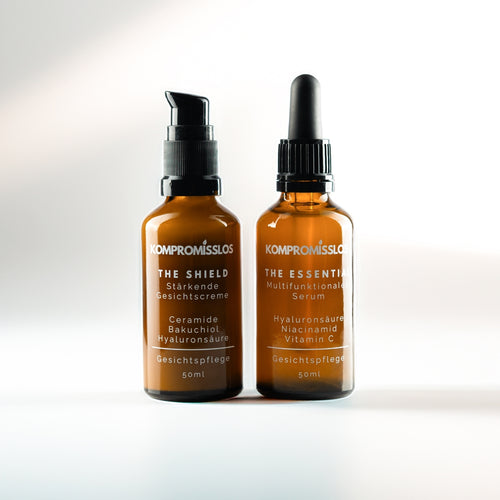
What helps in the long run is skincare that covers both needs, morning and evening: humectants first, then lipids on top that keep that moisture in the skin. The article on winter face cream for mature, dry skin covers which cream suits cold weather and heated indoor air. The ideas behind the useful home remedies – plant juice for moisture, plant oils for lipids – can be put into practice more safely in a stable formulation: no spoiling, a consistent composition and no detour via the fridge. The Duo, a serum and a cream, addresses both of these needs, with aloe vera juice as its base, hyaluronic acid in three molecular sizes in the serum, and jojoba oil, squalane and ceramides in the cream.
In the Duo, aloe vera juice comes first on the ingredient list, even before water, and the cream contains jojoba oil and squalane. These are the same ideas that lie behind the useful home remedies: binding moisture and replenishing lipids. The difference is in the formula. A freshly mixed mask soon becomes a breeding ground for germs. That is why the Duo is preserved, with Sodium Benzoate and Sodium Levulinate, and deliberately fragrance-free. For skincare that contains water, I think ‘completely preservative-free’ is the wrong promise to make. What the Duo cannot do is get to the bottom of cracked, itchy skin; that is a job for a dermatologist. You can see exactly what goes into it in the full A–Z ingredient list.
Frequently asked questions
How long does a homemade face mask keep?
A homemade mask has practically no shelf life: mix it fresh, use it straight away and throw away any leftovers. Without preservatives, germs can multiply quickly in mixtures of water, dairy products or oats, even in the fridge. The same goes for homemade creams that contain water. How to tell how long shop-bought skincare will last is explained in the article on skincare shelf life after opening.
Does shea butter work as a home remedy?
Shea butter can cover dry patches well, because as a rich plant fat it slows down water loss. On very dry skin it feels pleasant; if you are prone to blemishes, it is often too heavy. How it measures up on the face is covered in the article on shea butter on your face.
Is lemon juice good for your skin?
No, lemon juice does not belong on your face. It is highly acidic and can make dry skin sting. Citrus fruits also contain substances that, combined with sunlight, can trigger phototoxic reactions with redness, blisters and dark spots. For a more even complexion, there are stable, precisely dosed active ingredients that do not carry this risk. Why lemon is not a good idea for dark spots either is covered in our article on home remedies for dark spots.
How often can I do a honey mask?
Once or twice a week is enough. Honey binds moisture but does not replace daily skincare, and applying and rinsing it off more often brings no extra benefit. Take the honey out of the jar with a clean spoon, not your fingers, and skip the mask if you react to pollen or bee products.
Are home remedies safe for sensitive skin?
Not automatically, because natural does not mean gentle. Olive oil, citrus fruits and essential oils are plant-based and still a poor choice for sensitive skin. Test every new remedy on a small patch first, use only fresh ingredients and avoid anything strongly scented. If you notice redness, stinging or small blisters, rinse it off straight away and stop using it.
Can I combine home remedies with my skincare?
Yes, as long as the mask comes before your skincare and is rinsed off again. A honey or oat mask after cleansing, followed by serum and cream as usual, is no problem. An oil belongs at the end of the routine, and whether you still need one at that point comes down to the question of serum or face oil. Do not combine acidic home remedies with acid exfoliants.
Do I need home remedies if I use The Duo?
No, you do not need them. The serum and cream cover both needs of dry skin: humectants such as hyaluronic acid and aloe vera juice, plus lipids such as jojoba oil, squalane and ceramides. A fresh oat or honey mask on a particularly tight day does no harm; afterwards, apply The Duo as usual. If your skin is dry, you can use a little more.
Sources
- Danby SG, AlEnezi T, Sultan A, Lavender T, Chittock J, Brown K, et al. Effect of olive and sunflower seed oil on the adult skin barrier: implications for neonatal skin care. Pediatric Dermatology, 2013. Source
- Agero AL, Verallo-Rowell VM. A randomized double-blind controlled trial comparing extra virgin coconut oil with mineral oil as a moisturizer for mild to moderate xerosis. Dermatitis, 2004. Source
- Burlando B, Cornara L. Honey in dermatology and skin care: a review. Journal of Cosmetic Dermatology, 2013. Source
- Ilnytska O, Kaur S, Chon S, Reynertson KA, Nebus J, Garay M, et al. Colloidal Oatmeal (Avena Sativa) Improves Skin Barrier Through Multi-Therapy Activity. Journal of Drugs in Dermatology, 2016. Source
- Grosu Dumitrescu C, Jîjie AR, Manea HC, Moacă EA, Iftode A, Minda D, et al. New Insights Concerning Phytophotodermatitis Induced by Phototoxic Plants. Life (Basel), 2024. Source