Aloe vera gel for your face: what it can and cannot do
SINGLE INGREDIENT
Aloe vera gel is around 99 per cent water and mainly cools, hydrates and soothes irritated skin. It does not replace a skincare product with lipids, because it lacks the oil-based components that hold moisture in the stratum corneum. It makes sense as an addition, but it is not enough as your only facial skincare.
What does aloe vera gel actually do for your skin?
Aloe vera gel hydrates, cools and visibly calms irritated skin. The reason lies in its composition. According to a review in the Journal of Traditional and Complementary Medicine, the inner leaf gel is 99 to 99.5 per cent water, and the remaining 0.5 to 1 per cent contains more than 75 potentially active compounds such as polysaccharides, amino acids, enzymes and vitamins. That explains both sides. Water and water-binding polysaccharides settle as a light film on the stratum corneum, and the skin looks plumper and calmer in the short term. At the same time, a substance made almost entirely of water is no powerhouse of active ingredients. If you use aloe vera to hydrate and as a soothing component for sensitive skin, that is exactly what you get. If you expect a visible change in dehydration lines, an uneven complexion or declining elasticity, you are looking in the wrong place. That expectation is the most common reason why aloe vera ends up disappointing.
It helps to compare it with other water-binding ingredients. Hyaluronic acid binds water in the upper layers of the skin and works on the same principle, only it can be dosed more precisely. That is why aloe vera plays a supporting role in our formula rather than the lead. Which active ingredients take the leading role is set out openly in our overview of The Duo.
Why aloe vera gel does not replace a moisturiser
Aloe vera gel does not replace a moisturiser, because it lacks the lipids that stop water evaporating from the stratum corneum. Moisturising always involves two jobs. The first is to bring water into the upper layers of the skin and bind it there. Aloe vera does that well. The second is to keep that water there, and for that you need oil-based components such as ceramides, squalane or plant oils. Without the second part, the water you have applied evaporates again, and your skin often feels drier afterwards than before. This effect is not a flaw in the product but a question of who does which job. If you only use a water-based gel, you have done half your skincare and are then surprised by a skin feel that does not improve. How to divide the two jobs cleanly is explained in our article on why serum and cream have different jobs.
| Job | Pure aloe vera gel | Skincare with lipids |
|---|---|---|
| Bringing water into the stratum corneum | Yes, this is its strength | Yes, via humectants |
| Keeping water in the skin | No, it lacks oil-based components | Yes, via ceramides, squalane and oils |
| Visibly calming irritated skin | Yes, mainly through its cooling effect | Depends on the formula |
| Suitable as your only facial skincare | No | Yes, with the right formula |
One customer wrote to tell us that she now only used pure aloe vera gel on her face, because it felt light and cool, and yet her skin still felt tight. That is exactly the mechanism described above. The gel feels right when you apply it, but without an oil-based layer on top, little of the water remains. What helped her was the simplest solution: keep the gel as the first step and apply a skincare product with lipids over it. If your skin feels tight all the time, it is also worth taking a look at the skin barrier and how to care for it.
How can you tell a good aloe vera gel?
You can tell a good aloe vera gel by its ingredient list, not by the percentage on the front. Three points are enough to judge it. First, the first position on the INCI list. If it says Aloe Barbadensis Leaf Juice, aloe is the largest ingredient by quantity. If it says Aqua and aloe only comes further down, it is a gel with aloe, not an aloe gel. Second, the rest of the list. A gel needs thickeners and a preservative system; that is normal and not a sign of poor quality. It becomes a concern when alcohol is near the top or when fragrances and colourants dominate the list, because neither is needed on irritated skin. Third, any mention of decolourised or purified quality. Between the rind and the leaf gel sits a yellowish latex layer containing anthraquinones, which is removed with careful processing. Brands that mention this step give you more information than any percentage on the front of the pack.
The second most common misconception concerns the percentage. A gel with 99 per cent aloe sounds impressive but says little, because aloe vera itself is almost 99 per cent water. It tells you more whether a brand names the quality and origin of the raw material and whether the rest of the formula contributes anything. How we handle this is set out in our complete overview of ingredients.
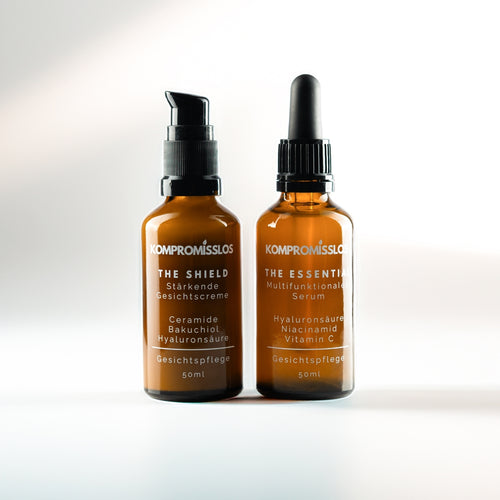
How we use aloe vera in the Duo
We use aloe vera as a soothing base component, not as an active ingredient with a percentage attached. What we declare are the values that actually tell you something, and they always apply to The Duo as a whole: 5 per cent niacinamide, 2 per cent hyaluronic acid, 2 per cent vitamin C as 3-O-ethyl ascorbic acid, 2 per cent edelweiss extract, 2 per cent gentian root extract, 1 per cent zinc and 0.3 per cent bakuchiol. Aloe vera deliberately sits alongside them without a percentage, together with ceramides, squalane, panthenol, jojoba oil, vitamin E and tamarind seed extract. The reason is honesty. With aloe vera, the quality of the raw material matters more than the number on the label, and a percentage would suggest a precision that simply does not exist here. Aloe vera makes the texture pleasant and the formula gentler on the skin, and that is exactly what it is there for. The real work is done by the declared active ingredients.
In practice, that means aloe vera appears in our formula, not as a separate step in your routine. Two products morning and evening, three to six drops of serum and three to six pumps of cream – you do not need more than that. The details are in the instructions for using both products. If you are looking for the soothing component on its own, you will also find it in panthenol, while squalane covers the oil-based side that aloe vera cannot provide.
When aloe vera gel is not the right choice
Aloe vera gel is not the right choice if your skin is dry rather than irritated, because then it is lacking oil, not water. Dry skin needs lipids, and in this case a water-based gel is more likely to increase the feeling of tightness. You can also do without it if your skincare already contains humectants and a good cream, because an extra gel would only add another step without contributing anything. And it is the wrong answer if there is no cosmetic issue behind the problem at all. Persistent redness, weeping patches, severe itching, broken skin or a complexion that suddenly changes a great deal belong with a dermatologist. Cosmetics care for the skin and support how it looks. Making a diagnosis is not part of that, and neither is treating a skin condition. Drawing this line honestly is part of giving good advice.
The state of the research is also part of the picture. A pharmacological review in the journal Molecules notes that clinical studies so far have been carried out with aloe vera as a whole, not with its isolated individual compounds. If you read that a single aloe component does this or that, do not skip the step from cell culture to facial skincare. Aloe vera remains a good, well-tolerated supporting ingredient, and if you want to see the approach behind it, you will find it in the structure of our serum and cream.
During development, I thought for a long time about whether to label aloe vera with a percentage. It would have been easy, because aloe sells well and sounds natural. I decided against it, because a number says little for this raw material. With niacinamide or bakuchiol, the concentration tells you something. With aloe vera, it mainly tells you how much water is in the product. So I declare the seven values that genuinely mean something and let aloe vera be what it is: a good supporting ingredient that makes the formula more pleasant. I would rather have one number less on the label than a number that is of no use to anyone.
Dominic Bertschin
Frequently asked questions
Can I use aloe vera gel every day?
Yes, aloe vera gel is suitable for daily use as long as your skin tolerates it well. It works best as the first step on cleansed skin, followed by a skincare product with lipids. It is not enough as your only step, because it lacks the oil-based components that hold moisture in the stratum corneum.
Is aloe vera gel good for dry skin?
Only as an addition. What dry skin lacks above all is lipids, and a gel that is around 99 per cent water is exactly what does not supply them. If you have dry skin and use nothing but aloe vera gel, you will often notice a stronger feeling of tightness afterwards. A cream with ceramides or squalane is the better choice here.
Can I use the gel straight from the aloe plant?
In principle, yes, but with two caveats. Between the rind and the leaf gel sits a yellowish latex layer that should be removed carefully before use. Fresh leaf gel is also unpreserved, so it only keeps for a very short time. For daily facial skincare, a properly processed product is the more reliable option.
Does aloe vera gel help after too much sun?
Aloe vera gel cools and can make overheated skin feel more comfortable in the short term. Sunburn, however, is a burn and not a cosmetic matter. If there is blistering, severe pain or redness over a large area, that belongs in medical hands, not in your skincare routine.
Does The Duo contain aloe vera?
Yes, The Duo contains aloe vera, but without a declared percentage. The values declared with percentages are 5 per cent niacinamide, 2 per cent hyaluronic acid, 2 per cent vitamin C, 2 per cent edelweiss extract, 2 per cent gentian root extract, 1 per cent zinc and 0.3 per cent bakuchiol. All values apply to The Duo as a whole.
What does Aloe Barbadensis Leaf Juice on the packaging mean?
Aloe Barbadensis Leaf Juice is the INCI name for the juice from the inside of the aloe vera leaf. If it is in first place on the ingredient list, aloe is the largest ingredient by quantity. If Aqua comes before it, the product is water-based with a proportion of aloe, not a pure aloe gel.
Sources
- Radha MH, Laxmipriya NP, Evaluation of biological properties and clinical effectiveness of Aloe vera: A systematic review, Journal of Traditional and Complementary Medicine, 2015. Source
- Sanchez M, Gonzalez-Burgos E, Iglesias I, Gomez-Serranillos MP, Pharmacological Update Properties of Aloe Vera and its Major Active Constituents, Molecules, 2020. Source