Hyaluronic acid for skin: what it really does and when a higher percentage adds nothing
SINGLE INGREDIENT
Hyaluronic acid is a humectant that binds water in the outermost layer of the skin, making it look plumper and smoother. It suits almost every skin condition, from dry to oily. On its own, though, it isn’t enough: without a layer of skincare on top, the water it has bound evaporates again. And the percentage on the packaging tells you less than most people assume.
What does hyaluronic acid do in skincare?
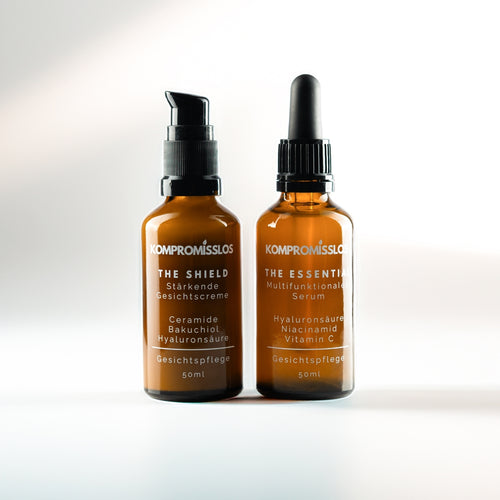
Hyaluronic acid attracts water and holds it where it is applied: in the uppermost layers of cells. Chemically, it is a long-chain sugar molecule that the body makes itself and whose proportion in the skin declines over the years. Applied to the skin, it doesn’t replace this loss; it tops up the water reserve of the outer layer of the skin for a short time. You can see this within minutes to hours: the surface looks smoother, fine dehydration lines are less noticeable, and the skin feels softer. The Duo contains 2% hyaluronic acid, together with active ingredients that take on other jobs. What hyaluronic acid does not do: it doesn’t build collagen, it doesn’t change pigmentation, and it doesn’t replace a layer of lipids. It is a hydrator, not an ingredient that remodels the skin. That is exactly why it appears in almost every formulation, from the chemist’s cream to the expensive serum, and yet is regularly overestimated.
How deep it gets depends on the size of the molecule. According to a review in the journal Biomolecules, only chains below about 100 kilodaltons penetrate the skin at all, while large molecules of around 1000 to 1400 kilodaltons form a film on the surface. Both have a purpose: the film smooths and slows down water loss, while the smaller chains cushion the outer layer of the skin from within. A formulation that offers both therefore makes more sense than one that works with a single size only.
Which skin conditions benefit from hyaluronic acid, and which don’t?
Hyaluronic acid is worthwhile for any skin that feels dry, tight or dull, regardless of whether it is also shiny or prone to blemishes. The reason: a lack of water and a lack of oil are two different problems. Oily skin can be dehydrated at the same time, and that is exactly where a light hydrator plays to its strengths, because it adds nothing oily. The benefit is clearest for mature and dry skin, because its own hyaluronic acid content is lower and the outer layer holds on to water less well. For sensitive and red-looking skin, the main argument in its favour is how well it is tolerated, as hyaluronic acid is one of the few active ingredients with no significant potential for irritation. It is less worthwhile if your skin is already well cared for and you are just slotting another product into a routine that works. And it isn’t worthwhile as the only measure if your skin barrier is damaged: then what is missing is lipids, not water.
| Skin condition | Does hyaluronic acid help? | What to watch |
|---|---|---|
| Dry skin | Yes, noticeably | Always use a cream on top, otherwise the effect fizzles out. |
| Dehydrated skin | Yes, this is the core case | The effect only lasts with daily use. |
| Mature skin | Yes, for dehydration lines | Hyaluronic acid doesn’t change the depth of wrinkles. |
| Sensitive or red-looking skin | Yes, because it is very well tolerated | Other active ingredients address the redness itself. |
| Combination skin | Yes, as a light base | In the T-zone, often enough without a rich cream. |
| Blemish-prone skin | Yes, because it is non-comedogenic | Hyaluronic acid does nothing against the blemishes themselves. |
| Over-treated skin | To a limited extent | Cut back first, then judge what is missing. |
How much hyaluronic acid should a product contain?
With hyaluronic acid, the percentage matters much less than with other active ingredients. In the double-blind comparative study published in the Archives of Dermatological Research in 2024, a concentration of just 0.1% measurably improved skin hydration in older people with dry skin, with the low-molecular-weight version of 7 kilodaltons performing better than the high-molecular-weight version of 1800 kilodaltons. So what mattered was the size of the molecule, not the amount. There is also a practical limit: beyond a certain proportion, pure hyaluronic acid powder makes a formulation thick and sticky, which is why high percentages usually refer to a ready-made raw-material blend rather than the pure substance. A claim of 5% or 10% hyaluronic acid is therefore no proof of quality. The more useful question is which molecular sizes are included and what else is in the formula. You can find out which active ingredients we use and at what concentration in the overview of ingredients.
How often and how should you apply hyaluronic acid?
Hyaluronic acid belongs on skin that is still slightly damp, twice a day, morning and evening, followed by a cream on top. This order is not a detail – it is half the effect: a humectant binds the water that is available. If your skin is completely dry and so is the surrounding air, it draws some of that water from the deeper layers, and without a final layer of skincare this water evaporates again. That is why we never offer the serum on its own, but always serum and cream as a set. In concrete terms, that means 3 to 6 drops of serum, followed immediately by 3 to 6 pumps of cream, with no waiting time in between. Applying it more than twice a day adds nothing, because the outer layer of the skin can only hold a limited amount of water. What matters is regularity, not the amount per application. You will find the complete routine on the How to use page.
What if your skin doesn’t tolerate hyaluronic acid?
Genuine intolerances to hyaluronic acid are rare, because the body makes the substance itself and doesn’t recognise it as foreign. What people usually describe as an intolerance is something else: a feeling of tightness or slight stinging shortly after application, often in dry, centrally heated air or in winter. Behind this there is usually the drawing effect just described, or skin that is already irritated and reacts sensitively to every product. The first step is therefore not to drop hyaluronic acid, but to consistently apply a layer of skincare on top and reduce the number of products. If the reaction persists, it is more likely to come from a preservative, a fragrance or a second active ingredient in the same formula. Persistent stinging, flaking or hives should be checked rather than further experimented with. How plain dryness differs from a genuine reaction is something I describe in our article on dry skin with age.
Where hyaluronic acid stops and a professional takes over
Hyaluronic acid is a cosmetic hydrator, not a remedy for skin conditions. It can improve the appearance of dry, dull skin and soften the look of dehydration lines. It does not treat rosacea, atopic dermatitis, acne or eczema – not at a high concentration, and not in combination with other active ingredients. If your skin weeps, itches constantly, flakes, hurts or keeps flaring up, it is no longer a question of the right skincare but a dermatological one. The same applies to redness that lasts for months and to changes in individual spots. In such cases, cosmetics can play an accompanying role if the professional has no objection, but they don’t replace an assessment. I deliberately keep this line clear, because skincare advertising regularly blurs it. Which active ingredient you should prioritise instead is explained in our comparison of hyaluronic acid or niacinamide.
I thought for a long time about whether we should make a pure hyaluronic acid serum. It would have been the simplest product: cheap to make, immediately noticeable, hardly any complaints. I decided against it, because the effect is gone again the next morning if there is nothing on top. If you buy hyaluronic acid without a cream to go with it, you are buying a promise the formulation can’t keep on its own. That is why we only offer the set of serum and cream, and why hyaluronic acid doesn’t feature on our front label but in the formula, where it plays its part at 2%.
Frequently asked questions
What is the difference between hyaluron and hyaluronic acid?
They are the same substance. Hyaluron is the shortened everyday form; hyaluronic acid is the chemically correct name. The ingredient list usually says sodium hyaluronate, the sodium salt of the acid, because it is more stable and dissolves better in water. Differences in effect don’t come from the name, but from the size of the molecule.
What percentage of hyaluronic acid makes sense?
Considerably less than advertising suggests. Studies show measurable effects on skin hydration at just 0.1%. High percentages usually refer to a raw-material blend, not to pure hyaluronic acid, and make the texture sticky. The mix of molecular sizes and the layer of skincare on top matter more than the figure.
How often should you use hyaluronic acid?
Twice a day, morning and evening, each time on slightly damp skin and with a cream on top. More often brings no additional benefit, because the outer layer of the skin can only store a limited amount of water. Regularity matters more than frequency: the effect lasts hours, not days.
Can hyaluronic acid dry out your skin?
Indirectly, yes, if you use it without a final layer of skincare. In very dry ambient air, a humectant draws some of the water from the deeper layers of the skin up to the surface, where it evaporates. The solution is not to leave out hyaluronic acid, but always to apply a cream on top.
Is hyaluronic acid suitable for combination and blemish-prone skin?
Yes. Hyaluronic acid is non-comedogenic and adds no oil, so it also suits shiny areas and skin that is prone to blemishes. It does nothing against the blemishes themselves. In the T-zone, a thinner layer of cream on top is often enough, rather than none at all.
Can you combine hyaluronic acid with AHA, BHA or salicylic acid?
Yes, hyaluronic acid is unproblematic with acids and is often used to cushion their drying effect. Apply the acid first, then the hyaluronic acid, then the cream. Which combinations make sense and which you are better off keeping apart is covered in our article on combining hyaluronic acid.
Does hyaluronic acid really do anything for mature skin?
Yes, but only at the level of hydration. Dehydration lines are less noticeable and the surface looks smoother, because the outer layer of the skin is better cushioned. Hyaluronic acid doesn’t change deep wrinkles, loss of elasticity or dark spots. Other active ingredients are responsible for those, and the Duo contains them as well.
Sources
- Zanchetta C, Scandolera A, Reynaud R. Hyaluronic Acid in Topical Applications: The Various Forms and Biological Effects of a Hero Molecule in the Cosmetics Industry. Biomolecules, 2025. Source
- Muhammad P, Novianto E, Setyorini M et al. Effectiveness of topical hyaluronic acid of different molecular weights in xerosis cutis treatment in elderly: a double-blind, randomized controlled trial. Archives of Dermatological Research, 2024. Source