Hyaluronic acid filler vs cream: what injections and skincare can each do
SKIN OVER 40
Hyaluronic acid filler vs cream is not an either-or question, because the two work in completely different places. A hyaluronic acid filler is a cross-linked gel that a doctor injects beneath the skin, where it replaces lost volume. According to a review, the effect lasts roughly 6 to 18 months, depending on the product. A hyaluronic acid cream stays in the upper layers of the skin, binds moisture and makes dehydration lines less noticeable. What it cannot do is fill a wrinkle.
What is the difference between a hyaluronic acid filler and a hyaluronic acid cream?
The difference lies not in the ingredient but in where it works and in what form: a filler is a gel placed with a needle or cannula into the deeper layers of the skin or beneath them, while a cream is skincare that stays on the surface. Both are called hyaluronic acid, and that is exactly what causes the confusion. Hyaluronic acid occurs naturally in connective tissue and can bind a lot of water. In a filler, its chains are chemically cross-linked so that the liquid becomes a mouldable gel that the body does not break down straight away. In a cream, by contrast, it is dissolved and acts as a humectant in the stratum corneum, the skin’s outermost layer. So a filler lifts an area from within, while a cream improves how the surface feels and looks. The same misunderstanding lies behind creams that borrow the vocabulary of injections: the name promises a treatment the jar cannot deliver. You can read more about this in the article on what so-called Botox creams can really do and where they stop.
| Criterion | Hyaluronic acid filler | Hyaluronic acid cream or serum |
|---|---|---|
| Where it works | Deeper skin and the tissue beneath it | Stratum corneum, the outermost layer of the skin |
| Aim | Replacing lost volume, lifting deeper wrinkles | Binding moisture, making the skin look plumper and smoother |
| How long it lasts | Roughly 6 to 18 months, depending on the product | For as long as you keep applying it regularly |
| Risk | Mostly bruising and swelling, rarely serious vascular complications | Low, occasionally a reaction to individual ingredients |
| Who applies it | A medical professional, after a full explanation of the risks | You, morning and evening |
Why can’t a hyaluronic acid cream fill a wrinkle?
A hyaluronic acid cream cannot fill a wrinkle because it never reaches the place where a wrinkle forms. A true wrinkle is a depression set in the dermis and the tissue beneath it, in other words below the stratum corneum. And the stratum corneum is precisely the skin’s most important barrier. A widely cited paper in Experimental Dermatology describes the so-called 500 dalton rule: according to this rule, a substance has to weigh less than 500 daltons to be absorbed into the skin through the stratum corneum. Hyaluronic acid is a long-chain molecule and lies far above that. A study in the Journal of Drugs in Dermatology tested hyaluronic acid creams with molecular weights between 50 and 2,000 kilodaltons, that is, between 50,000 and two million daltons. Even the smallest variant is many times larger than the limit. A filler gets round the problem with a needle, placing a cross-linked gel directly where the lift is needed. The same principle explains why collagen from a cream does not reach the deeper layers either.
That does not mean hyaluronic acid is useless on the skin. It binds water in the upper layers, which makes the skin look smoother and plumper. How much of that is realistic, why molecular size plays a part and how to use it are covered in the article on what hyaluronic acid really does for your skin.
What can a hyaluronic acid filler do, and how long do the results last?
A hyaluronic acid filler can replace volume where it has been lost and visibly lift deeper wrinkles or hollows, but the result is not permanent. A review by Funt and Pavicic in the journal Clinical, Cosmetic and Investigational Dermatology states that hyaluronic acid fillers generally last 6 to 18 months. According to the paper, how long they last in an individual case depends on the source of the material, the degree of cross-linking, the concentration and the particle size. More heavily cross-linked and more concentrated gels are firmer and are broken down more slowly by hyaluronidase, an enzyme the body produces itself. That is why there is no single filler, but different products for fine lines, deeper wrinkles or contours. It also explains why the treatment has to be repeated if the result is to last. What a filler does not change is the surface of the skin itself: dryness, a dull complexion, pigmentation marks or a stressed skin barrier stay as they are. Which area, which product and what amount make sense is a question for a medical consultation, not for a guide.
What are the risks of hyaluronic acid injections, and who should do them?
Hyaluronic acid injections are usually well tolerated, but they are not a harmless cosmetic step, which is why they belong in medical hands. The review by Funt and Pavicic notes that most side effects are mild and temporary, such as bruising and swelling from the injection. According to the authors, serious complications are rare and can mostly be avoided with careful planning and technique. The most dangerous of these is vascular occlusion: if filler enters an artery, it can cause tissue death, and in the worst case the blood supply to the retina is cut off. A review in Dermatologic Surgery found 98 cases of visual changes after filler injections in the medical literature worldwide. The patient’s own fat was most often involved, followed by hyaluronic acid fillers, and most cases of vision loss did not recover. The authors therefore stress that the person injecting must know the blood vessels of the face in detail. For you, this means getting a thorough explanation beforehand and clarifying at least these points in the consultation.
- What material will be injected, and can it be dissolved again if problems arise?
- Who is doing the injecting, and what training do they have?
- What happens if pain, skin discolouration or problems with your vision occur during or after the treatment?
- Who can you reach after the treatment if something does not seem right?
When is skincare the right choice, and when is a medical consultation the better step?
Skincare is the right choice if your skin mainly looks dry, tight or dull and the lines soften when you apply cream; a medical consultation makes more sense if what bothers you is volume that has been lost. Fine lines that are more noticeable in the morning and fade once you have applied skincare are often a sign of a lack of moisture. Whether you are dealing with dehydration lines or a real wrinkle is fairly easy to assess yourself. With dehydration lines, consistent skincare is the right approach, because the problem lies at the surface. It is a different matter if a wrinkle stays deep even when your face is relaxed and your skin is well cared for, or if an area looks hollow. Then it is about structure deep down, and no cream reaches that far. How skincare can help with sagging skin on the face, and where it stops, is a topic of its own. What matters is not letting an advertising claim push you in one direction or the other. Not every wrinkle needs to be injected, and no expensive jar replaces a medical assessment. Whether a filler is an option for you at all is something to discuss with a doctor.
Do not let anyone rush you: the consultation and the treatment do not have to take place on the same day. Bring your questions, ask for the answers to be explained and then decide in your own time.
Do you still need skincare after a filler?
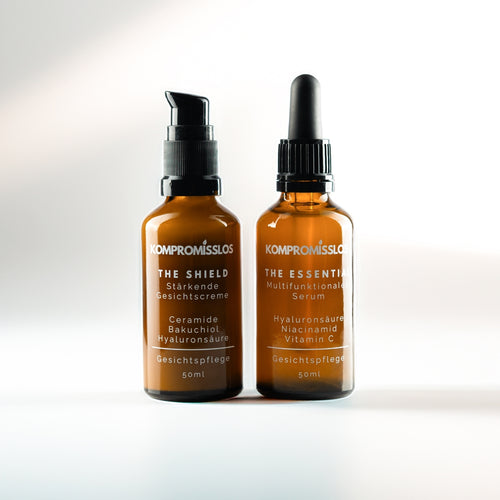
Yes, you still need skincare after a filler, because a filler changes what lies deep down, not the surface of your skin. The skin on top continues to lose moisture, needs an intact barrier and reacts to UV radiation just as it did before. In the first few days after the treatment, follow your clinic’s instructions, such as not massaging the treated area. After that, the division of labour is simple: the filler replaces volume deep down, while skincare takes care of moisture, the barrier and a more even-looking complexion. The Duo, made up of The Essential serum and The Shield cream, is designed for exactly this part. The serum contains hyaluronic acid in three molecular sizes plus niacinamide, and the cream on top contains ceramide NP, squalane and bakuchiol. Together they can visibly soften dehydration lines and make the skin look plumper. They cannot fill a wrinkle, and we do not claim that they can. If you want to know which anti-wrinkle ingredients are actually proven, that article gives you a level-headed overview.
The most important skincare step after a filler, however, is not one that comes in the Duo: daily sunscreen for your face. UV radiation is one of the factors that visibly age the skin, and no injection changes that.
I put hyaluronic acid in three molecular sizes into the serum because it binds moisture, not because it fills anything. That is why I do not promise a ‘filler effect’: a cream does not fill anything, it keeps the skin hydrated and supports the barrier. That sounds less spectacular, but it is what skincare can actually do. There is a second decision too: two products instead of eight, and deliberately no sun protection factor in the cream. If volume loss is on your mind, you should wear a separate sunscreen during the day, because UV radiation keeps driving skin ageing and the cream does not protect against it. I have set out which active ingredients are in the Duo and what each one is there for on the page about our active ingredients and what they do.
Frequently asked questions
Can a hyaluronic acid cream replace fillers?
No, a hyaluronic acid cream cannot replace a filler. It stays in the stratum corneum and binds moisture there, whereas a filler is injected deep down as a cross-linked gel and replaces volume. For dehydration lines, the cream is the right choice; with genuine volume loss, it does not reach the cause.
Does hyaluronic acid from a cream penetrate the skin?
Into the upper layers, yes; into the depth of a wrinkle, no. Hyaluronic acid is a large molecule, far above the 500 dalton limit beyond which substances barely pass through the stratum corneum. According to a study in the Journal of Drugs in Dermatology, smaller molecular sizes probably penetrate a little better than large ones, but they do not reach the depth at which a filler sits.
Are hyaluronic acid injections dangerous?
Usually not, but they are a medical procedure with real risks. Bruising and swelling are common and go away on their own. In rare cases, filler can block a blood vessel, which can cause tissue damage and, in the worst case, loss of vision. That is why the treatment belongs with a medical professional who knows the blood vessels of the face and can act immediately in an emergency.
Can a hyaluronic acid filler be reversed?
Yes, hyaluronic acid fillers can be dissolved with the enzyme hyaluronidase. The review by Funt and Pavicic explicitly recommends hyaluronic acid for the area under the eyes so that it can be dissolved if complications arise. Whether and when that is necessary is for your doctor to decide. Without any intervention, the body breaks the filler down on its own over time.
Does drinking hyaluronic acid or taking it in capsules help with wrinkles?
Capsules and drinkable ampoules are no substitute for a filler. Whatever you swallow is processed in the digestive tract and distributed throughout the body, rather than ending up in a particular wrinkle. Much the same applies to collagen drinks: they are not a way to build volume in one specific area. If you want to try capsules, talk to your doctor or pharmacist first.
Does skin lose volume faster without fillers?
No, a filler does not halt the natural ageing process, and you do not lose volume any faster without one. Once a filler has broken down, you see roughly the state your skin would have been in anyway. What you can influence yourself is above all daily sun protection and skincare that supports the skin barrier.
Do I still need The Duo if I get hyaluronic acid injections?
If you want to look after the surface of your skin, yes. A filler changes what lies deep down, not the moisture and barrier of the skin above it. The Duo takes care of exactly that part: a serum with hyaluronic acid in three molecular sizes, topped by a cream with ceramide NP and squalane. In the first few days after the treatment, follow your clinic’s instructions.
Sources
- Funt D, Pavicic T. Dermal fillers in aesthetics: an overview of adverse events and treatment approaches. Clinical, Cosmetic and Investigational Dermatology, 2013. Source
- Beleznay K, Carruthers JD, Humphrey S, Jones D. Avoiding and Treating Blindness From Fillers: A Review of the World Literature. Dermatologic Surgery, 2015. Source
- Bos JD, Meinardi MM. The 500 Dalton rule for the skin penetration of chemical compounds and drugs. Experimental Dermatology, 2000. Source
- Pavicic T, Gauglitz GG, Lersch P, Schwach-Abdellaoui K, Malle B, Korting HC, et al. Efficacy of cream-based novel formulations of hyaluronic acid of different molecular weights in anti-wrinkle treatment. Journal of Drugs in Dermatology, 2011. Source