Dehydration lines vs wrinkles: how to tell them apart and what skincare can do
SKIN CONCERNS
The easiest way to tell dehydration lines from wrinkles is to check whether the lines disappear once your skin has enough moisture again. Dehydration lines are very fine, often form a criss-cross pattern and sit only in the outermost layer of the skin. After moisturising, they usually fade over the course of the day. True wrinkles, by contrast, stay visible even when your face is relaxed and your skin well cared for, because they form deeper down, in the dermis. Skincare can markedly soften dehydration lines, but it can only make a true wrinkle look softer.
How can you tell dehydration lines from true wrinkles?
You can recognise dehydration lines by the fact that they are very fine, run in all directions and do not follow the pattern of your facial expressions. They form in the stratum corneum, the outermost layer of the epidermis. When it lacks water, it becomes stiffer and the skin’s natural fine surface texture stands out more. The result looks like a fine net of lines, often together with a dull, slightly rough feel. A study in hairless mice, published in the Archives of Dermatological Research, showed that skin surface roughness increased significantly within three days in a dry environment and partly receded again with glycerin or water. True wrinkles sit deeper: they develop over years in the dermis, as the network of collagen and elastin fibres weakens and the skin creases in the same places again and again.
That is why true wrinkles usually follow typical lines, such as across the forehead, between the eyebrows or as crow’s feet, and they stay even when your skin is well looked after. A third criterion is timing: dehydration lines come and go with the weather, central heating and your skincare, while true wrinkles do not. So fine lines alone are not proof of skin ageing. What actually counts among the first signs of skin ageing is worth looking at separately.
Dehydration lines, crepey lines or a true wrinkle: how does the self-test work?
The self-test works with four observations in front of the mirror: relax, stretch, push together and look again after moisturising. All you need is daylight, ideally from a window, and a few hours’ patience. It is important to treat your skin gently throughout and not to rub it.
- Relax your face completely: lines that only appear when you laugh or frown are expression lines, not permanent wrinkles yet.
- Gently stretch the skin apart with two fingers: if the fine lines disappear completely, they are superficial. A true wrinkle remains visible as a groove.
- Gently push the skin together: if it crinkles into lots of tiny lines like tissue paper, this is what many people call crepey skin.
- Moisturise and look again after one to two hours: if the lines are noticeably fainter, dryness was involved.
Crepey lines sit between the other two. The skin has become thinner and less elastic, and dryness makes the crinkling even more visible. Some of it can be smoothed out with moisture, some of it remains.
| Feature | Dehydration lines | Crepey lines | True wrinkle |
|---|---|---|---|
| Appearance | Very fine, net-like, no fixed direction | Lots of tiny lines, like crumpled paper | A single, clearly defined line that follows your expressions |
| Where the cause lies | Stratum corneum lacking water | Thinner, less elastic skin plus dryness | Dermis with a changed fibre network |
| When gently stretched | Disappear completely | Largely smooth out | Remains visible as a groove |
| After moisturising | Noticeably fainter | Somewhat fainter | Hardly changed |
| What skincare can do | Visibly soften them, often almost completely | Make them look softer | Make the edges look softer, not remove it |
Why do dehydration lines show up mainly under the eyes and on the forehead?
Dehydration lines appear particularly early around the eyes because the skin there is very thin and moves with every blink, and on the forehead because it is involved in so many facial expressions and is directly exposed to wind and cold. A study in Plastic and Reconstructive Surgery compared skin thickness at 15 sites on the faces of three body donors: the upper eyelid had the thinnest skin in all three, while the skin of the brow and forehead was 2.8 times as thick by comparison. Thin skin has less in reserve. When its outermost layer loses water, every small movement shows up as a line more quickly. On top of that, the eye area has relatively few sebaceous glands and produces hardly any oil film of its own to slow evaporation.
The forehead is built differently: the skin is thicker, but it lies over a large muscle that folds the whole area into horizontal lines when you raise your eyebrows. Between these expression lines, fine dehydration lines become particularly visible, especially after a day in cold, dry air. Whether a lack of water in the skin is behind the lines is explained in the article on dehydrated skin and how to recognise it. Fine vertical lines above the lip, incidentally, are a separate topic with a mechanism of their own, covered in the article on upper lip wrinkles.
How do you get rid of dehydration lines?
You get rid of dehydration lines by giving water back to the stratum corneum and stopping it from evaporating straight away. That takes two things in the right order: first humectants such as hyaluronic acid or glycerin, which bind water in the outermost layer of the skin, then lipids such as ceramides or squalane on top, which support the barrier and slow down water loss. A study in the Journal of Drugs in Dermatology tested creams containing hyaluronic acid in five different molecular sizes around the eyes of 76 women aged between 30 and 60, applied twice a day over a 60-day treatment period. All versions improved skin hydration and elasticity compared with the cream without the active ingredient. Wrinkle depth decreased significantly only with the two smallest molecular sizes. What else the ingredient can do and where it reaches its limits is covered in the article on what hyaluronic acid really does.
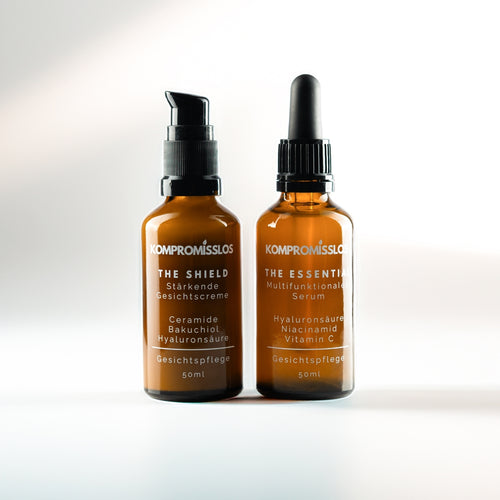
The principle of moisture underneath and lipids on top is also behind The Duo of serum and cream: hyaluronic acid in three molecular sizes in the serum, ceramide NP and squalane in the cream, morning and evening. The study results above apply to the creams tested there, not automatically to every product containing hyaluronic acid. What you leave out matters just as much: very hot water on your face, harsh cleansing and frequent exfoliation strip even more oil and water from the stratum corneum. If your skin feels tight all the time, flakes and barely responds even to rich creams, it is usually missing more than moisture. In that case, it is more useful to look at what very dry skin on the face needs.
Photograph the affected area in the morning before applying your skincare, always at the same window and at the same time of day. After two to three weeks, the photos will tell you more honestly than the mirror whether the lines have become fainter or whether you are looking at a true wrinkle.
What does moisturising do if it is a true wrinkle?
With a true wrinkle, moisturising can soften its appearance but cannot remove the wrinkle itself. The visible effect happens mainly at the surface: well-hydrated skin is plumper and reflects light more evenly, so the edges of a wrinkle look softer. A true wrinkle is often overlaid by a network of dehydration lines that makes it look deeper than it is. That part can be reduced quite well with moisture and lipids. The groove underneath remains. Which ingredients have evidence behind them for true wrinkles, and where every cream reaches its limit, is a topic of its own: whether anti-wrinkle creams actually work.
Looking ahead, one thing matters above all: consistent sun protection, because UV light is one of the main drivers of wrinkle formation. If you really want to change deep wrinkles, you will end up looking at aesthetic dermatology treatments. For that, a dermatologist is the right person to talk to, not the next shelf of creams.
Why are dehydration lines more common in winter?
Dehydration lines are more common in winter because cold air holds little water and central heating lowers indoor humidity even further. Your skin then loses more water to its surroundings than it can replenish from deeper layers. A review in the Journal of the European Academy of Dermatology and Venereology concludes that low humidity and low temperatures generally weaken the skin’s barrier function and make it more susceptible to mechanical stress. For dehydration lines, this means that switching between the cold bise wind outdoors and dry heated air indoors hits exactly the layer in which they form.
In winter it is therefore worth adjusting your skincare slightly rather than buying new products: apply a little more cream, stay consistent morning and evening, take shorter and less hot showers, and make sure heavily heated rooms do not get too dry. Over the years, the skin also produces fewer lipids of its own and holds on to moisture less well. How this shows up in everyday life is covered in the article on dry skin with age.
The serum contains hyaluronic acid in three molecular sizes, the cream ceramide NP and squalane. I chose this split deliberately: the serum brings moisture into the outermost layer of the skin, and the cream sits on top and helps to keep it there. Both are fragrance-free, because dry, irritated skin does not need fragrance. What I will not promise you, though, is that a true wrinkle will disappear. A line that stays when your face is relaxed will stay with the Duo, too. What can change is what sits on top of it: the fine lines that make your face look more tired. And because the cream contains no sun protection, you need a separate sunscreen during the day. You can find out what job each ingredient does in our active ingredients with disclosed concentrations.
Frequently asked questions
How quickly do dehydration lines go away?
Dehydration lines often become fainter shortly after moisturising, because the stratum corneum absorbs water quickly. To stop them coming back every evening, it usually takes a few weeks of consistent skincare morning and evening. If the lines are unchanged after that, you are more likely dealing with a true wrinkle.
Does hyaluronic acid help with dehydration lines?
Yes, hyaluronic acid can visibly soften dehydration lines because it binds water in the outermost layer of the skin. In a study in the Journal of Drugs in Dermatology, hyaluronic acid creams improved skin hydration and elasticity around the eyes. For the effect to last, you need a cream with lipids on top to slow evaporation.
Are dehydration lines a sign of skin ageing?
Not necessarily. Dehydration lines can appear at any age, for example after a winter’s day, a flight or overly harsh cleansing. They do become more common over the years, because the skin gets drier. On their own, though, they point to a lack of moisture rather than being a reliable sign of ageing.
Do home remedies help with dehydration lines?
Home remedies only help to a limited extent. A pure plant oil provides oil but no humectants, and masks made with quark or honey only work briefly. Your skin improves noticeably when moisture and barrier lipids come together and you repeat this every day. The most useful home remedies are really habits: washing with lukewarm rather than hot water and not letting heated indoor air get too dry.
Why do I see more fine lines in the morning?
Many people see more fine lines in the morning because their skin has lost water overnight in warm, dry indoor air. Pillow creases often add to this, and they smooth out on their own over the course of the morning. If the lines fade within an hour or two of moisturising, dryness was involved, not a new wrinkle.
Can dehydration lines turn into real wrinkles?
There is no solid evidence for this. True wrinkles develop over years in the dermis, mainly as a result of UV light, age and repeated facial expressions. Even so, a permanently dry, stressed skin barrier is not a good starting point. Consistent skincare and daily sun protection are therefore the most sensible precautions.
What can The Duo do for dehydration lines?
The Duo can soften the appearance of dehydration lines because it combines moisture with barrier lipids: hyaluronic acid in three molecular sizes in the serum, ceramide NP and squalane in the cream. This makes the skin look plumper and suppler. True wrinkles remain; at most, they look softer. You can see how the two steps work together in The Duo in detail.
Sources
- Sato J, Yanai M, Hirao T, Denda M. Water content and thickness of the stratum corneum contribute to skin surface morphology. Archives of Dermatological Research, 2000. Source
- Ha RY, Nojima K, Adams WP Jr, Brown SA. Analysis of facial skin thickness: defining the relative thickness index. Plastic and Reconstructive Surgery, 2005. Source
- Pavicic T, Gauglitz GG, Lersch P, Schwach-Abdellaoui K, Malle B, Korting HC, et al. Efficacy of cream-based novel formulations of hyaluronic acid of different molecular weights in anti-wrinkle treatment. Journal of Drugs in Dermatology, 2011. Source
- Engebretsen KA, Johansen JD, Kezic S, Linneberg A, Thyssen JP. The effect of environmental humidity and temperature on skin barrier function and dermatitis. Journal of the European Academy of Dermatology and Venereology, 2016. Source