Crow’s feet: what causes them, what helps and what skincare can really do
SKIN OVER 40
What helps most with crow’s feet is anything that slows down the cause: daily sunscreen, sunglasses so you squint less, and skincare that uses moisture to make fine lines look softer. Crow’s feet form through the repeated movement of the ring-shaped muscle around the eye, made worse by UV light and the loss of firmness that comes with age. A cream can soften how they look, but the expression line itself stays. Only a doctor can smooth them out noticeably, for example with botulinum toxin.
What are crow’s feet, and why do they form at the outer corner of the eye?
Crow’s feet are fan-shaped lines at the outer corner of the eye, caused by the repeated contraction of the ring-shaped muscle around the eye. This muscle, known medically as the orbicularis oculi, encircles the eye like a ring and is closely attached to the skin above it. When it contracts, it pushes the skin sideways into folds that radiate out from the eye. As long as the skin is elastic, these lines disappear again as soon as the face relaxes. Over the years, the skin loses its ability to spring back, and a line that only appeared with movement becomes one that stays even when your face is at rest. There are several reasons why the corner of the eye is affected so early: the skin there is thin, has few sebaceous glands, is folded every time you smile and is exposed to light without any protection.
Crow’s feet do not look the same on everyone, either. A review in the Aesthetic Surgery Journal, which analyses the major approval studies on crow’s feet, distinguishes four different patterns in how the lines are distributed around the corner of the eye. In some people, the lines fan out across the whole corner of the eye; in others, they cluster more above or below it.
What role do laughing, blinking and squinting play?
Laughing and squinting are the real triggers of crow’s feet, which is why they are also known as laughter lines. What matters is not so much normal blinking, which only closes the eyelids, as the strong contraction that comes with a genuine smile, with looking into bright light or with reading without the right glasses. In those moments, the outer part of the ring muscle works particularly hard, and it always folds the skin in the same places. This is not a bad habit you need to train yourself out of. Laughing is part of your face, and crow’s feet are visible traces of expression. What you can influence are the avoidable triggers: bright light without sunglasses, screen work with text that is too small, or a glasses prescription that is out of date.
On top of this comes an amplifier that is often underestimated. If the outermost layer of skin is dry, it forms additional fine creases when you smile, and these sit on top of the actual expression line. The crow’s feet then look deeper and more numerous than they really are. This is the part that skincare changes fastest, and it is exactly why it pays to tell dryness and real wrinkles apart before you spend money on new products.
Why does UV light make crow’s feet deeper than age alone?
UV light makes crow’s feet deeper because it breaks down the connective tissue in the dermis faster than age alone would. UVA radiation penetrates as far as the dermis, where it damages the collagen and elastin fibres that give the skin its firmness. Without this firmness, folded skin smooths out more slowly after a smile and eventually not at all. A study in the journal Clinical, Cosmetic and Investigational Dermatology compared 298 women aged between 30 and 78 who either sought out the sun or avoided it. Crow’s feet were among the 18 of the 22 signs of ageing examined that the team classified as particularly strongly influenced by UV exposure. The researchers concluded that UV light appears to be responsible for 80 per cent of visible signs of ageing on the face.
At the corner of the eye, the sun has a double effect: it hits thin skin directly, and it makes you squint. If you spend a lot of time outdoors – doing sport, in the mountains or on the water – you fold the skin most strongly at exactly the moment it is getting the most radiation. Age determines that crow’s feet will come. How deep they become depends to a large extent on the sun.
What can a cream realistically do for crow’s feet?
A cream can make crow’s feet look softer and less noticeable, but it cannot smooth away an expression line. The biggest and fastest effect comes from moisture: a well-hydrated outer layer of skin is plumper, the fine creases around the actual line recede, and light is reflected more evenly. You will see this difference relatively quickly, but it only lasts as long as you keep up your skincare. Over a period of months, well-researched active ingredients can also improve the texture of the skin. Even so, they make only a limited difference to the line that the muscle creates afresh every day. A line that is deeply etched into your face at rest will remain visible, whatever skincare you use.
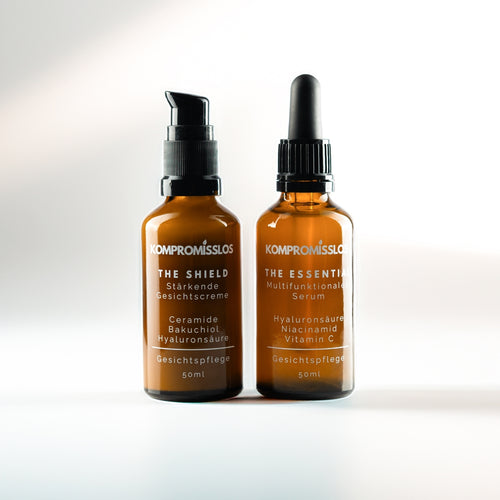
Nicole B. describes what a realistic expectation sounds like in her review on Judge.me: ‘The lines don’t go away, which isn’t the idea anyway […], but the overall expression becomes softer’ (review translated from German). That is the framework skincare works within. The Duo serum and cream relies on two layers for this: The Essential serum with niacinamide and hyaluronic acid in three molecular sizes for moisture (5% niacinamide in The Duo as a whole), followed by The Shield cream with ceramide NP, bakuchiol and squalane, which supports the skin barrier. Neither product contains a sun protection factor, so a separate sunscreen is part of your daytime routine.
Which active ingredients are proven for the corners of the eyes, and what can the skin there tolerate?
For fine lines at the corners of the eyes, the same groups of active ingredients have evidence behind them as for the rest of the face; the real question in this area is how well your skin tolerates them. Retinoids have the strongest evidence, but they quickly irritate the thin skin at the side of the eye, causing flaking, redness and burning. Bakuchiol is a serious alternative here. In a randomised, double-blind study in the British Journal of Dermatology with 44 participants, both 0.5 per cent bakuchiol twice daily and 0.5 per cent retinol once daily reduced wrinkle surface area after twelve weeks, with no statistical difference between the two. The retinol group, however, reported flaking and burning more often. A separate article explains in detail what bakuchiol does for your skin. Humectants such as hyaluronic acid and glycerin, as well as barrier ingredients such as ceramides and squalane, are usually well tolerated in this area and deliver the quickly visible part. For the bigger picture, there is an overview of which anti-wrinkle ingredients are actually proven. For the corner of the eye, three simple rules apply:
- Introduce retinoids slowly: at first only on a few evenings a week, and keep them well away from the edge of the eyelid.
- Only one new active ingredient at a time: that way, if your skin reacts, you know what caused it.
- Take reactions seriously: burning, flaking or swollen eyelids are a reason to take a break, not to push through. If swelling does not go down or the eyes themselves are affected, see a doctor.
When do sunglasses and sunscreen do more than any cream?
Sunglasses and sunscreen always do more than any cream when the aim is to stop crow’s feet getting deeper. A cream improves what is already there; sunscreen slows down what is still to come. This is shown by a randomised study in the journal Annals of Internal Medicine with 903 adults under the age of 55: the group that applied a broad-spectrum sunscreen every day showed no detectable increase in skin ageing after 4.5 years, measured by the fine texture of the skin’s surface. Compared with the group that used sunscreen only at their own discretion, skin ageing was 24 per cent lower.
At the corner of the eye, sunglasses have a double effect. They keep radiation away from the thin skin, and they take away the reason to squint against bright light. We are not aware of any study that has measured the effect of sunglasses directly on crow’s feet. The logic behind it, however, is the same as with sunscreen: less radiation and less squinting. A well-fitting pair with wide arms also covers the area at the side of the eye. The sunscreen itself should go right up to the bony rim around the eye. The article on sunscreen for your face when your skincare has no SPF explains which sunscreen suits you and how to layer it over serum and cream.
Think of the mountains in winter: snow reflects UV light, and bright snow is exactly where you squint the hardest. Your sunglasses belong in your rucksack just as much as your sunscreen does.
What can Botox and other treatments do, and when is it no longer a skincare issue?
Botulinum toxin smooths crow’s feet most directly because it temporarily switches off the cause: muscle movement. It is injected into the outer part of the ring muscle around the eye and relaxes it; the effect wears off again after a few months. A review in the Aesthetic Surgery Journal summarises two randomised phase 3 studies with a total of 1,362 participants: after 30 days, significantly more people responded to the treatment than to placebo. The only side effect reported in at least 1 per cent of those treated was swelling of the eyelid. This is a medical procedure using a medicinal product, and it belongs in the hands of a dermatologist or a suitably trained doctor. The same goes for lasers, chemical peels or fillers: you weigh up the benefits and risks at a specialist clinic, not in the chemist’s aisle. Incidentally, creams that advertise a Botox effect contain no botulinum toxin; the article on what so-called botox creams can really do explains what is behind them.
It stops being a skincare issue when a deep line in your face at rest bothers you and you genuinely want it smoothed out. That is a perfectly legitimate decision, but not one a cream can make for you.
| Approach | Targets | What is realistic | Limit |
|---|---|---|---|
| Moisturising skincare | A dry outer layer of skin | Fine creases recede, the line looks softer | Only lasts as long as you keep using it |
| Retinoid or bakuchiol | Skin texture over months | Fine lines can look shallower | The expression line stays; watch tolerability near the eye |
| Sunscreen and sunglasses | UV damage and squinting | Slows down lines getting deeper | Does not smooth existing lines |
| Botulinum toxin | Muscle movement | Lines smooth out noticeably, but only temporarily | Medical procedure, has to be repeated |
I deliberately do not sell an eye cream or a sunscreen – two products instead of eight. For crow’s feet, the honest consequence is this: against lines that are getting deeper, a separate sunscreen matters more than anything I could put into a cream, because The Shield contains no SPF. In the cream, I chose bakuchiol instead of retinol, because in the comparison study retinol led to flaking and burning more often, and I wanted skincare that is also designed for sensitive skin. That will not smooth out an expression line, and I do not promise that it will. What The Duo can do is provide moisture and support the skin barrier so that fine lines look softer. I disclose which active ingredients it contains and in what concentrations.
Frequently asked questions
At what age do you get crow’s feet?
There is no fixed age. The lines at the corner of the eye show up when you smile even at a young age, while for many people they only stay visible in a relaxed face later on. Exactly when depends heavily on sun exposure, skin type and facial expression. Crow’s feet at 30 are therefore normal and not a sign that your skincare has failed. Above all, they show that you laugh and spend a lot of time outdoors.
Can you get rid of crow’s feet?
You cannot get rid of established crow’s feet completely with skincare. Fine lines caused by dryness can be softened considerably, while the expression line itself will at most look softer. A doctor can smooth it out temporarily with botulinum toxin. What is in your own hands is the pace: with daily sunscreen and sunglasses, the lines deepen more slowly.
Are crow’s feet just dehydration lines?
No, crow’s feet are expression lines caused by the work of the ring muscle around the eye. Dryness can, however, make them look much more pronounced, because fine creases settle over the actual line. A simple test helps you tell dehydration lines apart from real wrinkles, so you know how much skincare can actually do in your case.
Does eye cream help with crow’s feet?
For crow’s feet, an eye cream does not work fundamentally differently from a well-tolerated facial skincare product with the same active ingredients; what matters is the ingredients and how well your skin tolerates them, not the label. Whether a separate eye product is worth it depends mainly on how the skin around your eyes reacts to your facial skincare; more on this in the article on whether you really need an eye cream.
Does retinol help with crow’s feet?
Retinol is one of the best-researched active ingredients for fine lines and, over a period of months, can make them look shallower at the corner of the eye too. The thin skin there, however, quickly reacts with flaking and burning. So start with a low strength, on a few evenings only, and keep it away from the eyelid. If retinol does not agree with your skin, bakuchiol is a gentler alternative that performed similarly well in a comparison study.
Can I prevent crow’s feet with face yoga?
So far, there is hardly any solid evidence for this. Crow’s feet are caused precisely by the work of a muscle, and there is no evidence that extra training of the ring muscle around the eye smooths them out. Face yoga can feel good and help you relax. For prevention, however, sunscreen and sunglasses are far better supported.
What can The Duo do for crow’s feet, and what can’t it do?
The Duo is a facial skincare set made up of a serum and a cream: it provides moisture and supports the skin barrier so that fine lines look softer. It does not smooth out an expression line, and because it contains no sun protection factor, you also need sunscreen during the day. For the sensitive area right next to the eye, the answer on eye cream above applies.
Sources
- Flament F, Bazin R, Laquieze S, Rubert V, Simonpietri E, Piot B. Effect of the sun on visible clinical signs of aging in Caucasian skin. Clinical, Cosmetic and Investigational Dermatology, 2013. Source
- Dhaliwal S, Rybak I, Ellis SR, Notay M, Trivedi M, Burney W, et al. Prospective, randomized, double-blind assessment of topical bakuchiol and retinol for facial photoageing. British Journal of Dermatology, 2019. Source
- Hughes MC, Williams GM, Baker P, Green AC. Sunscreen and prevention of skin aging: a randomized trial. Annals of Internal Medicine, 2013. Source
- Carruthers A, Bruce S, Cox SE, Kane MA, Lee E, Gallagher CJ. OnabotulinumtoxinA for Treatment of Moderate to Severe Crow's Feet Lines: A Review. Aesthetic Surgery Journal, 2016. Source