Eye cream: do you really need one, or is your facial skincare enough?
SKIN CONDITION
Do you need an eye cream? Not necessarily. For most people, a well-tolerated facial skincare product, applied carefully up to the bony edge of the eye socket, is enough. A separate eye product is mainly worth it if your facial skincare irritates the area, is heavily fragranced or has a texture that migrates into your eyes.
What is the difference between an eye cream and a face cream?
In most cases, an eye cream is a face cream with less fragrance and a lighter formula, in a smaller jar. There is no protected definition of what makes a product an eye cream. Each brand decides for itself whether to call a cream that. Three adjustments are typical: little or no fragrance, a lower concentration of potentially irritating active ingredients and a texture that does not creep into the tear film. Good facial skincare can meet all three criteria just as well. If your cream is already fragrance-free and gently formulated, it does the same job around the eyes as a product with an eye label. The difference then lies mainly in the price per millilitre, because small containers are more expensive to produce. If you already have a routine your skin tolerates, an extra eye cream often means buying another product whose contents are very close to what is already in your bathroom.
| Feature | Typical eye cream | Gentle facial skincare |
|---|---|---|
| Fragrance | Usually reduced or left out. | Present or not, depending on the brand. |
| Texture | Light to medium-rich, so that nothing creeps into the eye. | From very light to very rich. |
| Concentration of active ingredients | Often lower than the facial skincare in the same range. | Depends on the formula. |
| Container | Small, usually a higher price per millilitre. | Larger, usually cheaper per millilitre. |
| Area of use | Only up to the edge of the eye socket. | The whole face up to the edge of the eye socket. |
Separating the two makes sense where the requirements differ: with heavily scented night creams, very heavy textures and high-dose acids. How serum and cream work together matters more than the number of jars.
Is the skin around the eyes really thinner?
Yes, the skin of the eyelid is the thinnest on the face, but the reason lies deeper than advertising suggests. In a measurement of 39 areas of the face published in the Aesthetic Surgery Journal, the dermis was thinnest on the upper inner eyelid at around 759 micrometres and thickest on the lower side of the nose at around 1969 micrometres. The epidermis, on the other hand, was not at its thinnest on the eyelid. So the difference arises mainly in the dermis underneath, not in the outer protective layer. In practice, this means the barrier on the eyelid is not dramatically weaker than on the cheek, but the tissue underneath is less cushioned. That is why blood vessels, swelling and expression lines show there earlier. Less follows from this for skincare than is often claimed. It argues for restraint with fragrance and quantity, not automatically for a second product.
There is also a second finding that is rarely mentioned. A study in the Journal of Craniofacial Surgery of 61 women found no significant decrease in eyelid skin thickness with age, averaging around 860 micrometres across all age groups. What changes is rather the elasticity and the volume underneath. You can read more about how to recognise a weakened skin barrier in a separate article.
When is a separate eye product worth it?
A separate eye product is worth it if your existing skincare causes problems around the eyes or never gets there in the first place. Three situations speak in its favour. First: your facial skincare is fragranced or contains essential oils, and your eyes sting or water after you apply it. Second: the texture is so oily or so runny that it migrates into the tear film overnight and blurs your vision in the morning. Third: you use high-dose acids or retinoids that you do not want on your eyelids, and you need something gentle there instead. If none of these three situations applies, a fourth product is not progress but just another variable in a routine that already works. Even the most expensive eye cream can do little cosmetically about inherited shadows or the shape of the tear trough. That is not a formulation problem but a question of anatomy.
An enquiry from our inbox illustrates this. A customer wrote that she had been using an expensive eye cream for years and wondered why her eyelids still felt tight in the morning. In the course of our exchange it turned out that she was dabbing the eye cream very sparingly on the eyelid and, to be on the safe side, stopping her regular facial skincare well short of the eye. The dry strip lay exactly in between, on the edge of the eye socket, where no product reached. The issue was not a missing specialist product but a gap in how the products were applied. With sensitive skin in particular, what you leave out matters more.
What is enough around the eyes instead?
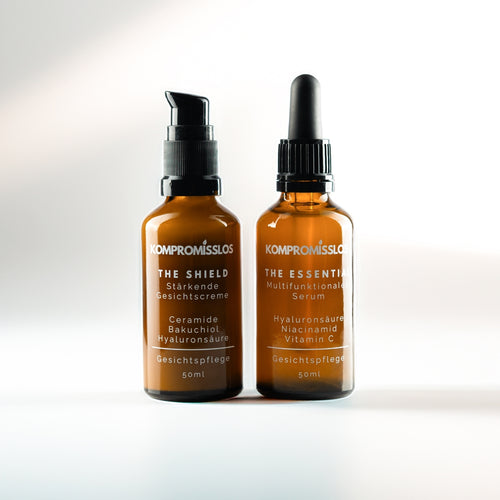
Around the eyes, your usual facial skincare is enough in most cases, used sparingly and applied up to the bony edge of the eye socket. That is the ridge you can feel when you run your finger from your cheekbone towards your eye. Skincare can go that far, but no further. Leave the mobile eyelid and the lash line free, because product migrates from there into the tear film when you blink. For both eyes together, use about as much as sticks to the tip of your ring finger, and pat it on rather than rubbing. Kompromisslos deliberately has no eye product in its range. The Duo, made up of The Essential serum and The Shield cream, is facial skincare for CHF 109.90 and is not marketed as eye care. How to apply serum and cream properly morning and evening is explained in the instructions for use. Only one additional rule applies to the eye area: use less, and keep more distance from the edge of the eyelid.
You do not need a separate eye product if your skincare is fragrance-free, does not sting and does not end up in your eyes in the morning. In that case, the extra tube only costs you money.
What should you look out for in terms of tolerance around the eyes?
Around the eyes, look out first for fragrances, essential oils and high-dose acids, because these three cause most reactions. Fragrances are the most common trigger of contact reactions in cosmetics, and the skin of the eyelid is where this shows up fastest: with stinging, redness or fine flaking at the edge of the eyelid. So test a new product for a few days at the outer corner of your eye before using it more widely. If you wear contact lenses, only put them in once your skincare has been absorbed. Avoid pulling movements, because the tissue there has little support. And only ever change one product at a time, otherwise you will not know what caused a reaction. These rules apply regardless of age and are part of any routine for mature skin. They will spare you most expensive mistakes.
When a professional is the better port of call
Anything that appears suddenly, stays on one side or affects your vision is a matter for a professional. Cosmetics care for the skin and influence how it looks; they do not replace a medical check. An ophthalmologist or a dermatologist is the right person to see if you have swelling that affects only one eye, weeping or very itchy eyelid margins, a hard lump on the eyelid, persistently red, burning eyes or any change in the sharpness of your vision. Recurring eczema around the eyes should also be checked, because it may be caused by a contact allergy that can only be identified through a test. The same applies if swelling regularly persists beyond the morning. In such cases, an eye cream is not a stopgap; it only delays the appointment that is due anyway. Cosmetics may care for the skin around the eyes and keep it supple. Anything that looks like inflammation, infection or a problem with your eyesight belongs in professional hands – sooner rather than later.
I deliberately did not develop an eye cream. When I was building Kompromisslos, the question came up of whether a third product would make the range stronger. When I worked through the formulation, the answer was sobering: what would have gone into an eye cream from me is already in The Shield cream, just in a smaller jar at a higher price per millilitre. I would rather sell two products you really need than three, one of which mainly fills a gap in the range. If a dedicated eye product is important to you, another brand is the more honest choice for you. What I can offer is two steps designed to work together instead of four half-hearted ones.
Frequently asked questions
Do I need an eye cream from 40?
No, age alone is not a reason for a separate eye product. What matters is how well your existing skincare is tolerated around the eyes. If it does not irritate the area and does not migrate into your eyes, you can keep using it up to the edge of the eye socket. An eye cream does not suddenly become necessary at 40.
Does an eye cream help with dark circles?
Only to a limited extent. Dark shadows are usually caused by blood vessels showing through, by pigment or by the shape of the tear trough, and cosmetics change little about that. Well-tolerated skincare can make the skin look smoother and so soften their appearance a little. If you expect a marked change, every product will disappoint you.
Can I use my normal face cream around my eyes?
In most cases, yes, provided it is fragrance-free and gently formulated. Apply it sparingly up to the bony edge of the eye socket and leave the mobile eyelid and the lash line free. If it stings, makes your eyes water or blurs your vision in the morning, it is not suitable for this area.
What do eye cream tests really tell you?
A product test usually compares the ingredient declaration, contaminant analysis and how a selection of products feels in use at a given date. That is useful for a shortlist, but it tells you nothing about how your skin will react. Tolerance cannot be read from a table; it only shows after a few days around your own eyes.
When should I start using eye care?
As soon as you use any facial skincare at all, because the area up to the edge of the eye socket is simply cared for along with the rest. There is no separate starting point for eye care. Consistent sun protection makes more sense than buying a product early, because UV radiation has the greatest influence on visible skin ageing around the eyes.
Does an eye cream help with morning puffiness?
Hardly. Morning puffiness is caused by fluid that remains in the tissue overnight, and it usually redistributes itself. Cold and sleeping with your head raised work faster than any product. If the puffiness persists beyond the morning or affects only one eye, it should be checked.