Dry, flaky eyelids: why they happen and what the skin tolerates
SKIN PROBLEMS
Dry, flaky eyelids usually happen because eyelid skin is very thin, produces hardly any oil of its own and catches everything that fingers, make-up, make-up removers and facial skincare carry there. If your lids feel only slightly tight and flake finely, leaving things out often helps: removing make-up more gently, no new products, and a little fragrance-free skincare. If they are red, itchy or burning, or the problem keeps coming back, eyelid eczema or a contact allergy is often behind it. That calls for a doctor, not another cream.
Why do eyelids get dry and flaky so easily?
Eyelids become dry and flaky more quickly than the rest of the face because their skin is particularly thin and has almost no oils of its own on the surface. A measurement study in Skin Research and Technology compared the upper eyelids of 22 healthy adults with their cheeks and noses. The eyelid skin had extremely low levels of surface lipids, yet still kept its moisture at the same level as the neighbouring skin, thanks to remarkably large cells in the outermost layer that hold water well. So the system works – as long as nothing gets in the way. But because there is no sebum to act as a buffer, it takes very little to tip the balance: dry heated air, cold wind, frequent rubbing, overly harsh cleansing or a new product. On top of that comes the constant movement of blinking, which makes every fine flake in the eyelid crease visible.
An analysis in the Journal of Clinical Medicine describes eyelid skin as the thinnest skin on the body (0.55 millimetres), with a highly hydrated outer layer. That is precisely what makes it easier for substances that come into contact with the lid to penetrate. If, on the other hand, the sides of your nose, your eyebrows or your cheeks are flaking too, that points more towards dry patches on your face than to a problem with the eyelids alone.
Which products most often cause dry eyelids?
Among the most common triggers of dry, irritated eyelids are fragrances, preservatives, metals such as nickel, and nail polish – and they often reach the lid not via eye products but via your hands, hair and face. An analysis in Contact Dermatitis looked at 1,215 patients who had an allergy test on the skin over a ten-year period. Of the 105 people with eyelid eczema, 43.8 per cent had allergic contact dermatitis and 36.2 per cent had seborrhoeic dermatitis. The authors name fragrances, metals, the antibiotic neomycin, preservatives such as benzalkonium chloride, and tosylamide formaldehyde resin – a well-known component of some nail polishes – as common triggers. The study in the Journal of Clinical Medicine, covering 7,955 people tested over 25 years, found an eyelid contact allergy in 4.6 per cent of them; 88.6 per cent of those affected were women. The most common allergen was nickel sulphate (54 per cent). The authors suggest that the rise in nickel cases over the years is probably down to electronic devices and hand-to-eye contact.
- Nail polish and artificial nails: your fingers touch your eyelids more often than you think, while the nails themselves usually look perfectly normal.
- Fragrances from facial skincare, shampoo, hairspray or perfume that reach the lids in the shower or via your pillow.
- Preservatives in make-up remover wipes, eye drops or micellar water that is not rinsed off.
- Metals such as nickel, for example from an eyelash curler or from fingers that have just touched devices and keys.
- New eye products: mascara, eyeshadow, lash serum or a newly bought eye cream.
One important point: the eyelids often react to something the rest of your skin tolerates without any problem. If you want to rule out fragrance as a possible trigger, it is worth taking a close look at what fragrance-free really guarantees on a label.
How can you tell whether it is dryness or eyelid eczema?
Simple dryness feels tight and rough and flakes finely, but is hardly red and improves within a few days once you leave out whatever is irritating it. Eyelid eczema, by contrast, is visibly red, itches or burns, can swell, weep or thicken over time, and keeps coming back. Various skin conditions can lie behind eyelid eczema: a contact allergy, seborrhoeic dermatitis, atopic eczema, ocular rosacea or psoriasis. In the Contact Dermatitis study, seborrhoeic dermatitis was actually the most common diagnosis among people affected only on the eyelids, at 46.3 per cent. Which of these it is cannot be reliably judged from the outside, and the treatment differs considerably. There is also a third possibility that many people confuse with dry eyelids: dry eyes. In that case, the problem lies in the tear film, not in the skin.
| Feature | More likely dry eyelid skin | More likely eyelid eczema or contact allergy | More likely dry eyes |
|---|---|---|---|
| Main sensation | Tightness, roughness | Itching, burning | Burning, gritty feeling in the eye |
| Appearance | Fine flakes, hardly any redness | Redness, swelling, possibly weeping or thickened skin | Skin looks normal, eye red or watery |
| Course | Improves after a few days without irritants | Keeps coming back, often with a delay after contact | Worse with screens, heated air and wind |
| Who to see | Leave things out, keep skincare simple | Dermatologist | Eye doctor (ophthalmologist) |
What helps dry eyelids, and which skincare does eyelid skin tolerate?
What eyelid skin tolerates best is very little: a few familiar, fragrance-free products, applied sparingly and without rubbing. So the first step is not a new product but a break. For two weeks, leave out everything you have introduced recently, including lash serum and nail polish, and wear as little eye make-up as possible during that time. Apply your facial skincare around the eye only up to the bony rim, meaning below the eyebrow and on the cheekbone. The lid itself often needs nothing extra. If it still feels tight, a trace of a simple, fragrance-free product is enough, patted on with your ring finger and kept a little away from the lash line. An anonymous review of The Duo on Judge.me also shows how sensitive this area is: “nice feel on the skin, but watch out for hypersensitivity on the eyelids” (review translated from German). So even a facial skincare product that your skin tolerates well does not necessarily belong on the lid itself.
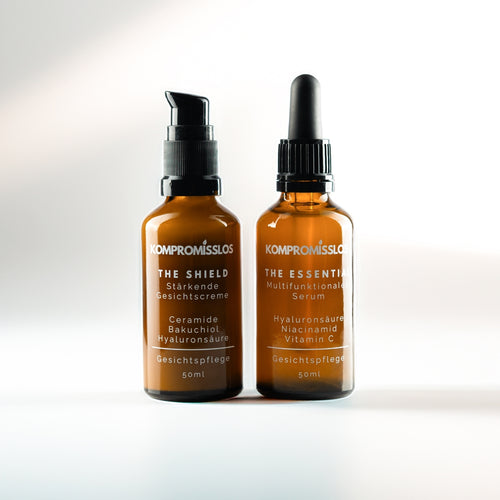
For the skin around the eyes, the same rules apply as for caring for sensitive skin in general: fewer active ingredients at once, no fragrance, no essential oils. The Duo of serum and face cream is built this way: fragrance-free, without essential oils, with Ceramide NP and squalane in the cream and hyaluronic acid in both products. That means there is no need for a third product around the eyes with its own list of auxiliary ingredients. When a separate eye product is still worth it is covered in the article on whether you really need an eye cream. If it is not just your lids but your whole face that feels tight after every cleanse, it is worth looking at how to recognise a damaged skin barrier.
Never get skincare on the edge of the lid or in your eye. And if you rub your eyes during the day, wash your hands first. With nickel and nail polish in particular, your finger is often what actually carries the trigger to the lid.
How do you remove eye make-up without drying out your eyelids?
To remove eye make-up gently, soak rather than scrub, use just one mild product and rinse off any residue with water afterwards. Most problems are caused not by the make-up itself, but by the friction of taking it off and by remover residue that stays on the lid overnight. Waterproof mascara needs an oil-based or rich product, while regular mascara often comes off with lukewarm water and a mild facial cleanser. Make-up remover wipes are practical, but they leave preservatives and surfactants on the skin if you do not rinse afterwards.
- Soak a cotton pad in remover and leave it on the closed lid for 20 to 30 seconds.
- Wipe downwards in the direction of the lashes rather than rubbing from side to side.
- Rinse with lukewarm water so that no remover is left on the lid.
- Pat dry with a clean towel, and only then apply your facial skincare up to the bony rim.
If your eyelids are already irritated, an evening without eye make-up is often the quickest relief, because it spares you the removal step as well.
When should you see a dermatologist or eye doctor about dry eyelids?
You should see a dermatologist about dry eyelids if they are red, itchy, swollen or weeping, or if they do not settle after two weeks of leaving things out or keep coming back. At that point, it is no longer a question of skincare but of diagnosis. If a contact allergy is suspected, a patch test can show which substances you react to. Ideally, bring along the products you use around your eyes and on your hands, including your nail polish. You should see an eye doctor if the eye itself burns, waters or feels as though it is full of sand, if the edges of your lids are stuck together or if flakes form at the base of your lashes. This can point to dry eyes or inflammation of the lid margins (blepharitis), which are treated differently from dry eyelid skin. Pain in the eye, problems with your vision or severe, rapid swelling should be checked straight away.
I deliberately did not add an eye cream to our range. Not because eyelid skin does not matter, but because every additional product around the eyes brings another list of fragrances, preservatives and auxiliary ingredients – and the eyelids are often the first to react. That is why there are two products instead of eight, and why both are fragrance-free and free of essential oils. Here is the limit: no cream can diagnose a contact allergy. If your lids turn red, flake or itch, the only thing that helps is finding the trigger. That is why our complete list is openly available, so that you can check it against the results of an allergy test: all the ingredients in The Duo from A to Z. And even our skincare does not necessarily need to go on the lid itself.
Frequently asked questions
Can mascara or eyeshadow dry out your eyelids?
Yes, it can, but usually indirectly. The cause is often fragrance or preservatives in the product, residue left on overnight or rubbing when you take your make-up off. If your lids start flaking shortly after you begin using a new product, leave it out for two weeks. If nothing improves, or redness and itching appear, have it checked by a dermatologist.
Can nail polish cause dry eyelids?
Yes, nail polish is one of the known triggers of eyelid eczema. A resin found in some polishes can cause a contact allergy, and your fingers carry it to your lids when you rub them. Typically, the nails themselves look perfectly normal. If your lids flake every time you paint your nails, it is worth taking a break and having an allergy test done by a dermatologist.
Can I put Vaseline on dry eyelids?
Yes, pure petroleum jelly such as Vaseline is one of the simplest options for tight eyelids, because it contains no fragrance and forms a film that slows down water loss. Apply a very thin layer, ideally in the evening, and keep it away from the edge of the lid so that it does not get into your eye and blur your vision. For red, itchy eyelids, it is no substitute for getting them checked.
Are dry eyelids the same as dry eyes?
No. Dry eyelids affect the skin; dry eyes affect the tear film on the eye. With dry eyelid skin, the lid feels tight and flakes. With dry eyes, the eye burns, feels gritty or waters. The two can occur together, partly because eye drops containing preservatives can irritate eyelid skin. Dry eyes are a matter for an eye doctor.
Why are my eyelids drier in winter?
Because dry heated air, cold and wind draw more water out of eyelid skin, and it has hardly any sebum of its own to cushion this. On top of that, people often rub their eyes more and bring a new, richer skincare product into the bathroom. So in winter, less irritation tends to help more than an extra product.
How long does it take for dry eyelids to settle down?
Simple dryness usually feels noticeably calmer within a few days once the irritant is gone. With a contact allergy, things only improve once the trigger is consistently avoided, and it flares up again as soon as you use it again. If your eyelids have not calmed down after two weeks without new products, that is a clear sign to get them checked.
Can I use The Duo if I have dry eyelids?
Around the eyes, yes – on the facial skin up to the bony rim, but not in the eye and not on the edge of the lid. The Duo is fragrance-free and contains no essential oils, but it is no substitute for getting your lids checked. If they are red, flaky or itchy, find out what is behind it first, and leave out the lid itself until then.
Sources
- Pratchyapruit W, Kikuchi K, Gritiyarangasan P, Aiba S, Tagami H. Functional analyses of the eyelid skin constituting the most soft and smooth area on the face: contribution of its remarkably large superficial corneocytes to effective water-holding capacity of the stratum corneum. Skin Research and Technology, 2007. Source
- Amin KA, Belsito DV. The aetiology of eyelid dermatitis: a 10-year retrospective analysis. Contact Dermatitis, 2006. Source
- Rubegni G, Padula T, Calabrese L, D'Onghia M, Tognetti L, Cinotti E et al. Eyelid Contact Dermatitis: 25-Year Single-Center Retrospective Study. Journal of Clinical Medicine, 2025. Source