Droopy eyelids: what a cream can do and when it’s no longer a skin issue
SKIN OVER 40
A cream cannot lift droopy eyelids. What sinks on the upper lid is excess skin, a weakening lid-lifting muscle or a brow that has dropped, and all three lie beyond the reach of skincare. Good skincare can keep the very thin skin around the eye hydrated so that it looks smoother and less crêpey. If the lid hangs into your field of vision, drops suddenly or droops on one side only, it is no longer a skin issue but a matter for an ophthalmologist.
Can a cream tighten droopy eyelids?
No, no cream lifts a drooping upper eyelid, not even one marketed with words like “lifting” or “firming”. The reason lies in the anatomy: hooded eyelids develop because the eyelid skin becomes longer and slacker over the years, because the fatty tissue beneath it shifts, or because the muscle that lifts the lid loses its hold. A cream works in the uppermost layers of the skin. It can bind moisture, support the skin barrier and make fine lines look softer. What it cannot do is make excess skin disappear or tighten a loosened muscle attachment again. The “firmer” feeling many people notice after applying an eye cream is usually a brief tightening effect from film-forming ingredients, or a plumper, better-hydrated surface. That is pleasant, but it does not change how far the lid falls over your lashes. Whether you need a separate product for the eye area at all is a different question. We have looked at whether you really need an eye cream, and the short answer is: usually not.
Why do eyelids droop more with age?
Eyelids droop more with age because several tissues give way at the same time: the skin, the connective tissue, the lid muscle and the brow above. A review in the Arquivos Brasileiros de Oftalmologia describes dermatochalasis, meaning excess eyelid skin, as surplus skin pulled downwards by gravity, often accompanied by bulging fatty tissue. The tissue itself shows fewer elastic fibres and collagen bundles that lie further apart. The same review names so-called aponeurotic ptosis as the most common cause of a true drooping lid: the muscle that lifts the lid becomes thinner, loses tension or partly detaches from where it is anchored.
On top of that, eyelid skin has very little in reserve. In measurements at 15 sites on the face, published in Plastic and Reconstructive Surgery, the upper eyelid had the thinnest skin, while the tip of the nose was 3.30 times as thick. According to the review, part of this ageing is genetic, while another part is linked to sun exposure, smoking and lifestyle. That is why daily sunscreen for your face is one of the few levers you have in your own hands, for the eyelid skin too. The lids are only part of the picture, though: if what you notice is more like sagging skin and fading firmness across your whole face, the issue is volume and contours, not the lid.
Is it the eyelid skin, the brow or the lid itself – how can you tell?
You can roughly tell whether it is the eyelid skin, the brow or the lid itself that droops by asking three questions: is your lash line visible, does your brow sit lower than it used to, and does the picture change over the course of the day? This is no substitute for an examination, but it helps you ask the right question. With excess eyelid skin, a fold of skin lies over the eyelid crease, sometimes down onto the lashes, but the lid margin itself sits where it always has. With ptosis, by contrast, the lid margin drops and covers more of the pupil. If the brow droops, it pushes the skin of the upper lid down from above, and if you gently lift the brow back to its former position with a finger, most of the hooding disappears. Two or all three causes often occur together. If the lid sinks noticeably lower as the day goes on, that is not a skincare issue but a reason to get it checked by a doctor – more on that below.
| What droops | Typical sign | What skincare can do | Who can help |
|---|---|---|---|
| Eyelid skin (dermatochalasis) | A fold of skin rests on the eyelid crease or the lashes, lid margin normal | Make the skin look smoother and less crêpey | Ophthalmologist, eyelid surgeon |
| Lid margin (ptosis) | The lid margin covers more of the pupil, often with raised brows to compensate | Nothing for the muscle that lifts the lid | Ophthalmologist, promptly if it is new |
| Brow | The hooding disappears when you lift the brow | Nothing for the position of the brow | Ophthalmologist, plastic surgeon |
Do eye creams, eyelid tapes and eyelid exercises help with hooded eyelids?
With hooded eyelids, eye creams, eyelid tapes and eyelid exercises mainly change how the eye area looks for a few hours, not its anatomy. That is no reason to dismiss them, but it is a reason to put their promises into perspective. The best evidence exists for active ingredients against fine lines, and even there, it is about the surface of the skin. We have looked separately at which anti-wrinkle ingredients are actually proven. On the hooded lid itself, that ranking changes little.
- Eye creams: provide moisture, and some tighten briefly by leaving a film on the skin. The excess eyelid skin stays.
- Eyelid tapes or strips: lift the fold of skin mechanically for as long as they stick. On thin eyelid skin, the adhesive and frequent peeling off can cause irritation.
- Eyelid exercises and eye yoga: train the ring muscle around the eye, but there is no robust evidence for a measurably higher lid margin or less excess skin.
- Cooling or massage: can briefly ease morning puffiness, but does not lift the lid.
Face yoga and focused ultrasound devices are also marketed for hooded eyelids. They are no substitute for a medical assessment.
What can daily skincare realistically do for the eye area?
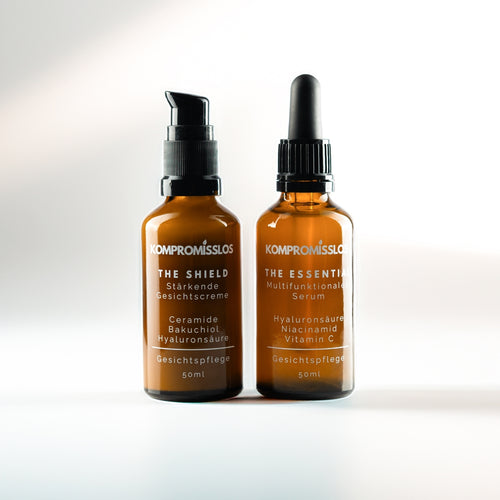
Realistically, daily skincare can make sure the thin skin of the eye area is well hydrated, less crêpey and more comfortable – no more and no less. Precisely because the skin there is so thin, dryness shows sooner, and part of what people perceive as “tired eyelids” is fine lines and dull, dry skin. We have explained separately how to tell dehydration lines around the eyes from real wrinkles. Humectants such as hyaluronic acid, barrier-related lipids such as ceramides and squalane, and a fragrance-free formula are sensible criteria here. That is exactly how The Duo of serum and cream is put together: hyaluronic acid in three molecular sizes in the serum, and ceramide NP, squalane and bakuchiol in the cream. According to the application instructions, you apply both to your face and neck; the moving eyelid itself is not covered there. A hooded lid will not get any smaller as a result. The skin around it can, however, look plumper and calmer. And if what bothers you under the eye is shadows rather than lines, it is worth looking into what causes dark circles.
Apply skincare around the eye sparingly with a light dabbing motion, and do not pull at the eyelid skin. If a product runs into your eyes or stings, using less or keeping a little more distance is usually a better solution than adding another product.
When are droopy eyelids a matter for an ophthalmologist or eyelid surgery?
Droopy eyelids are a matter for an ophthalmologist as soon as they restrict your field of vision, are new and progressing quickly, or come with other symptoms. A report by the American Academy of Ophthalmology concludes that surgical correction of ptosis and excess upper eyelid skin can markedly improve vision, peripheral vision and everyday activities. As indicators of a functional benefit, it lists, among other things, a loss of the upper visual field of at least 12 degrees or 24 per cent, difficulty reading, tilting the head back, and tired, strained eyes caused by the lids. A review in Community Eye Health states that any acquired ptosis should be examined by an ophthalmologist, and names warning signs that should not wait:
- One lid drops suddenly or noticeably within a few days.
- It comes with double vision, or one eye is positioned differently from the other.
- The drooping lid is accompanied by a sudden, severe headache on one side.
- The pupil on the affected side is visibly a different size from the other.
- The lids droop noticeably more in the evening than in the morning.
With the first three, get it checked by a doctor immediately; with the other two, promptly – not at your next routine appointment. In Switzerland, eyelid lifts, medically known as blepharoplasty, are mainly performed by ophthalmologists specialising in eyelid surgery and by plastic surgeons. Whether your health insurer pays depends on whether a functional impairment has been documented by a doctor, for example with a visual field test. A purely cosmetic correction is something you pay for yourself.
I deliberately do not sell an eye cream or make any firming promises. It would be easy to turn two products into three and put a little pot for the eyelids next to them. But it would not be honest: a drooping upper lid is anatomy, not a skincare problem, and I would rather say so openly than sell you hope. What I can offer is fragrance-free skincare for the skin on your face, with bakuchiol instead of retinol in the cream, because it is meant for sensitive skin too. The cream deliberately has no sun protection factor, which is why a separate sunscreen belongs in your daytime routine. The page on how to apply the serum and cream explains how to use both on your face and neck. We deliberately give no instructions there for the moving eyelid.
Frequently asked questions
At what age do eyelids start to droop?
There is no fixed age. A review of eyelid ageing describes drooping lids as a common change in middle and later adulthood. When they become visible depends on your predisposition, but also on sun exposure and smoking. That is why hooded eyelids appear early in some people and only late in others.
Does retinol help with hooded eyelids?
Retinol does not help with hooded eyelids, because it does not remove excess skin or tighten a muscle. In a study in the Archives of Dermatology, fine wrinkles on the arms of very elderly people were significantly reduced after 24 weeks with 0.4% retinol. That concerns the skin’s surface. Retinol can also irritate thin eyelid skin, so use it with care and keep it away from the lid margin.
Are hooded eyelids hereditary?
Partly, yes. According to a review of eyelid ageing, a genetic component is part of how the eyelids age, and studies in larger populations found a hereditary share alongside age. Whether and how strongly it shows also depends on smoking, body weight and sun exposure – factors you can partly influence.
Can eye yoga lift droopy eyelids?
There is no robust evidence that eye yoga genuinely lifts the eyelids. The exercises train the ring muscle around the eye, while the excess eyelid skin and a loosened lid-lifting muscle remain unaffected. If you enjoy the exercises, there is nothing wrong with them. Just do not expect a higher lid or a smaller fold of skin.
Does health insurance pay for an eyelid lift?
Only if it is medically justified. For that, an ophthalmologist has to document that the lid restricts your field of vision, for example with a visual field test. A purely cosmetic eyelid lift is something you pay for yourself. Whether you need cost approval before the procedure is best clarified directly with your insurer before your appointment.
Why does only one eyelid droop?
Slight differences between the two sides are normal and have often been there for a long time. But if one lid starts drooping, gets worse quickly or drops suddenly, it needs to be checked by a doctor, especially with double vision, headache or pupils of unequal size. A nerve or muscle may be affected, and that is not something for skincare products.
Can The Duo lift droopy eyelids?
No. The Duo does not tighten eyelids or lift hooded lids. The serum and cream hydrate the skin on your face and neck and support the skin barrier so that it looks plumper and smoother. We give no application instructions for the moving eyelid itself. We have deliberately kept the description of what The Duo can do for your face honest.
Sources
- Damasceno RW, Avgitidou G, Belfort R Jr, Dantas PE, Holbach LM, Heindl LM. Eyelid aging: pathophysiology and clinical management. Arquivos Brasileiros de Oftalmologia, 2015. Source
- Ha RY, Nojima K, Adams WP Jr, Brown SA. Analysis of facial skin thickness: defining the relative thickness index. Plastic and Reconstructive Surgery, 2005. Source
- Cahill KV, Bradley EA, Meyer DR, Custer PL, Holck DE, Marcet MM, et al. Functional indications for upper eyelid ptosis and blepharoplasty surgery: a report by the American Academy of Ophthalmology. Ophthalmology, 2011. Source
- Ogun O. Red flags in neuro-ophthalmology. Community Eye Health, 2016. Source
- Kafi R, Kwak HS, Schumacher WE, Cho S, Hanft VN, Hamilton TA, et al. Improvement of naturally aged skin with vitamin A (retinol). Archives of Dermatology, 2007. Source