Under-eye bags: causes, what helps and what cream really does
SKIN OVER 40
What helps with under-eye bags depends on which kind you have. If your eyes are mainly puffy in the morning and flatter again by midday, the cause is retained fluid: cooling, raising your head slightly at night, eating less salt in the evening and getting enough sleep make a visible difference here. If the bulge stays all day, usually from 40 onwards, it is a fat pad pushing forward. Neither cold nor cream helps with that – it can only be changed surgically.
What are under-eye bags, and how are they different from dark circles?
Under-eye bags are a bulge below the lower eyelid, whereas dark circles are a discolouration. That is the most important difference, because the two are often lumped together even though their causes are completely different. Beneath the eye, behind a thin layer of skin and muscle, lies a fat pad that cushions the eyeball in the bony eye socket. A layer of connective tissue, the septum, holds it in place. If this fat pushes forward, or the loose tissue above it retains water, the typical swelling appears. The best way to tell whether your problem is a bulge is to look at yourself in profile or to look at the area from below with a hand mirror: a swelling catches the light and casts a shadow, while pure discolouration stays flat. Both can occur at the same time, because a shadow often forms beneath a bulge and looks like a dark ring. If it is mainly the colour that bothers you, you are better off reading what causes dark circles under your eyes and what helps with dark circles under the eyes.
| Feature | Morning puffiness | Permanent under-eye bag | Dark circles |
|---|---|---|---|
| What you see | Soft, fairly even swelling | Clearly defined bulge, often with a groove beneath it | Dark, bluish or brownish discolouration |
| Cause | Fluid retained in the loose eyelid tissue | Fat pad pushing forward, tissue giving way | Blood vessels, pigment, shadow |
| Over the course of the day | Pronounced in the morning, much less in the afternoon | The same all day | Largely the same |
| What realistically helps | Cooling, raising your head, less salt, sleep | Only surgery changes the fat pad | Depending on the type, sun protection, skincare, concealer |
Why are under-eye bags worse in the morning and almost gone by the afternoon?
Under-eye bags are worse in the morning because fluid collects in the face while you are lying down, and the tissue under the eye takes up water particularly easily. During the day, when you are upright, gravity helps it drain away, and blinking and the movement of your facial muscles do the rest. That is why your face often looks noticeably fuller at seven in the morning than at two in the afternoon. The skin on the lower eyelid is thin and the tissue beneath it is loose, so fluid shows up here sooner than on the cheek. Several things make it worse: a salty dinner, crying the evening before, hay fever or an allergy, sleeping on your front with your face in the pillow, and a short night. For many people, alcohol the evening before plays a part too.
How clearly lack of sleep shows was measured in a study in the journal Sleep. Researchers at the Karolinska Institutet photographed ten people once after normal sleep and once after 31 hours awake, which followed a night of only five hours’ sleep. Forty raters judged the faces after sleep deprivation as having, among other things, more swollen eyes, darker circles under the eyes and droopier eyelids. The same faces looked less puffy after normal sleep: this kind of swelling is temporary and not a fat pad.
Why do under-eye bags become permanent after 40?
Under-eye bags become permanent over the years because the fat pad under the eye gains volume and bulges forward, while the skin and surrounding tissue give it less support. In many people, this becomes noticeable from their 40s. Exactly how this happens was disputed for a long time. A study in the journal Plastic and Reconstructive Surgery measured the eye sockets of 40 people aged between 12 and 80 using high-resolution magnetic resonance imaging. The soft tissue below the eyeball increased with age, and fat accounted for the largest share of that increase. The position of the eyeball itself remained unchanged across all age groups. The authors conclude that the lower eyelids bulge with age mainly because the fat expands, rather than because the eyeball sinks or the septum slackens.
It becomes even more visible because the surrounding area changes as well. The cheek loses fullness, creating a groove between the under-eye bag and the cheek that accentuates the bulge. At the same time, the skin loses elasticity. What happens with sagging skin on the face and why the skin on your face thins with age is covered in separate articles. In practice, this means that a permanent under-eye bag is not a skincare mistake but anatomy. In some people, this predisposition is visible even at a young age. Drooping upper eyelids, by the way, are a separate topic and have little to do with under-eye bags.
What do cooling, sleep and less salt do for puffy eyes?
Cooling, sleep and less salt help with morning puffiness, but not with the fat pad of a permanent under-eye bag. All of these measures target the fluid: they make sure that less fluid builds up overnight or that it drains away more quickly in the morning. If your eyes are barely puffy by two in the afternoon, they are worth the effort. If the bulge looks the same in the evening as in the morning, you are better off saving yourself the trouble.
- Cooling: a cold, damp flannel, a chilled spoon or a cool pack from the fridge for a few minutes. Never put ice directly on your skin – always use a cloth in between. You do not need the current trend of dunking your face in ice water for this.
- Raise your head slightly: an extra pillow or a slightly raised head end of the bed can stop so much fluid collecting in your face overnight. Sleeping on your back helps more than sleeping on your front.
- Less salt in the evening: salty ready meals, crisps or soy sauce late in the evening encourage fluid retention the next morning in many people.
- Get enough sleep, and keep to regular hours: as described above, lack of sleep makes the eye area visibly puffier.
- Don’t rub: rubbing irritates the loose tissue even further. If hay fever has you constantly rubbing your eyes, have the allergy checked by a doctor.
Gently smoothing the skin with your fingertips, from the inner corner outwards, can help the fluid drain away. Gua sha and rollers work in essentially the same way: their effect comes mainly from cold and light pressure, not from the tool.
Take two photos on the same day in the same light, one straight after getting up and one in the afternoon. If the swelling is clearly smaller in the afternoon, you can achieve a lot with cooling and sleep. If it looks the same, it is anatomy, and you can save yourself expensive remedies.
What can a cream do for under-eye bags, and what can’t it do?
A cream can moisturise the skin over under-eye bags and make it look smoother, but it does not change the fat pad underneath. No active ingredient applied to the skin reaches the fat behind the septum or makes it shrink. Even eye care with caffeine, which is often advertised for puffy eyes, can at best reduce morning puffiness briefly – it does not reach the fat pad. Honestly, that leaves skincare a modest but real role: dry, crêpey skin over a bulge makes it more noticeable. Well-cared-for skin shows fewer fine creases and reflects light more evenly.
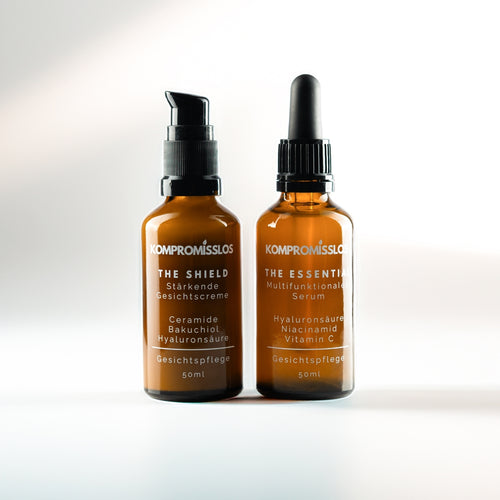
That is exactly where a simple routine comes in. In The Duo, The Essential provides the skin with hyaluronic acid in three molecular sizes and niacinamide, and on top of it The Shield supports the skin barrier with ceramide NP and squalane – both fragrance-free. According to the instructions, the serum and cream are worked in from the centre of the face outwards and down over the neck. You do not need a separate eye cream for this. Because UV radiation speeds up skin ageing around the eyes just as much as on the rest of the face, daily sunscreen for your face is part of the routine. If you want to change the fat pad itself, you end up looking at eyelid surgery: only an operation removes or repositions the fat. Whether that is an option for you is a matter for a conversation with a doctor, not for a skincare guide.
When should you see a doctor about puffy eyes?
Puffy eyes need to be seen by a doctor if the swelling is new, sudden, one-sided, painful or accompanied by other symptoms. A review in Current Opinion in Ophthalmology groups the causes of swelling around the eyes into infections, inflammation or tumours, side effects of medication, and the consequences of surgery or injury. Most under-eye bags are harmless, but in individual cases an allergy, an inflamed eyelid, a thyroid condition or a kidney problem may be behind them. Get checked if any of these signs apply:
- The swelling appears suddenly and on one side only.
- The eyelid is red, warm or painful, or you have a temperature.
- It itches badly, or the edge of the eyelid is red, flaky or crusted.
- You are seeing double or less clearly, or your eyes are visibly bulging.
- Your ankles or legs are swelling too, or you feel unusually tired and exhausted.
Your first port of call is your GP; for problems with your vision, bulging eyes or symptoms at the edge of the eyelid, go straight to an ophthalmologist. Skincare is no substitute for having this checked.
I deliberately did not add an eye cream to our range, even though it is considered a standard step in many routines. Two products instead of eight, both fragrance-free, so that they are well tolerated even by sensitive skin. But I also want to be clear with you about the limits: The Duo can do nothing about the fat pad of an under-eye bag. It moisturises the skin and supports the skin barrier, nothing more. And it contains no sun protection, so during the day you also need a separate SPF. If puffy eyes bother you in the morning, a cold flannel and a second pillow will do more than any additional product. How the serum and cream are meant to work and how to apply them is explained in the instructions for use.
Frequently asked questions
Can you get rid of under-eye bags without surgery?
You can noticeably reduce morning puffiness without surgery, but not the fat pad of a permanent under-eye bag. Cooling, a higher pillow, less salt in the evening and enough sleep work on the retained fluid. Fillers can even out the transition to the cheek, but they do not remove the fat pad. Whether that makes sense is best discussed with a doctor.
Are under-eye bags hereditary?
A tendency to under-eye bags can run in families. If you already have them at 20 or 25, even though you sleep well and eat little salt, it is often simply down to the anatomy of your eye area. With age, many people also see changes in the fat pad and connective tissue, regardless of their predisposition.
Does sleeping with your head raised help?
Yes, raising your head slightly can reduce morning puffiness, because less fluid collects in your face overnight. An extra flat pillow is usually enough. Your sleeping position has no effect on a permanent under-eye bag, however. For many people, sleeping on their front with their face in the pillow tends to make the swelling worse.
Do tea bags or cucumber slices help with under-eye bags?
Tea bags and cucumber slices help mainly because they are cold and moist. A chilled spoon or a cold flannel does the same job. For morning puffiness, that is a useful trick for a few minutes, but it does nothing for a fat pad. With tea bags, pay attention to hygiene and don’t let anything run into your eyes.
Why is only one of my eyes puffy?
Swelling on one side often has a harmless cause, such as the side you slept on or rubbing your eye. But it can also point to a stye, an inflamed eyelid, an allergy or an infection. If it comes on suddenly, hurts, is red or lasts longer than a day or two, have a doctor look at it.
Do I need an eye cream for under-eye bags?
No, an eye cream will not help with the fat pad of an under-eye bag either. Whether a separate eye product is worth it for other reasons is covered in the article on whether you really need an eye cream.
Does The Duo help with under-eye bags?
No, The Duo can do nothing about the fat pad of an under-eye bag, and morning puffiness responds better to cooling and sleep as well. What The Duo can do: moisturise the skin on your face and support the skin barrier so that it looks smoother. It does not contain sun protection.
Sources
- Darcy SJ, Miller TA, Goldberg RA, Villablanca JP, Demer JL, Rudkin GH. Magnetic resonance imaging characterization of orbital changes with age and associated contributions to lower eyelid prominence. Plastic and Reconstructive Surgery, 2008. Source
- Sundelin T, Lekander M, Kecklund G, Van Someren EJ, Olsson A, Axelsson J. Cues of fatigue: effects of sleep deprivation on facial appearance. Sleep, 2013. Source
- Sobel RK, Carter KD, Allen RC. Periorbital edema: a puzzle no more? Current Opinion in Ophthalmology, 2012. Source