Thin skin on the face: why it thins with age and what skincare can realistically do
SKIN OVER 40
Thin skin on the face develops mainly because skin loses collagen over the years, sunlight speeds up that loss and, in some cases, long-term use of cortisone adds to it. Skincare cannot fully reverse this. What it can realistically do is support the skin barrier, hold in moisture, avoid friction and irritation and – with daily sun protection – stop UV light from speeding up skin ageing even further. Anything a cream promises beyond that deserves a critical read.
Why does the skin on your face get thinner with age?
The skin on your face gets thinner with age because the dermis contains less collagen and the epidermis renews itself more slowly. Collagen is the scaffolding that gives skin its thickness and resilience. A classic study in the British Journal of Dermatology, which measured skin collagen and dermal thickness on the forearm in a large number of healthy people, found that collagen content falls with age and is lower in women than in men at every age. The same study showed a direct relationship between the amount of collagen and the thickness of the dermis. Less scaffolding, in other words, means less substance. On top of that, the outermost layer of skin renews itself more sluggishly as you get older – more on this in the article on skin cell turnover and why it slows with age.
The second major factor is UV light. Decades of unprotected sun exposure accelerate the breakdown of connective tissue, which is why the face, neck and backs of the hands usually start to look thin earlier than skin that rarely sees the sun. A third, often overlooked cause is medication: cortisone creams used over long periods and, in some people, cortisone taken as tablets. Genetics and smoking also play a part. What this means for you: you cannot change your age, but you can change how much sun your skin gets and how you handle medication.
How can you tell if you have thin skin?
You can tell you have thin skin when it looks more translucent, creases more quickly when you gently push it together and reacts more sensitively to friction, cold and products. Typical signs are fine veins showing through, a slightly shiny, almost papery look often described as parchment skin, and redness after things that never used to be a problem. Small scratches or bruises after the slightest knock are another sign, although they are less common on the face than on the forearms and backs of the hands. Many people first notice it when a familiar exfoliant suddenly starts to sting.
Two things are worth keeping separate. First, the skin under the eyes is considerably thinner than on the rest of the face in everyone; that is a topic of its own, covered in the article on what causes dark circles and what skincare can realistically do. Second, thin skin is not the same as a loss of firmness. If sagging contours are what bothers you most, take a look at sagging skin on the face. The two often occur together, but they have different causes and call for different realistic expectations.
Can thin skin become thicker again?
Skin that has thinned with age does not become thicker again through cosmetics, and any cream that promises exactly that is promising too much. Skincare works primarily at the surface: it binds water and replenishes the lipid layer, which makes skin look plumper and smoother. That is a visible but temporary effect, not a rebuilding of the dermis. What you can genuinely influence is the pace. Skin that is consistently protected from UV light has been shown to age more slowly. A randomised trial of 903 adults under the age of 55, published in the Annals of Internal Medicine, found no measurable increase in skin ageing after 4.5 years with daily use of a broad-spectrum sunscreen. Compared with the group that used sunscreen at their own discretion, skin ageing was 24 per cent lower.
The situation is different if the thinning has been caused by cortisone. Whether and how far it recedes depends on how long, how strong and where it was applied, and that belongs in a doctor’s hands. Medical treatment options do exist, but they are not a matter of skincare.
What skincare protects thin skin?
The best way to protect thin skin is with a few gentle products that support the barrier, plus daily sun protection. The thinner the skin, the less reserve it has against friction, water loss and irritating ingredients. So your skincare should not try to do as much as possible, but to get as little wrong as possible. Tried-and-tested choices are humectants such as hyaluronic acid, lipids similar to the skin’s own such as ceramides and squalane, and soothing ingredients such as panthenol. If tightness and flaking come on top of that, you will find the background in the article on dry skin with age.
- Cleanse with lukewarm water or a mild cleanser, without rubbing and without hot water.
- Use a light serum with humectants, followed by a cream with ceramides and lipids, morning and evening.
- Apply sunscreen as the last step during the day, even in winter and when it is cloudy.
- Choose products without fragrance or essential oils, because every extra irritation weighs more heavily on thin skin.
- Massage products in with light pressure from the centre of your face outwards, without rubbing or pulling.
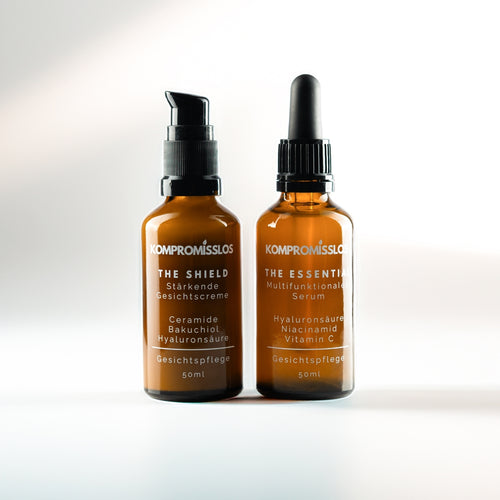
The Duo of serum and cream is built on exactly this principle: hyaluronic acid in the serum, ceramides, squalane and bakuchiol in the cream, plus panthenol in the Duo, all without fragrance. It does not contain sun protection, so you need that separately. Which sunscreen is suitable and how much to use is covered in the article on sunscreen for your face. In her review on Judge.me, Eveline writes: “Simple and effective for skin that reacts sensitively to products” (review translated from German). That is a personal experience, not proof of any effect on thin skin.
If you are older and wondering whether a serum is still worth it at all, read the article on serum over 70. It covers texture, quantity and when a cream on its own is enough.
Which active ingredients are too much for thin skin?
For thin skin, the main things that are too much are strong exfoliation, high-strength retinoids and fragrance, because they put extra strain on a barrier that is already stretched. That does not mean these ingredients are bad in principle. It means that a dose that works well on robust skin can quickly lead to redness, stinging and flaking on thin skin. What counts is the total: using an acid exfoliant, a retinol serum and a vitamin C booster at the same time is more likely to overwhelm thin skin than any one of these products on its own.
| Ingredient or habit | Why it is tricky for thin skin | Gentler alternative |
|---|---|---|
| High-strength retinol | Irritating, especially in the first few weeks, with redness and flaking | A low strength used infrequently, or bakuchiol |
| Fruit acid peels several times a week | Remove the outermost layer faster than it can grow back | Use them less often or leave them out altogether |
| Grainy scrubs and cleansing brushes | Friction on skin that has little cushioning | Cleansing with your hands |
| Fragrance and essential oils | An extra source of irritation with no skincare benefit | Fragrance-free products |
| Lots of alcohol denat. in toner | Strips oil and dries the skin out | No toner, or an alcohol-free one |
If a cream stings on thin skin, that is not a sign that it is working. Stop using the product, watch your skin for a few days and introduce new products one at a time, not three at once.
When should you see a doctor about thin skin?
You should see a doctor about thin skin if it tears after minor knocks, if bruises appear for no obvious reason, if wounds heal poorly or if the thinning began after cortisone treatment. Dermatologists at the University of Geneva have proposed the term dermatoporosis for this pronounced form of skin fragility, by analogy with osteoporosis. In their review in the journal Dermatology, they describe visible signs such as patchy bleeding into the skin in old age (senile purpura), star-shaped, scar-like white marks and skin atrophy, along with frequent skin tears and delayed wound healing after minor injuries. The authors stress that this makes skin ageing more than a cosmetic issue, because it affects the skin’s protective function.
You should also get medical advice if you have been using a cortisone cream on your face for months. A review in Drug Safety, also from Geneva, concludes that skin atrophy is caused more by chronic use of topical corticosteroids than by short courses of treatment. Even so, do not stop a prescribed medicine on your own. Your doctor can discuss the strength, duration and alternatives with you. Cosmetic skincare can accompany this, but it cannot replace it.
For The Shield, I deliberately chose bakuchiol rather than retinol. Retinol is well researched, but it often causes irritation, especially at the start, and skin that becomes thinner and more sensitive over the years has little reserve for that kind of settling-in phase. On top of that, there is panthenol in the Duo, an ingredient that stands for tolerability rather than quick results. We do not use fragrance at all. To be honest: none of these decisions will make your skin thicker. Bakuchiol is not retinol under another name, and a cream does not bring back lost collagen. What it can do is support the barrier and hold in moisture while causing as little irritation as possible. Exactly what goes into it is set out in our overview of all active ingredients with their concentrations disclosed. You apply sun protection separately, because the cream has no SPF.
Frequently asked questions
Does cortisone make your skin thinner?
Yes, cortisone can make your skin thinner, especially with long-term, regular use as an ointment or cream. Short courses of treatment are considered much less of a problem. The skin on the face is particularly susceptible. Even so, do not stop prescribed cortisone on your own, but discuss the duration and alternatives with your doctor.
Is retinol a good idea for thin skin?
Retinol is not off limits for thin skin, but it is often too irritating at first, so use it only at a low strength, infrequently and with plenty of patience. What is normal when it comes to redness and flaking, and when to stop, is covered in the article on retinol side effects.
Why do veins show through thin skin?
Veins show through thin skin because there is less tissue covering the blood vessels and the skin becomes more translucent. Often the veins are not new at all; they have simply become more visible. Permanently dilated vessels, on the other hand, are a separate topic – more on this in the article on couperose and broken capillaries.
Does sunscreen help with thin skin?
Sunscreen will not make thin skin thicker, but it does slow further damage from UV light. In a randomised trial in the Annals of Internal Medicine, the group using sunscreen every day showed no measurable increase in skin ageing after 4.5 years. That makes it one of the most effective steps you can take yourself.
Is exfoliating bad for thin skin?
Frequent exfoliation tends to do thin skin more harm than good, because it removes the protective outer layer faster than it grows back. Grainy scrubs and brushes add friction on top. If you do not want to give it up, keep it gentle and infrequent, and stop immediately if your skin stings or stays red.
How often should I moisturise thin skin?
You should moisturise thin skin morning and evening, and once more in between if it is very dry. Consistency matters more than frequency: the barrier benefits from daily care, not from a thick layer at the weekend. In the morning, always follow with sunscreen.
Is The Duo suitable for thin skin?
The Duo was developed for sensitive, dry and mature skin, which makes it a gentle choice for thin skin too: fragrance-free, with ceramides, squalane, panthenol and bakuchiol instead of retinol. It will not make your skin thicker. It supports the barrier and provides moisture. During the day, you also need sunscreen, because the Duo contains no SPF.
Sources
- Shuster S, Black MM, McVitie E. The influence of age and sex on skin thickness, skin collagen and density. British Journal of Dermatology, 1975. Source
- Hughes MC, Williams GM, Baker P, Green AC. Sunscreen and prevention of skin aging: a randomized trial. Annals of Internal Medicine, 2013. Source
- Kaya G, Saurat JH. Dermatoporosis: a chronic cutaneous insufficiency/fragility syndrome. Clinicopathological features, mechanisms, prevention and potential treatments. Dermatology, 2007. Source
- Barnes L, Kaya G, Rollason V. Topical corticosteroid-induced skin atrophy: a comprehensive review. Drug Safety, 2015. Source