Couperose and broken capillaries: what skincare can do and where its limits lie
SKIN CONDITION
Couperose describes permanently dilated fine blood vessels in the skin of the face – often called broken capillaries – usually on the cheeks and the sides of the nose. Cosmetic skincare does not make these vessels disappear. It can support the skin barrier, reduce triggers and soften the look of diffuse redness. Visible vessels can only be removed with dermatological procedures such as laser or IPL, carried out by a professional.
What exactly is couperose?
Couperose is the everyday term for permanently dilated fine blood vessels in the skin of the face, visible as red or bluish thread-like veins. Typical areas are the cheeks, the sides of the nose and the chin. The medical term for these visible vessels is telangiectasia. They become visible because they lie so close to the surface that the skin colour above them no longer hides them. Couperose is not a skin type in its own right, not an allergy and not the result of poor hygiene; it is a pattern of blood vessels. It develops gradually, often over years, and a cream will not make it disappear. What can change is the skin around it: how irritated it looks, how much diffuse redness on the face is added to it and how strongly it reacts to heat or cold. This distinction between the individual vessel and its surroundings is the key to realistic expectations. Once you understand it, you shop differently and end up more satisfied with the result.
Why do broken capillaries become visible?
Broken capillaries become visible because fine vessels in the upper layer of the skin dilate repeatedly and lose their elasticity over time. It usually starts with flushing: brief, sudden reddening after a trigger. The dermatological literature describes heat, cold, UV radiation, spicy food, hot drinks and psychological stress as such triggers, along with irritating components of cosmetic products and certain soaps. As long as the vessels contract again afterwards, nothing remains. If this repeats over years, some of them stay permanently dilated and become visible as a fine red network. Two factors reinforce this: fair skin with a thin epidermis shows vessels earlier, and light-induced skin ageing loosens the connective tissue around them, so the vessels are less well supported. A family predisposition also plays a part. That is why the first broken capillaries appear in some people in their late twenties and in others never, even though both use the same skincare.
What can skincare cosmetically soften with couperose?
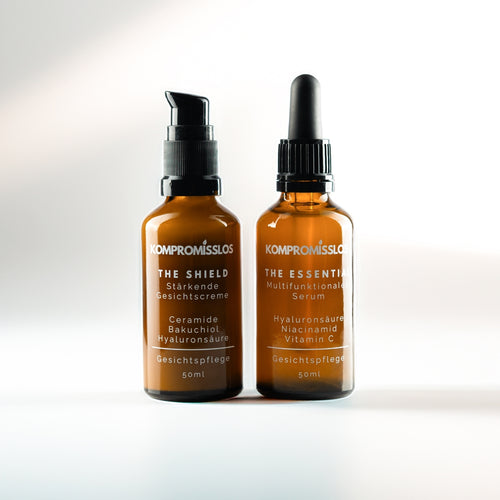
With couperose, skincare can do three things: stabilise the skin barrier, raise the irritation threshold and soften the look of diffuse redness. The visible capillaries themselves remain. The lever lies in the surroundings, because skin with an intact barrier loses less water, reacts less strongly to changes in temperature and looks calmer overall. That is exactly where niacinamide, ceramides, panthenol and squalane come in. For niacinamide, a paper in the British Journal of Dermatology describes how it stimulates the skin’s own ceramide production and reduces water loss through the skin. The Duo, made up of serum and cream, contains 5% niacinamide, 2% hyaluronic acid as well as ceramides, squalane and panthenol. What skincare cannot do is close a permanently dilated vessel again. If you expect that, every cream will disappoint you, whatever the price. What is realistic is a calmer overall look, not the disappearance of the capillaries.
A customer wrote to us that she had fine red capillaries on the sides of her nose and wanted to know whether they would go away with the Duo. The answer was no. What we wrote to her instead: the capillaries stay, but the skin around them can look calmer and less irritated when the barrier is stable, and that is exactly the part skincare influences. She chose the Duo with that expectation.
If your skin also quickly feels tight or burns, it is worth first reading up on how the skin barrier works. And if you want to know exactly which substances are in the two products, you will find the complete list of ingredients on the information page.
Which active ingredients and routines are tricky with couperose?
With couperose, anything that dilates the vessels further or weakens the barrier is tricky. That includes toners with a high alcohol content, high doses of fragrance and essential oils, harsh physical scrubs with hard particles, and very hot water when cleansing. Classic retinol is also often too much when capillaries are visible, because the adjustment phase can come with redness and flaking. That does not mean these substances are bad in general. They simply do not suit skin that turns red easily anyway. A short routine with a few well-tolerated steps makes more sense, as it does for routines for sensitive skin. The fewer products you put on your skin each day, the easier it is to find out which one is actually making you red. Sun protection is also important: UV radiation is one of the best-documented triggers and at the same time speeds up the breakdown of the surrounding connective tissue.
| Tricky with couperose | Why | Better-tolerated choice |
|---|---|---|
| Toner with a lot of alcohol | Strips lipids and weakens the barrier | Cleanse without toner, then go straight to serum |
| Heavily fragranced skincare | Fragrances are among the common triggers of irritation | Formulas with little or no fragrance |
| Physical scrubs with hard particles | Friction irritates the already thin epidermis | Leave them out entirely, or use very rarely and gently |
| Very hot water, and a sauna straight afterwards | Heat briefly dilates the vessels even further | Cleanse with lukewarm water and let your skin cool down |
| Classic retinol at a high dose | The adjustment phase often comes with redness | Gentler alternatives such as 0.3% bakuchiol |
The Duo does not contain an SPF. If you have couperose, you need a separate sun protection product in the morning, otherwise the most important protective factor is missing. How serum and cream fit into the order of your routine is explained under how to apply serum and cream.
When is couperose a matter for a professional?
Couperose is a matter for a professional if the capillaries bother you and you actually want them removed. There are dermatological procedures for that, such as laser or IPL, and only these work on the vessel itself. Cosmetics work on the surroundings. An appointment also makes sense if papules or pustules appear alongside the redness, if your skin constantly burns or stings, if your eyes are affected too or if things get noticeably worse within a few weeks. In the dermatological literature, couperose is listed as a synonym for rosacea, and the boundaries are fluid. What skincare may do here and where the line lies is covered in detail under what skincare can do with rosacea. Neither a cream nor a guide provides a diagnosis – a dermatology practice does. This distinction is not small print; it is the reason you should not expect treatment from cosmetics.
I deliberately decided not to make a dedicated product for couperose, even though people often ask about it. The reason is simple: I could not promise anything with it that I could deliver. No cream will close a vessel that has been dilated for years. What I can influence is the irritation threshold around it. That is why, when formulating, I chose 5% niacinamide rather than a higher dose, along with ceramides, squalane and panthenol. A higher figure would have been better for marketing and would have tingled more often on exactly this kind of skin. I left out fragrance and alcohol, because both regularly cause problems for redness-prone skin. And I would rather say it up front: if your goal is to get rid of the capillaries, the two products in the Duo are not the right tool. In that case you belong with a dermatologist, not in my shop.
Frequently asked questions
Does couperose go away on its own?
No, permanently dilated capillaries do not recede on their own. What can fluctuate is the diffuse redness around them: it is less noticeable on calm days and stronger after heat, alcohol or stress. The fine vessels themselves remain visible unless they are removed by a dermatologist.
What is the difference between couperose and rosacea?
In everyday language, couperose mainly describes the visible capillaries and persistent redness. In the dermatological literature, the term is listed as a synonym for rosacea. Rosacea also includes forms with papules, pustules or thickening of the tissue. A dermatology practice can clarify which applies to you.
Which cream makes sense for couperose?
A cream that supports the barrier and has little potential for irritation makes sense: ceramides, niacinamide, panthenol and squalane, with no fragrance, no alcohol and no hard exfoliating particles. There is no cream that gets rid of couperose. Even the best formula works on the surroundings, not on the vessel itself.
Does vitamin C help with couperose?
Vitamin C does not remove capillaries. It has an antioxidant effect and so supports protection against light-induced breakdown in the connective tissue, which benefits the surroundings of the vessels. The Duo contains 2% vitamin C as 3-O-ethyl ascorbic acid, a stable form that is generally well tolerated by sensitive skin.
Can I exfoliate if I have couperose?
Physical scrubs with hard particles are not worth it with couperose, because the friction further irritates the thin epidermis. Chemical exfoliants are possible depending on the acid and concentration, but rarely necessary. If in doubt, leave it out. A calm, short routine achieves more for redness-prone skin than an extra step.
Is sun protection important with couperose?
Yes. UV radiation is one of the triggers described in the literature and at the same time speeds up the breakdown of the supporting connective tissue. Daily sun protection is therefore the most effective single step against progression. The Duo does not contain an SPF, so you need a separate product for this in the morning.
Can the wrong skincare cause couperose?
The wrong skincare is not the cause, but it can make things worse. Irritating components of cosmetic products are among the described triggers of flushing, and the more often the vessels dilate, the more likely it is that something remains. The underlying factors are predisposition, fair skin and UV exposure over years.
Sources
- Reinholz M et al., Pathogenesis and clinical presentation of rosacea as a key for a symptom-oriented therapy, JDDG Journal der Deutschen Dermatologischen Gesellschaft, 2016. Source
- Tanno O et al., Nicotinamide increases biosynthesis of ceramides as well as other stratum corneum lipids to improve the epidermal permeability barrier, British Journal of Dermatology, 2000. Source