Serum over 70: worthwhile or unnecessary – and what matters for thin skin
SKIN AND AGE
A serum over 70 makes sense if your skin is dry, feels tight or flakes. At 70, what matters is no longer the density of active ingredients but how well your skin tolerates the product – and that you actually use it every day. A serum on its own is never enough: it always needs a cream on top to hold the moisture in.
Is a serum over 70 worthwhile or unnecessary?
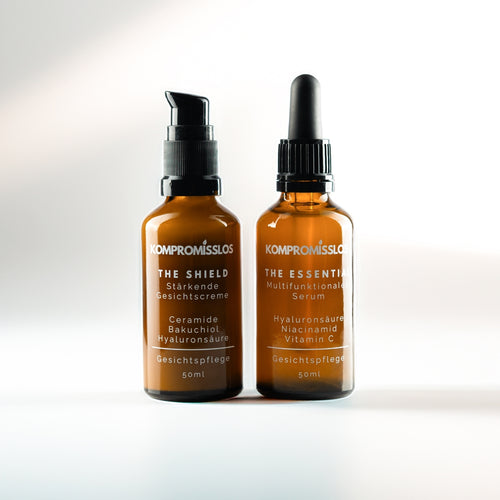
Worthwhile, as soon as your skin is dry, feels tight or flakes. Unnecessary if it stays calm and you get on well with your cream alone. At 70, the yardstick shifts noticeably compared with earlier years: it is not the wrinkle that decides, but the condition of the skin’s surface. A serum is a light, low-fat preparation with a high proportion of water and active ingredients. It brings moisture and active ingredients to places a purely lipid-based cream barely reaches. What it cannot do is stay put. Without a cream on top, a large part of it evaporates again, because the skin’s own lipid layer that would otherwise hold it in place is missing. Over 70, the question is therefore never serum or cream, but both or neither. For exactly this reason, Kompromisslos only offers serum and cream together. If you use only one of them, you get either active ingredients with nothing to hold them or something to hold them with no active ingredients.
A decade earlier, the balance is different – see serum over 60.
How does skin at 70 differ from skin at 60?
The difference lies mainly in the lipid layer and in how common dry skin is in this age group. In a study of 150 healthy women aged between 18 and 80, published in the International Journal of Cosmetic Science, sebum production fell markedly over the lifespan, while transepidermal water loss and the moisture content of the outer layer of skin were only weakly linked to age. How common dry skin actually is in later life is shown by a cross-sectional analysis of the Rotterdam Study with 5547 participants aged between 51 and 101, published in the Journal of the American Academy of Dermatology: 60 per cent had dry skin as assessed by a doctor. For you, that means two things. First, dry skin over 70 is the norm, not a personal failing. Second, the lever lies in the lipids your skin no longer produces itself, and in the moisture that does not stay without those lipids.
How to tell that your skin’s protective layer has suffered is covered in the article on the damaged skin barrier.
Which texture and which active ingredients suit skin over 70?
Over 70, a light, water-based texture without irritating additives suits your skin best, combined with a cream that replenishes lipids. When it comes to active ingredients, three jobs count: binding water, supporting the barrier and gently influencing the look of your skin. In the Duo, 2 per cent hyaluronic acid binds water. Ceramides, squalane, panthenol and jojoba oil support the barrier, along with 2 per cent edelweiss extract and 2 per cent gentian root extract. For the look of your skin, there are 5 per cent niacinamide, 2 per cent vitamin C as 3-O-ethyl ascorbic acid, 1 per cent zinc and 0.3 per cent bakuchiol as a gentler alternative to retinol. All percentages refer to the Duo of serum and cream together, never to a single product. Over 70, you can leave out almost everything that works through irritation: high-strength fruit acids, weekly exfoliation and toners containing alcohol. Thin skin is less forgiving, and in the end an irritated state costs you more than any single active ingredient gives you.
Our Duo is guaranteed fragrance-free. Details are listed under ingredients, and the other half of the story is in the article on face cream over 70.
Isn’t a rich cream enough on its own over 70?
A rich cream is the more important half if you had to choose just one product. It replaces exactly what your skin no longer produces itself. But one problem remains unsolved: there is hardly any room in a cream for active ingredients at a meaningful concentration, because that space is taken up by lipids and emulsifiers. Over 70, though, regular use matters more than this question of products anyway. In the Rotterdam analysis mentioned above, daily use of a cream was associated with less localised dry skin. That is an association from an observational study and not proof of cause and effect, but it fits what you notice in practice: two steps you take every day achieve more than five steps you manage twice a week. The honest answer is therefore: a cream on its own is better than nothing, and a cream with a serum underneath is better than a cream on its own.
| Complaint over 70 | What helps first | What tends to do harm |
|---|---|---|
| Tightness after washing | Cleanse gently, apply skincare straight away to damp skin | Hot water, foaming soap |
| Fine flaking on cheeks and forehead | Serum on damp skin, cream straight on top | Exfoliating to remove the flakes |
| Itching without a visible rash | Daily skincare, have the cause checked | Scratching and toners containing alcohol |
| Very thin, sensitive skin | Pat on gently instead of massaging in | Rubbing, brushes or exfoliating cloths |
| Skincare gets forgotten in daily life | Two steps at a fixed time | An eight-step routine |
How do you apply a serum over 70 in everyday life?
Sitting down, in good light, on skin that is still slightly damp and always before the cream. Over 70, handling becomes the real sticking point, not the formula. If your fingers are stiff in the morning or your eyesight in the mirror is not what it was, it is at the washbasin that it is decided whether you keep up a skincare routine. That is why it pays to keep the process deliberately simple: few movements, the same order, always at the same time. Apply the serum in a thin layer and press it in with your fingertips rather than massaging it in. Thin skin reacts more quickly to mechanical pressure with redness, and vigorous rubbing brings no additional benefit. Amount and rhythm stay simple: morning and evening, three to six drops of serum, three to six pumps of cream. Used like this, a bottle lasts two to four months, depending on how often you apply it. Using more does not make up for anything.
- Sit down and warm your hands briefly.
- Cleanse gently and just pat your face dry.
- Pat the serum onto damp skin.
- Wait a minute until nothing feels sticky.
- Apply the cream on top, down to your décolleté.
- In the morning, finish with sun protection.
The full sequence is set out under how to use the serum and cream.
When a serum over 70 is not the right choice
You don’t need a serum if your skin is calm, doesn’t feel tight, doesn’t flake and you don’t want to change anything about your skincare. In that situation, an extra product just adds one more step. Nor does it make sense to start something new in the middle of an irritated phase: if your skin is currently burning or red, it needs calming first before new active ingredients are added. And there are situations in which skincare is the wrong tool. Skincare can influence the appearance of your skin, but it does not make a diagnosis and does not replace treatment. Over 70, this boundary is particularly important, because dry skin in this age group can also be linked to medication, underlying conditions or sun-related changes. If you overlook that, you may spend months applying cream against something that really needed a medical assessment. In such cases, a serum does not replace an examination; it only delays it.
You should have the following checked: patches that don’t heal, a mole that changes, rough, flaky patches that persist for weeks and severe itching without a trigger. There is more on this in the article on dry skin with age.
I am often asked whether our serum is even intended for customers over 70. My answer is meant honestly and is not a comfortable one: only together with the cream. I deliberately decided against selling the serum on its own, even though that would have brought in more orders in the short term. On skin that barely produces any lipids of its own, a serum without something to seal it mostly evaporates again, and in the end it looks as though the product is at fault. Two products instead of eight, CHF 109.90, morning and evening. And if your skin is calm, you don’t need even that.
Frequently asked questions
Is a serum over 70 still worthwhile or unnecessary?
Worthwhile, as soon as your skin is dry, feels tight or flakes. Unnecessary if it stays calm and your current cream is enough. Over 70, what matters is not the number of active ingredients but how well your skin tolerates them and how regularly you use them. Without a cream on top, a large part of the serum evaporates again.
Is a rich cream enough on its own over 70?
For the feeling of tightness it is often enough, because it replaces the lipids your skin no longer produces itself. It hardly brings any active ingredients at a measurable concentration, though, because its space is taken up by lipids and emulsifiers. If you also want to change something about the look of your skin, a serum belongs underneath.
How much serum is right over 70?
Three to six drops per application, morning and evening, plus three to six pumps of cream. More is not absorbed better; it just sits on the surface. Depending on how often you use it, a bottle lasts two to four months. With very dry skin, you are more likely to be at the upper end.
In what order do you apply serum and cream?
Serum first, then cream. The serum is the lighter preparation and barely gets through a lipid layer that has already been applied. Apply it to skin that is still slightly damp, pat it in gently and wait about a minute until nothing feels sticky.
Which ingredients should you avoid over 70?
Avoid anything that works through irritation: high-strength fruit acids, frequent exfoliation and toners containing alcohol. Your skin has become thinner and reacts more sensitively to both chemical and mechanical irritation. That includes how you apply your skincare: press it in gently rather than massaging it in, because friction alone can cause redness.
Does skincare help with dryness-related itching over 70?
Regular skincare can noticeably improve how dry skin feels, because it adds moisture and replenishes lipids. But it is not a treatment. If the itching persists, occurs without an obvious trigger or comes with new medication, it should be checked by a doctor rather than met with ever more skincare.
When will you see a difference over 70?
Tightness and flaking usually improve within a few days. For changes in the look of your skin, such as fine lines or uneven pigmentation, allow eight to twelve weeks. Don’t make a final judgement any earlier, or you will switch away from a skincare routine that hasn’t yet had a chance to work.
Sources
- Luebberding S, Krueger N, Kerscher M. Age-related changes in skin barrier function: quantitative evaluation of 150 female subjects. International Journal of Cosmetic Science, 2013. Source
- Mekic S, Jacobs LC, Gunn DA, Mayes AE, Ikram MA, Pardo LM, Nijsten T. Prevalence and determinants for xerosis cutis in the middle-aged and elderly population: a cross-sectional study. Journal of the American Academy of Dermatology, 2019. Source