Serum over 60: worthwhile or unnecessary – and what matters now
SKIN AND AGE
A serum over 60 makes sense, but for a different reason than at 40. It is not wrinkles that decide it but the lipid film: sebum production falls markedly with age, and the skin holds on to applied moisture less well. A serum delivers water and active ingredients; the cream seals both in. Neither is enough on its own.
Is a serum over 60 worthwhile or unnecessary?
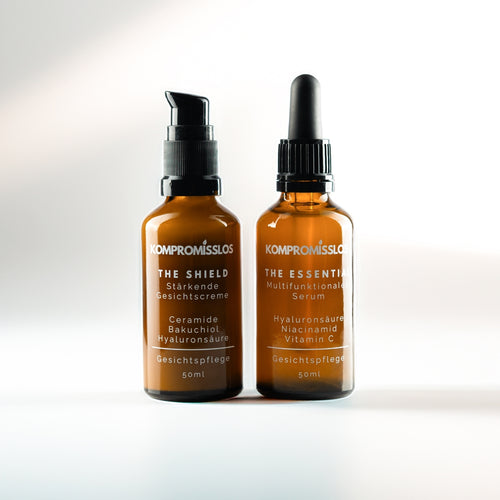
Worthwhile, as soon as your skin no longer holds applied moisture throughout the day. Over 60, that is the more common situation – regardless of how many wrinkles you see in the mirror. A serum is a light, low-fat preparation with a high proportion of active ingredients and water. A cream is the opposite: more lipids, fewer active ingredients, but a layer that slows down loss from the surface. Over 60, what your skin lacks above all is its own lipid film, and without that film, water from a serum quickly evaporates again. That is why the question of a serum over 60 is never really an either-or question. The real question is: are you getting both, or only half? For exactly this reason, Kompromisslos only offers serum and cream together as The Duo. A serum only becomes unnecessary if your skin is calm, doesn’t feel tight and you have no specific goal in mind.
When the step is worthwhile at all, and what applies a decade earlier, is explained in the article on serum over 50.
What really changes in your skin over 60?
Over 60, what changes most is the amount of lipid on the skin’s surface, less the water loss itself. This is the most important point, and the one most often misrepresented. In a study of 150 healthy women aged between 18 and 80, published in the International Journal of Cosmetic Science, sebum production fell markedly with age, with the lowest levels among the over-70s. Transepidermal water loss and stratum corneum hydration, on the other hand, correlated only very weakly with age. That sebum secretion falls continuously throughout adult life had already been shown by an older series of measurements in the Journal of Investigative Dermatology, covering 276 people aged between 15 and 97. For your skincare, this means something concrete: over 60, your skin doesn’t suddenly lose massive amounts of water; it loses the lipid layer that used to hold that water in. What else a weakened protective layer means is covered in the article on the damaged skin barrier.
Serum or richer cream: which does more over 60?
If you had to choose just one over 60, the richer cream would be the right choice. It replaces what your skin no longer produces itself. But it is an unnecessary choice, because a cream on its own delivers hardly any active ingredients at a meaningful concentration. Creams consist largely of fats and emulsifiers, and there is only limited room for niacinamide or vitamin C. A serum doesn’t have this space problem. It delivers the active ingredients and the water; the cream supplies the lipids and the seal. In that order, morning and evening. If you only reach for a rich cream over 60, you get well-protected skin that is short on active ingredients. If you only reach for a serum, you get active ingredients, some of which evaporate again. The criteria that count for the second half are covered in the article on face cream over 60, and what the whole routine around it looks like in the article on skincare for mature skin.
| Situation over 60 | Cream only | Serum and cream |
|---|---|---|
| Skin feels tight after washing | Usually improves | Usually improves |
| Moisture lasts until the evening | Often not | Much more reliably |
| Active ingredients at a measurable concentration | Hardly possible | Covered by the serum |
| Uneven complexion | Little influence | Can soften its appearance |
| Effort per application | One step | Two steps, about a minute |
Which active ingredients count over 60 – and which you can leave out
Over 60, three things count: something that binds water, something that supports the barrier with lipids, and a well-tolerated active ingredient for the look of your skin. Everything else is a bonus. In The Duo, water is bound by 2 per cent hyaluronic acid. For the look of your skin, there is 5 per cent niacinamide, 2 per cent vitamin C as 3-O-Ethyl Ascorbic Acid, 1 per cent zinc and 0.3 per cent bakuchiol as a gentler alternative to retinol. The barrier is supported by ceramides, squalane, panthenol and jojoba oil, together with 2 per cent edelweiss extract and 2 per cent gentian root extract. Over 60, on the other hand, you can leave out almost anything that works through irritation: high-percentage fruit acids, exfoliating several times a week, fragrances, alcohol near the top of the list. Your skin has become thinner and is less forgiving. All percentages apply to The Duo of serum and cream together, not to a single product. You will find the full breakdown under ingredients in detail.
How do you apply a serum correctly over 60?
On damp skin, in a thin layer, without friction, and always before the cream. The order matters more over 60 than in younger years, because the active ingredient can no longer get through a thick layer of fat if you apply cream first. The way you apply it is just as important. Thinner skin reacts more sensitively to mechanical pressure, and vigorous massaging brings no additional effect, only redness. Instead, press the serum in with your fingertips and let it absorb briefly. Amount and rhythm stay simple: morning and evening, three to six drops of serum, three to six pumps of cream. At that rate, a bottle lasts two to four months, depending on how often you use it. Sun protection is still part of your morning routine. The exact sequence, with pictures, is on the page about how to use the two products.
- Gentle cleansing; just pat your face dry, don’t rub it.
- Apply the serum to skin that is still slightly damp and pat it in.
- Wait about a minute, until nothing feels sticky.
- Cream on top, including over your neck and décolletage.
- In the morning, sun protection as the last step.
When you don’t need a serum over 60 – and when a specialist is the better choice
You don’t need a serum if your skin stays calm with your current cream, doesn’t feel tight, doesn’t flake and you don’t want to change anything. In that situation, a second product only adds effort. Nor does it make sense to start something new in the middle of an irritated phase: if your skin is currently stinging or red, it needs calming down first, before any active ingredients are added. And there are cases in which cosmetics are the wrong tool. Areas that don’t heal or that weep, a mole that changes in colour, size or border, rough, flaky patches that persist for weeks, or severe itching with no obvious trigger all need a dermatological assessment. Over 60 this applies in particular, because sun-related skin changes become more common over the years. Skincare can influence how your skin looks. It is no substitute for a diagnosis or treatment. How persistent dryness shows up at this stage of life is described in the article on dry skin in later life.
The most common feedback I get from customers over 60 isn’t about wrinkles. It is about the feeling of tightness after washing, and about the cream seeming to have vanished by the evening. That is exactly why I decided against a single rich product for The Duo. An even richer cream would have solved the tightness in the short term and left the skin short on active ingredients. Instead, I wanted the active ingredients where they arrive and the lipids where they hold. Two products instead of eight, CHF 109.90, morning and evening. If you stick with that, you will get further than with a cupboard full of half-empty jars.
Frequently asked questions
Is a serum over 60 really necessary, or is a rich cream enough?
A rich cream is enough if all you want is to get rid of the feeling of tightness. But it delivers hardly any active ingredients at a measurable concentration, because most of its space is taken up by fats. If you also want to change something about the look of your skin, you need a serum underneath. Over 60, using both together is the more sensible route.
What changes most in your skin over 60?
Sebum production falls the most. A study of 150 women aged between 18 and 80 found the lowest levels of skin surface lipids among the over-70s, while water loss and stratum corneum hydration were barely linked to age. So what your skin lacks above all is the lipid layer that otherwise holds moisture in.
Should you apply serum before or after cream?
Always before the cream. The serum is the lighter preparation and can hardly get through a layer of fat that is already on your skin. Apply it to skin that is still slightly damp, wait about a minute, and only put the cream on top once nothing feels sticky.
How much serum is right over 60?
Three to six drops per application, morning and evening, plus three to six pumps of cream. More brings no additional effect; it just stays on the surface and feels sticky. A bottle lasts two to four months, depending on how often you use it. With very dry skin, you are more likely to be at the upper end.
Which ingredients should you avoid over 60?
Avoid anything that works through irritation: high-percentage fruit acids, frequent exfoliation, fragrances and alcohol near the top of the INCI list. Your skin has become thinner and reacts more sensitively to both mechanical and chemical irritation. Applying gently without vigorous massaging is part of this too, because friction alone can trigger redness.
How long does a serum over 60 take to make a difference?
Tightness and dryness usually improve within a few days. For changes in the look of your skin, such as fine lines or uneven pigmentation, allow eight to twelve weeks. Don’t judge the result any earlier, or you will switch a product that hasn’t had a chance yet.
Is a serum still worthwhile over 70?
Yes, for the same reason as over 60, only more so. According to the study cited, skin surface lipids reach their lowest levels in the over-70s. Tolerability then becomes especially important: a gentle formulation, no fragrances, apply gently rather than massaging in. The amount stays the same, and so does the frequency.
Sources
- Luebberding S, Krueger N, Kerscher M. Age-related changes in skin barrier function: quantitative evaluation of 150 female subjects. International Journal of Cosmetic Science, 2013. Source
- Jacobsen E, Billings JK, Frantz RA, Kinney CK, Stewart ME, Downing DT. Age-related changes in sebaceous wax ester secretion rates in men and women. Journal of Investigative Dermatology, 1985. Source