Serum over 50: worthwhile or unnecessary – and how to decide

Made for mature skin
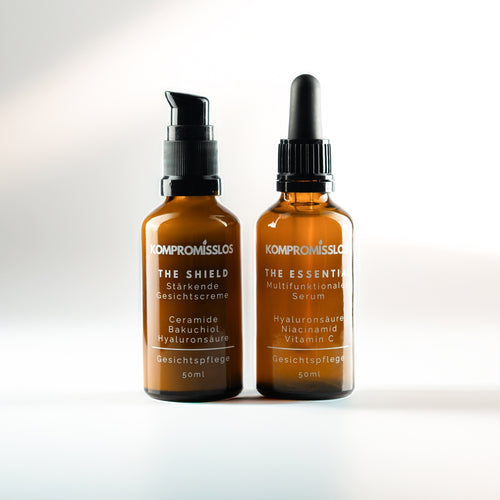
The Duo – serum & face cream
★★★★★ 4.9/5 · 120+ reviews
Two products instead of a long routine: serum with niacinamide, hyaluronic acid and vitamin C, cream with ceramides and bakuchiol. Fragrance-free, vegan.
CHF 109.90 119.80 · free shipping in Switzerland · 100-day trial
Serum over 50: worthwhile or unnecessary?
Worthwhile, as soon as you want more from your skincare than moisture and protection. A serum is a light preparation with a high proportion of active ingredients and little fat; a cream is the opposite. Each does a different job, which is exactly why the question of a serum over 50 is not about luxury but about a division of labour. If you only use a cream, you get moisture and a protective layer, but rarely meaningful concentrations of active ingredients such as niacinamide or vitamin C. If you only use a serum, you get active ingredients without a seal and lose some of them through evaporation. That is exactly why Kompromisslos only offers The Duo of serum and cream together. Over 50, this difference carries more weight, because your skin holds on to moisture less well and produces less sebum. The active ingredient then needs both: a carrier that delivers it in the first place, and a layer that stops it evaporating straight away. How the two work together day to day is shown in the article comparing serum and cream side by side.
A serum does become unnecessary, on the other hand, if there is no specific goal behind it. An extra product without a reason makes your routine more complicated, not better.
What skincare does skin over 50 really need?
Over 50, your skin reliably needs three things: moisture, an intact barrier and daily sun protection. Everything else is an addition. The reason lies in biology: sebum production falls, the skin binds water less well, and collagen breakdown speeds up markedly around menopause. According to a review in the journal Climacteric, the collagen content of the skin falls by about 30 per cent in the first five years after menopause, and more slowly after that. This explains why, for many women, their skin seems to change not gradually but suddenly at this stage. In practice, that means fewer products, used more consistently. A cleanser that doesn’t strip the skin of oil, a serum with clearly defined active ingredients, a cream that seals, and sun protection in the morning. You will find the order and amounts on the page about how to use the two products. What this routine needs to do in detail is covered at length in the article on skincare for mature skin.
Does skin over 35 or over 45 already need a serum?
At 35, a serum usually isn’t essential yet; at 45, in most cases it is. The difference lies less in age than in the condition of your skin. At 35, the first dehydration lines appear, but your skin still recovers quickly and holds moisture well. If you reach for a serum at this age, it makes sense to do so for a specific concern: an unsettled complexion, dark spots after the summer, redness. At 45, the picture shifts. For many women, perimenopause has already begun, the skin becomes more prone to tightness, and lines stay visible for longer in the morning. A serum then delivers active ingredients that a cream cannot carry in that quantity. In both cases, what matters is not the year you were born but what you notice in the mirror and when you touch your skin. The deciding factor is the condition of your skin, not your skin type, and certainly not your age on paper.
Does skin over 55 or over 65 still need a serum?
Yes – and over 65, often more urgently than at 50. The reason is increasing dryness: the skin produces much less sebum, the stratum corneum loses water faster, and for many women a cream on its own is no longer enough to address both at once. A serum brings moisture and active ingredients into the upper layers of the skin; the cream keeps them there. This two-part approach becomes more important with age, not less. At 55 the difference is usually already clearly noticeable; at 65 it is part of everyday life for many women. What changes over 65 is tolerability: the skin reacts more sensitively to fragrances, alcohol and high acid concentrations, and friction during application becomes more noticeable. Fewer products, applied more gently but twice a day, is usually the better approach here. How persistent dryness shows up at this stage of life is described in the article on dry skin in later life.
Which active ingredients should a serum over 50 deliver?
Over 50, three groups count: humectants, an active ingredient for an uneven complexion and something that supports the barrier. Anything beyond that is a bonus. Among humectants, there is hardly any way around hyaluronic acid, which The Duo contains at 2 per cent. For the look of your skin, niacinamide is the best-studied candidate: in a twelve-week, blinded split-face study of 50 women aged between 40 and 60, a formula with 5 per cent niacinamide showed visible improvements in fine lines, dark spots and redness compared with the base without the active ingredient. The Duo contains exactly this 5 per cent. Added to that are 2 per cent vitamin C as 3-O-Ethyl Ascorbic Acid, 1 per cent zinc and 0.3 per cent bakuchiol as a gentler alternative to retinol. The barrier is supported by ceramides, squalane and panthenol, together with 2 per cent edelweiss extract and 2 per cent gentian root extract. You will find the full list with all concentrations under ingredients in detail.
All percentages refer to The Duo of serum and cream as a whole, not to a single product. If you only use one of the two, you won’t get the full combination.
When you don’t need a serum over 50 – and when a specialist is the better choice
You don’t need a serum if your skin stays calm with your current skincare, neither feels tight nor looks shiny, and you are not aiming for any change. In that situation, a second product brings nothing but extra effort. Nor does it make sense to start a new serum in the middle of an irritated phase: if your skin is currently stinging, flaking or red, it needs calming down before any active ingredients are added. And there are situations in which cosmetics are fundamentally not the right tool. Persistent redness with visible thread veins, weeping or itchy patches, a mole that changes, open areas of skin or ones that won’t heal: these need a dermatological assessment, not a skincare routine. Skincare can influence how your skin looks. It is no substitute for a diagnosis or treatment. The criteria that count when buying the cream to go with it are covered in the article on face cream over 50.
Try it yourself
The Duo – serum & face cream
★★★★★ 4.9/5 · 120+ reviews
Serum with niacinamide, hyaluronic acid and vitamin C, cream with ceramides and bakuchiol. Not happy? A short message is all it takes.
CHF 109.90 119.80 · free shipping in Switzerland · 100-day trial