Face cream for over 50s: five criteria for spotting a good one
SKINCARE BY AGE
A face cream for over 50s has three jobs: to stabilise the skin barrier with lipids, to hold on to moisture and to protect against oxidative stress. The ingredients that make sense for this are ceramides, squalane, hyaluronic acid and niacinamide in transparent concentrations. Everything else, from texture to packaging, is about comfort and does not decide the result on your skin.
For the general criteria, whatever your decade: the best face cream for mature skin.
What changes in your skin after 50?
After 50, it is above all the collagen content that drops, and your skin holds on to moisture far less well than it used to. According to a review in the journal Climacteric, skin loses around 30% of its collagen in the first five years after menopause, then roughly 2% a year over the following fifteen years. At the same time, the skin produces fewer of its own lipids, more water is lost through the surface, and the barrier takes longer to close again after it has been disrupted. You notice this as tightness after cleansing, as fine dehydration lines around the eyes and mouth, and as a complexion that looks duller than it did ten years ago. On top of that, some women go through a hormonally triggered phase of an unsettled complexion and blemishes that has little to do with the acne of their younger years. What matters for your skincare, then, is not the year you were born but which active ingredients your cream contains, and in what concentration.
Which active ingredients should a face cream for over 50s contain?
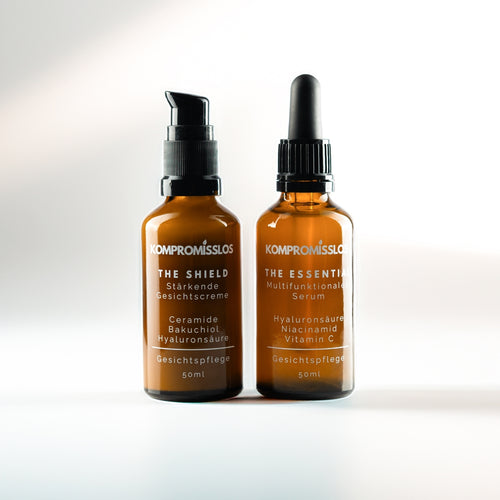
After 50, your skin needs four things at once: barrier-building lipids, moisture-binding ingredients, antioxidants and a gentle renewing ingredient. Lipids such as ceramides and squalane replace what the skin makes less of itself and stabilise the outermost layer. Hyaluronic acid binds water in the upper layers of the skin and makes dehydration lines look less pronounced. Niacinamide supports the barrier function and helps to even out the complexion. Antioxidants such as vitamin C and vitamin E neutralise free radicals generated by sun and environmental exposure. Bakuchiol is regarded as a gentle plant-based alternative to retinol and is considerably better tolerated if your skin reacts easily. The Duo contains hyaluronic acid at 2%, niacinamide at 5%, vitamin C as 3-O-ethyl ascorbic acid at 2%, zinc at 1% and bakuchiol at 0.3%, plus ceramides, squalane and panthenol with no fixed percentage stated. If you are wondering whether vitamin C or niacinamide goes on first, the question falls away with a formulation that already combines both.
These figures always refer to the serum and cream as a matched Duo, not to a single product. It is worth checking this with every brand: a percentage that doesn’t say what it refers to is not information.
How can you tell a good face cream for over 50s?
You can tell by four features you can check yourself, not by the word anti-ageing on the packaging. First, declared concentrations: a brand that states how much of an active ingredient a product contains opens itself up to scrutiny and usually has a reason to do so. Second, its position in the INCI list, because anything listed after the preservatives and fragrance is usually present at below one per cent. Third, the packaging, because vitamin C and plant extracts react to light and air and lose their effect faster in an open jar. Fourth, what is missing: on mature, sensitive skin, fragrance and high levels of volatile alcohol are more often a problem than a benefit, because the barrier has fewer reserves to recover from irritation. The same four points also help you judge what a plant extract such as gentian root extract actually contributes to a formula.
| Criterion | What to look for | Why it matters |
|---|---|---|
| Concentration | Is a percentage given on the product page? | Without a figure, you can’t tell whether the active ingredient is dosed effectively. |
| INCI position | Where does the advertised active ingredient appear in the list? | After the preservatives and fragrance, the amount is usually below one per cent. |
| Packaging | A pump dispenser or amber glass rather than an open jar. | Light and air break down vitamin C and plant extracts. |
| Irritation potential | Fragrance, essential oils, a high alcohol content. | Mature skin reacts more sensitively than younger skin. |
Does a face cream for over 50s have to be expensive?
No. The price says little about the result, and the most effective lever costs almost nothing. In a randomised trial published in the Annals of Internal Medicine, adults who applied sunscreen every day showed around 24% less visible photoageing after four and a half years than the comparison group, who used it only as they saw fit. No cream in the world can make up for what years of careless daily sun exposure do to your skin. What you get for your money is therefore less a question of price bracket than of formulation: a CHF 20 product with properly dosed lipids beats a CHF 200 cream with a pretty jar and a thin list of active ingredients. One important point for context: my cream contains no SPF. If you spend time outdoors every day, you need a separate sunscreen as well – and that is not a weakness of the formula but a deliberate separation of two different jobs.
Is a face cream enough after 50, or do you need a serum as well?
After 50, the two together make more sense than a cream on its own, because each step does a different job. A serum has a lighter formulation and delivers water-soluble active ingredients such as hyaluronic acid, niacinamide and vitamin C into the upper layers of the skin. The cream then lays a film of lipids over the top, which stops that moisture from evaporating again over the course of the day. Without a cream, part of the serum’s effect is lost; without a serum, the cream has nothing to seal in. In the vast majority of cases you don’t need more than these two steps, and an eight-step routine is more of a risk to your barrier than a gain. My recommendation is 3 to 6 drops of serum and 3 to 6 pumps of cream per application, morning and evening, so a bottle lasts 2 to 4 months depending on use. I’ve written up the exact order and amounts for everyday use separately.
If your skin has been calm for years with a single rich cream, that is a good sign and no reason to change anything. A two-step system of serum and cream is mainly worthwhile if tightness, dehydration lines or a dull complexion persist despite your skincare.
When a face cream is no longer enough
Skincare cares for the skin, but it is never a substitute for a medical assessment by a professional. If you notice persistent redness with pustules, scaly patches, intensely itchy eczema, open skin lesions or a mole that changes in size, colour or shape, that needs to be looked at by a dermatologist, not treated with a cream. This applies especially after 50, because the risk of skin changes increases with age and decades of sun exposure start to show. A sudden change in the condition of your skin with no obvious trigger is also a reason to get it checked, as are skin problems that appear around the time you start a new medication. A good face cream for over 50s supports the skin barrier, softens the look of dehydration lines and makes the complexion look more even. It does no more than that, and any brand that promises you otherwise is selling you an expectation it cannot meet.
I deliberately chose not to create a separate 50+ line. The reason is simple: the active ingredients mature skin needs are the same ones that make sense at 35 – only the need for lipids and moisture is greater. Instead of selling three age versions with almost identical formulas, I developed one formulation and put the dosage in your hands. If you need more, you use 6 pumps instead of 3. That is more honest than a number on the packaging that mainly serves to justify the price.
Frequently asked questions
Which face cream is right after 50?
The right cream after 50 contains lipids such as ceramides and squalane, moisture-binding hyaluronic acid and niacinamide, and it declares its concentrations. The condition of your skin matters more than the age on the packaging: dry, sensitive skin needs a different texture from skin that is still prone to shine.
Do you need a richer cream at 50 than at 40?
Usually yes, because with age the skin produces fewer of its own lipids and holds moisture less well. Richer doesn’t mean heavy or greasy here, but higher in lipids. You can achieve the same effect by applying a little more of your existing cream in the evening.
Is retinol a must after 50?
No. Retinol is well researched, but it is not the only option and is often too irritating for sensitive skin. Bakuchiol is regarded as a gentler plant-based alternative and does not make the skin more sensitive to light. The Duo contains bakuchiol at 0.3%, based on both products together.
How long does it take for a new face cream to make a difference?
Hydration and tightness often improve within a few days. For visible changes to your complexion, allow eight to twelve weeks, because renewal of the outermost layer of skin slows down with age. So don’t judge a new product after the first week.
Is a face cream with SPF enough for daytime?
Only if you apply it as thickly as the SPF test requires, and very few people do. A separate sunscreen over your skincare is the safer option. My cream deliberately contains no SPF, because skincare and sun protection are two different jobs.
How much does a good face cream for over 50s cost?
There is no price point at which a cream becomes good. What counts is how much active ingredient ends up on your skin per application and how long a pack lasts. My serum and cream cost CHF 109.90 together and last 2 to 4 months, depending on use.
Does a face cream for over 50s help with deep wrinkles?
No, skincare cannot fill deep wrinkles. What a good cream can do is soften the look of fine dehydration lines, support the skin barrier and make the complexion look more even. Anything beyond that falls within the field of aesthetic medicine.