Skincare for mature skin: the routine you actually need
AGE AND SKIN
Skincare for mature skin is above all about moisture, skin lipids and calm, rather than as many active ingredients as possible. As oestrogen levels fall, the ceramide content of the stratum corneum decreases, the skin loses water more quickly and becomes more sensitive. Two products designed to work together, morning and evening, meet this need more reliably than a seven-step routine.
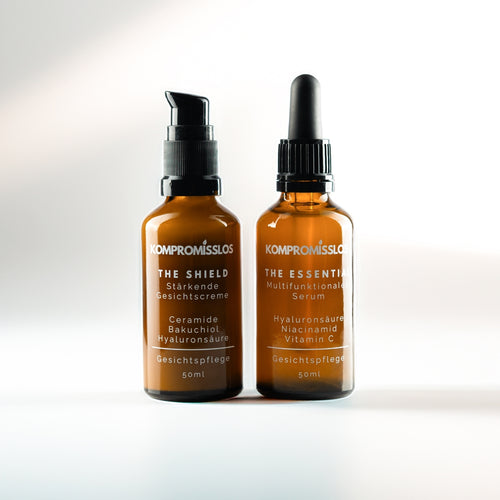
Two products designed to work together instead of seven steps – that is exactly how The Duo – Serum & Face Cream is built.
What to look for in a cream specifically is covered in the article on the best face cream for mature skin.
What actually changes in mature skin?
In mature skin, three things change at the same time: the amount of collagen in the dermis falls, the lipid film of the stratum corneum becomes thinner, and the skin holds on to water less well. A review in the Journal of Integrative Dermatology puts collagen loss at up to 30 per cent in the first five years after menopause. A study in Scientific Reports also showed that after menopause the stratum corneum contains fewer ceramides, and that these ceramides have shorter chains on average. Day to day, this shows up as fine dehydration lines in the morning, a feeling of tightness after washing and a complexion that looks tired in the evening. These changes are not a defect; they are physiology. Skincare doesn’t reverse them, but it can give the skin back water and lipids and visibly improve the way it looks. That is why it pays to understand first what is missing, and only then to choose the right active ingredients.
For many women, the first signs of skin ageing appear in their late thirties: fine lines around the eyes and more visible pores.
What skincare does mature skin need day to day?
Mature skin needs two steps, morning and evening: a water-based serum with moisture-binding, barrier-friendly active ingredients, and on top of it a cream that holds that moisture in. More steps rarely bring better results, because active ingredients dilute one another and every additional product brings an additional risk of irritation. In concrete terms, what makes sense is hyaluronic acid for binding water, niacinamide for the barrier and an even tone, ceramides and squalane to replenish lipids, and an antioxidant such as vitamin C. In The Duo from Kompromisslos, that means 2% hyaluronic acid, 5% niacinamide and 2% vitamin C as 3-O-Ethyl Ascorbic Acid, each based on both products together. Per application, that is three to six drops of serum and three to six pumps of cream. Sun protection belongs in your daytime routine, but it is a separate topic and no substitute for skincare. More important than any ingredients list is consistency: twice a day over eight to twelve weeks achieves more than a line-up that changes every week.
There is data for niacinamide at this level. In a double-blind split-face study in Dermatologic Surgery, 50 women applied 5% niacinamide to one half of their face twice a day for twelve weeks; compared with the vehicle, fine lines, red blotchiness and measured elasticity, among other things, improved. How this works in The Duo of serum and cream is shown on the how-to-use page.
Why fewer products often do more for mature skin
Over-treated skin develops when too many active products hit a barrier that has already become thinner. Typical signs are stinging on application, a film that is shiny and rough at the same time, small patches of redness on the cheeks and chin, and the feeling that every new product is tolerated less well than the last. The trigger is rarely a single product; it is the sum of an exfoliator, an acid, a retinoid, vitamin C and three serums in the same week. The solution is uncomfortable but effective: leave out everything except cleansing, moisture and lipids for two to three weeks, then reintroduce one active ingredient at most. At this stage, mature skin doesn’t need extra stimulation – it needs time. If you can’t stick with the break, you are mistaking activity for progress and starting the cycle all over again. An entry in your calendar helps more than willpower.
This reduction separates maturity from sensitivity. If your skin is still reactive after three calm weeks, the cause is a lower irritation threshold, not over-treatment. In that case, gentle fragrance-free products help in the long term.
Dehydrated, tired, flaky or reactive: which skin condition do you have?
Dehydrated, tired, flaky and reactive skin are four different conditions with four different needs, even though they often overlap in mature skin. Dehydrated skin lacks water and shows fine crinkly lines that briefly disappear after you apply cream. Tired skin looks dull and grey, usually after lack of sleep, alcohol or dry central-heating air, and benefits mainly from antioxidants and consistency. Flaky skin lacks lipids and the stratum corneum visibly sheds; here, ceramides and squalane help more than yet another layer of water. Reactive skin reacts to stimuli that used to have no effect and tolerates every new active ingredient less well. If you name the condition correctly, you avoid the most expensive mistake: the wrong product with the best of intentions. The overview below sorts the four conditions, plus over-treated skin, by what your skincare needs to do in each case.
| Skin condition | How to recognise it | What your skincare needs to do |
|---|---|---|
| Dehydrated | Fine crinkly lines that briefly disappear after applying cream | Bind water, for example with hyaluronic acid |
| Flaky | Visibly shedding stratum corneum, rough to the touch | Replenish lipids, for example ceramides and squalane |
| Tired | Dull, greyish complexion without tightness | Antioxidants and a consistent routine |
| Over-treated | Stinging with products that were previously tolerated | Pause actives, moisture and lipids only |
| Reactive | Redness and a pulling sensation even with gentle formulas | Short fragrance-free formulas, nothing new added |
With a dull complexion, the same question almost always comes up: vitamin C or niacinamide. The two have different jobs. Plant extracts complement them, such as gentian root extract, which The Duo contains at 2%.
How does skincare change during menopause?
During menopause, your skin’s needs shift from water towards lipids and barrier stability. Falling oestrogen affects the fibroblasts in the dermis, ceramide production in the epidermis and water binding, and the result is drier, thinner and more sensitive skin, sometimes accompanied by itching. At the same time, the balance between oestrogens and androgens shifts, which is why some women get blemishes on the chin again for the first time in decades. Having both at once is confusing, because the usual reflexes work against each other: drying products on skin that actually needs lipids. The adjustment is therefore less a change of product than a change of emphasis – the same routine, with more lipids and fewer experiments. Cleansing is part of this too, because hot water and strongly foaming surfactants make dryness worse. Cosmetics don’t affect the hormonal cause, but they can noticeably soften the look of dryness and redness.
If the new blemishes bother you more than the dryness, the article on blemish-prone skin will help. The order stays the same: barrier first, then blemishes.
When cosmetics are no longer enough
You should see a specialist if your skin itches, weeps, flakes or stays very red for weeks even though you have cut back your skincare. Cosmetics care for healthy skin and improve its appearance; they don’t treat skin conditions and are no substitute for a diagnosis. Persistent itching during menopause, sharply defined flaky patches, dark spots that change, or a sudden marked loss of tolerance all need a dermatological assessment rather than being papered over with the next serum. This also applies if you take medication that makes your skin drier. This limit is not a formality: it protects you from months in which skincare masks a problem that needs a diagnosis. The reverse is equally true: if your skin is happy with a simple routine, you don’t need an extra product. No active ingredient gets better by sitting next to five others, and no skin gets younger because the bathroom shelf is fuller.
Changing your skincare just because of a milestone birthday isn’t necessary. If your skin gets through the day calmly, the pared-back two-product routine is enough. How it has worked for others is covered in the reviews.
For The Duo, I deliberately decided against retinol and in favour of 0.3% bakuchiol. The reason is simple: the women who write to me have skin that is mature and reactive at the same time. Retinol would have sent some of them into a phase of irritation that they would then have experienced as a product failure. For the same reason, niacinamide is at 5% and no higher, even though higher sounds better. And that is why there are two products and not five. I would rather sell less and hear less often that something wasn’t tolerated again.
Frequently asked questions
At what age is skin considered mature?
Mature skin is not an age but a condition: declining firmness, a drier stratum corneum and fine lines that stay visible in the morning too. For many women this begins between 35 and 45, for others much later. What matters is how your skin feels, not the number in your passport.
What skincare does tired skin need?
Tired skin needs antioxidants, moisture and, above all, consistency. A dull complexion usually comes from lack of sleep, central-heating air or alcohol, not from a missing group of active ingredients. A serum with vitamin C in the morning and a cream that holds moisture through the day are usually enough.
What skincare does flaky skin need?
Flaky skin needs lipids, not another layer of moisture. Ceramides and squalane replace missing skin lipids and help the stratum corneum maintain its own moisture balance. Exfoliators usually make things worse, because they put further strain on the unstable barrier. If the flaking stays sharply defined or itches badly, it needs a dermatological assessment.
Is bakuchiol a good idea for mature skin?
Bakuchiol is a gentle option for skin that doesn’t tolerate retinol well, and it is used at low concentrations in cosmetics. In The Duo it is 0.3%, based on both products together. It is not a miracle ingredient and does not replace a retinoid in the medical sense, but for sensitive mature skin it can be the better-tolerated choice.
How long does it take to see a visible change in mature skin?
Allow eight to twelve weeks before changes in texture and evenness can be reliably judged. Moisture effects can be felt sooner, often after a few days, because the stratum corneum takes up water directly. Anything to do with skin cell renewal takes longer. Switching products after two weeks makes any assessment impossible.
Is a richer cream automatically better for mature skin?
Richer is not automatically better. What matters is whether your skin is lacking water or lipids. If it lacks water, a heavy cream does little and can even feel suffocating. If it lacks lipids, a richer texture is the right choice. The simplest test is how tight your skin feels straight after washing.
Sources
- Sadur A. et al., Beyond Hot Flashes: Understanding and Treating Menopause-Associated Skin Changes, Journal of Integrative Dermatology, 2025. Source
- Kendall A.C. et al., Menopause induces changes to the stratum corneum ceramide profile, which are prevented by hormone replacement therapy, Scientific Reports, 2022. Source
- Bissett D.L., Oblong J.E., Berge C.A., Niacinamide: A B Vitamin that Improves Aging Facial Skin Appearance, Dermatologic Surgery, 2005. Source