Face cream over 60: what it needs to do and how to recognise a good one
SKINCARE BY AGE
A face cream over 60 needs, above all, to replace lipids. Sebum production falls markedly with age, and the skin barrier recovers noticeably more slowly after stress. That is why ceramides, squalane and jojoba oil make sense as the lipid base, hyaluronic acid as a humectant and niacinamide to support the barrier. Rich doesn’t automatically mean heavy or greasy.
Why a test winner is of little help here: best-rated face creams in Switzerland.
What really changes in your skin over 60?
Over 60, what changes most is the skin’s lipid layer, less its water content. A study of 150 women in the International Journal of Cosmetic Science shows that sebum production falls markedly over the lifespan, while water loss and the moisture content of the stratum corneum vary only slightly with age. That explains the feeling of tightness better than any advertising formula: it is not primarily water that is missing, but the lipid film that holds the water in. This shift is at the heart of any routine for mature skin. There is also a second point that matters even more in practice. A paper in the Journal of Clinical Investigation measured how quickly a disrupted barrier closes again. In young test subjects, it had recovered by around 50 per cent after 24 hours; in people over 80, by only about 15 per cent. For your skincare, this means that over 60, a cleanser that is too harsh or exfoliating too often doesn’t cost you one day of recovery but more like a week. Knowing this saves you a large share of the products sold as a rescue for mature skin.
Which ingredients belong in a face cream over 60?
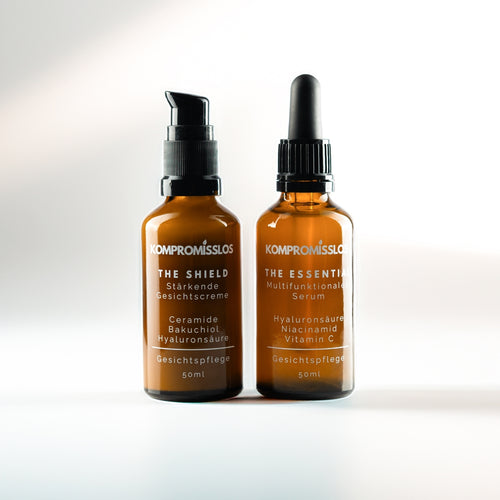
Over 60, a face cream should bring three building blocks: skin-identical lipids, a humectant and an active ingredient that supports the barrier. Skin-identical lipids are ceramides and squalane, plus plant oils such as jojoba oil, which is structurally close to the skin’s own sebum. They replace exactly what is lost as sebum production falls. As a humectant, hyaluronic acid is the obvious choice, because it holds water in the stratum corneum. The third building block is niacinamide, which supports barrier function and can soften the look of redness and uneven skin tone. The Duo of The Essential serum and The Shield cream contains 2 per cent hyaluronic acid and 5 per cent niacinamide, plus ceramides, squalane, panthenol, jojoba oil and vitamin E, without a stated percentage. All percentages refer to The Duo as a whole, not to a single product. What you don’t need over 60: high levels of fragrance, alcohol near the top of the list and more than a handful of active ingredients at the same time.
Antioxidants are a useful fourth building block, but not compulsory. In The Duo, that means 2 per cent vitamin C as 3-O-Ethyl Ascorbic Acid, plus 0.3 per cent bakuchiol as a gentle alternative to retinol. The full list is on the page about the ingredients in our two products.
Does a face cream over 60 need to be richer than at 40?
No – a face cream over 60 doesn’t need to be heavier, but it does need a more lipid-rich composition. That is a distinction many products blur. A heavy texture often comes from mineral oils, waxes and silicones that sit on the skin and create a rich feel, without the skin incorporating any of it. A lipid-rich composition, on the other hand, supplies building blocks that the skin can integrate into its own barrier: ceramides, squalane, fatty acids from plant oils. The result feels lighter and still lasts longer. If your skin feels tight again after two hours even though the cream was thick, that is exactly the explanation. Richness is also not a value in itself: in a heated home, a thicker texture can make sense in the evening, rarely in summer. Texture is a question of the season; composition is the constant. So what matters is not how thick a cream seems, but which building blocks it supplies to your skin.
How the selection criteria change with each decade
The criteria for choosing a face cream shift with each decade, but less dramatically than the beauty industry makes out. Until about 35, the main thing is not to damage the barrier: gentle cleansing, enough moisture, consistent sun protection. Between 40 and 50, the first dehydration lines and a slight loss of elasticity come along; this is where niacinamide is worth including as a permanent fixture. From 50, sebum production falls faster, and your cream can become richer in lipids. From 60, the emphasis finally shifts from the density of active ingredients to barrier stability and tolerability. What stays the same in every decade: sun protection during the day and gentle cleansing. Over the years, these two points make more difference than any additional active ingredient. The table summarises what changes per decade and what to base your choice of cream on each time. If you find yourself one stage below, the five criteria for a face cream over 50 will help.
| Age | What changes | What to look for in a cream |
|---|---|---|
| From 30 | First fluctuations in moisture, barrier reacts more sensitively | Gentle base, hyaluronic acid, no stacking of active ingredients |
| From 35 | Cell renewal slows down, complexion becomes less even | Add niacinamide, make cleansing gentler |
| From 40 | First dehydration lines, elasticity declines | Increase lipids, add antioxidants |
| From 45 | Hormonal shifts, skin becomes less predictable | Consistency before switching products, check tolerability |
| From 50 | Sebum production falls markedly, tightness increases | Ceramides and squalane as permanent fixtures |
| From 55 | Barrier recovers more slowly after stress | Reduce exfoliation, minimise fragrance |
| From 60 | Skin becomes thinner, lack of lipids dominates how it feels | Lipid-rich composition, short list of active ingredients |
Is a cream enough over 60, or do you also need a serum?
A cream alone is often not enough over 60, because cream and serum do different jobs. A serum is water-based and brings water-soluble active ingredients such as hyaluronic acid, niacinamide and vitamin C into the upper layers of the skin. A cream contains lipids, seals that moisture in and supplies the lipids that are missing over 60. If you only use a cream, you care for the barrier but deliver few active ingredients below the surface. If you only use a serum, you lose moisture over the course of the day. That is why our serum and cream are designed as a pair: 3 to 6 drops of serum, then 3 to 6 pumps of cream, morning and evening. A bottle lasts two to four months, depending on how often you use it. The full weighing-up is in the article on whether you really need both, and the order is on our page about how to use serum and cream.
What no skincare cream contains, yet still belongs in your routine: sun protection during the day.
I deliberately chose not to formulate a separate cream for over-60s. The reason is inconvenient for marketing, but honest: between 45 and 65, the requirements barely differ in composition; they differ in dosage and tolerability. Instead of making three age versions with minimally shifted percentages, I developed one formulation that you use more sparingly or more generously. If your skin feels very tight at 62, you use six pumps in the evening instead of three. That works better than a new label with a bigger number on it. And it saves you from throwing out a routine that works every ten years.
When a face cream is no longer enough
A face cream is a cosmetic product that cares for your skin; it is never a substitute for a medical assessment. There are conditions for which no skincare is the right answer. These include patches that itch badly, flake or weep for weeks, dark spots that appear suddenly or change, open areas that don’t heal, and marked redness with visible thread veins that gets worse despite gentle skincare. Over 60, medication and other conditions can also change the look of your skin. If the condition of your skin gets noticeably worse within a few weeks without you having changed anything in your skincare, the right step is a dermatological assessment, not the next product. You can also recognise good cosmetics by the fact that they name this limit rather than blurring it. How to deal with persistent dry skin in later life is covered in its own article.
Frequently asked questions
What skincare does skin over 60 need?
Skin over 60 needs a lipid-rich base cream, a humectant and sun protection during the day. In concrete terms: ceramides, squalane and plant oils in the cream, hyaluronic acid and niacinamide as active ingredients, plus a gentle cleanser without drying surfactants. More products don’t mean more effect, just more potential for irritation.
What should you look for in a face cream over 40?
Over 40, look for two things: more lipids than in a pure moisturising cream, and an active ingredient for the first dehydration lines. Niacinamide and antioxidants such as vitamin C make sense here. The texture can still be light; what matters is the composition. Sun protection remains the single most effective factor.
What should you look for in a face cream over 45?
Over 45, hormonal shifts make the skin less predictable, so tolerability matters more than the density of active ingredients. Look for a short ingredients list, little fragrance and a cream you can use consistently for months. Switching products frequently is the most common mistake at this stage.
What should you look for in a face cream over 30?
Over 30, the aim is to preserve the barrier rather than repair it. A gentle cream with hyaluronic acid and a light lipid base is usually entirely sufficient. Active ingredients are fine, but sparingly. More important than any anti-ageing promise are daily sun protection and a cleanser that doesn’t dry your skin out.
What should you look for in a face cream over 55?
Over 55, the skin barrier recovers much more slowly after stress. So what matters most is what you leave out: less exfoliation, less fragrance, no parallel courses of acids. The cream itself should contain ceramides and squalane as standard and go far enough that you can apply it more generously in the evening.
What should you look for in a face cream over 35?
Over 35, cell renewal slows down and the complexion becomes less even. A cream with niacinamide is the most sensible step here, because it supports the barrier and can soften the look of redness. At the same time, it is worth making your cleansing gentler before adding further active ingredients.
Does skin over 60 need a different cream for day and night?
No, that isn’t essential. A well-formulated cream works morning and evening; you simply apply more generously in the evening. The only real difference between day and night is sun protection, which you also need in the morning. In most cases, two separate products bring no additional benefit.
Sources
- Luebberding S, Krueger N, Kerscher M. Age-related changes in skin barrier function: quantitative evaluation of 150 female subjects. International Journal of Cosmetic Science, 2013. Source
- Ghadially R, Brown BE, Sequeira-Martin SM, Feingold KR, Elias PM. The aged epidermal permeability barrier. The Journal of Clinical Investigation, 1995. Source