Face cream in your 30s: what it needs to do and what can wait
SKIN OVER 30
A face cream in your 30s mainly needs to do three things: keep moisture in your skin, support the skin barrier and feel pleasant enough that you actually use it every day. At this age, you rarely need more than that. The biggest influence on how your skin ages later on is not your cream but daily sun protection. Retinol, anti-ageing complexes and a routine made up of several products can usually wait until there is a specific reason – for many women, that is from their mid-30s.
What does your skin need from a face cream in your 30s?
In your 30s, what your skin mainly needs from a face cream is moisture and protection for the skin barrier, not specialist anti-wrinkle ingredients. A cream has two basic jobs: humectants such as glycerin or hyaluronic acid bind water in the upper layers of the skin, and lipids such as ceramides, squalane or plant oils strengthen the barrier so that this water does not simply evaporate again. If a cream does both of these jobs and your skin tolerates it, you have covered the essentials in your 30s. Everything else is an extra that needs a reason. The most common mistake at this age is not a cream that is too weak, but too much at once: three new products with acids, retinol and fragrance that throw otherwise uncomplicated skin off balance. So when you try a new cream, check these points:
- Humectants: glycerin, hyaluronic acid or panthenol in the ingredient list, ideally with glycerin near the top.
- Barrier lipids: ceramides, squalane or plant oils that replenish the skin barrier.
- Texture: light enough for your T-zone, rich enough that your cheeks do not feel tight by the evening.
- Tolerance: fragrance-free if your skin quickly turns red or starts to sting.
- Sticking with it: a cream you are happy to apply morning and evening does more for you than an expensive one that sits in the cupboard.
How does your skin change between 30 and 40?
Between 30 and 40, your skin changes less dramatically than advertising would have you believe, but it does change. A study in the International Journal of Cosmetic Science measured the skin barrier in 150 healthy women aged between 18 and 80. Water loss through the skin and the moisture content of the outermost layer of skin were only very weakly linked to age. Sebum production, on the other hand, decreased significantly over the years. For you, this means that your skin does not suddenly lose its ability to hold on to moisture in your 30s, but it gradually produces less oil of its own. Many women first notice this in cheeks that feel tight more quickly in winter, or in a cream that used to be enough and now seems slightly lacking.
What becomes visible in this decade is mainly what has built up in the years before. A study in the journal Clinical, Cosmetic and Investigational Dermatology involving 298 fair-skinned women aged 30 to 78 concluded that UV radiation appears to be responsible for 80 per cent of the visible signs of ageing on the face. Uneven pigmentation was strongly linked to sun exposure, whereas sagging tissue was more closely linked to chronological age. A separate article explains how to recognise the first signs of skin ageing. When it comes to choosing a cream, this is all you need to know: in your 30s, you are caring for skin that can still do a great deal on its own, and above all, you are protecting it from the sun.
Which active ingredients are worth it in your 30s, and which are not yet?
In your 30s, the active ingredients worth using are mainly those that support moisture and the barrier; anything designed to target skin ageing specifically needs a reason. Niacinamide is a good example of an ingredient that sits somewhere in between. In a study in Dermatologic Surgery, 50 women with visible signs of photoageing applied 5% niacinamide to one half of their face twice a day for twelve weeks, and a base without the active ingredient to the other half. The niacinamide side showed fewer fine lines, fewer dark spots, fewer red blotches and a less sallow complexion. The context matters, though: the women studied already had visible signs, so they were not 30-year-olds without any concerns. If your skin looks unsettled or you are noticing your first dark spots, niacinamide is a sensible choice, but in your 30s it is not a must.
| Active ingredient | What it does | In your 30s |
|---|---|---|
| Glycerin, hyaluronic acid, panthenol | Bind water in the outermost layer of skin | Belong in a good basic cream |
| Ceramides, squalane, plant oils | Support the skin barrier | Worthwhile, especially if your cheeks are dry |
| Niacinamide | For a more even, calmer-looking complexion | Worthwhile if you have redness, dark spots or blemishes |
| Vitamin C | For a fresher-looking complexion, antioxidant | Optional if your complexion looks dull |
| Retinol, bakuchiol | Target lines and skin texture | Can usually wait until there is a specific reason |
| Anti-ageing complexes without clear details | Unclear, because nothing is disclosed | You can skip these |
Is a good cream plus sunscreen enough in your 30s?
Yes, for most women in their 30s, a good cream plus daily sunscreen is enough. This is not the budget option but the combination with the strongest evidence behind it. A randomised trial in the Annals of Internal Medicine followed 903 adults under the age of 55 in Australia. The group that applied a broad-spectrum sunscreen every day showed no detectable increase in skin ageing after 4.5 years. Compared with the group that used sunscreen only at their own discretion, skin ageing was 24 per cent lower. There are no comparably robust long-term data for a moisturiser without UV filters. How well you can slow down skin ageing therefore depends mainly on your habits rather than on products.
In practice, that means cream in the morning followed by sunscreen, and the same cream again in the evening. A day cream with built-in SPF is convenient, but it only protects as well as the amount you apply. A separate sunscreen makes it easier to control how much you apply. You only need more steps once your skin gives you a reason.
A good test for your routine in your 30s: leave out everything except cleanser, cream and sunscreen, and watch your skin for three to four weeks. Whatever you find yourself missing shows you which product is genuinely worth it.
What is different from 35 onwards?
From 35 onwards, many women start to notice the first specific reasons that justify more targeted skincare. Typical examples are fine dryness lines around the eyes, cheeks that feel tight by the evening, a complexion that looks tired for longer after a short night, or unsettled skin with redness and the odd blemish. This is not a fixed cut-off date. Some notice it at 32, others not until 40. What matters is not the age in your passport but whether your current cream is still enough.
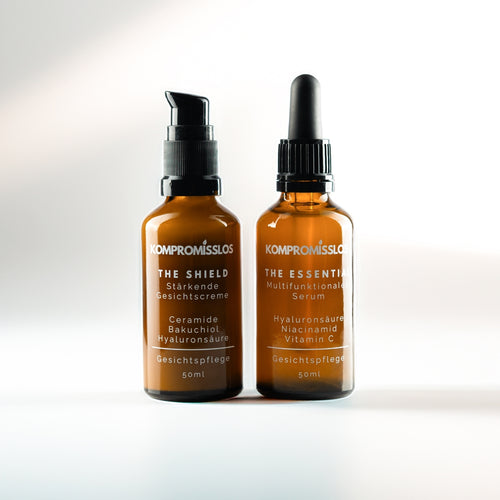
If it is no longer enough, building on your routine gradually makes more sense than changing everything at once. A light serum with niacinamide for your complexion, topped with a cream containing ceramides and squalane for the barrier, plus bakuchiol as a gentle alternative to retinol, covers many of the reasons that come up in these years. That is exactly how The Duo of serum and cream is put together: as a foundation for skin that is no longer quite as uncomplicated as it was in your late 20s, but does not yet need specialist treatment. In her review on Judge.me, Andrea G. writes: “Light yet nourishing skincare. Just two products that combine everything you need.” (review translated from German). What shifts after that, and what to look out for in the following decade, is covered in the article on face cream in your 40s.
What changes for combination skin in your 30s?
With combination skin in your 30s, the cheeks often become drier while the T-zone is still shiny, which means the skincare from your 20s often no longer suits you. Because sebum production declines over the years, the cheeks are usually the first to dry out, while the forehead and nose still shine. Mattifying, strongly oil-stripping products that suited you at 22 now dry out your cheeks without really calming your T-zone. What works better is a light cream with humectants and barrier lipids that you apply thinly all over and a little more generously to dry areas. As a rule, you do not need two separate creams for your T-zone and your cheeks. What combination skin needs in general is explained in detail in a separate guide. If, in your 30s, you start getting new inflamed, painful spots on your chin or along your jawline that do not heal, have them checked by a dermatologist – that is not a question of which cream to choose.
I will be upfront about it: I do not make Kompromisslos primarily for women in their 30s. The skin I developed The Duo for is more sensitive, drier or more mature – for most women, from around 35 or 40. In your 30s, you do not necessarily need two products. What you do need is sunscreen, every day. Our cream deliberately contains no SPF: you choose a separate sunscreen to suit your daily life and apply exactly the amount you need. It does not contain retinol either, but bakuchiol instead, because sensitive skin often reacts to retinol with flaking and stinging. If your skin is calm in your 30s and a simple cream is enough, stick with it. If you need more later on, our page on how to use the two steps explains how they build on each other.
Frequently asked questions
Do I need a night cream in my 30s?
No, you do not necessarily need a separate night cream in your 30s. If your day cream does not contain sunscreen, you can simply apply it again in the evening. A richer night cream is only worth it if your skin feels tight in the morning or becomes noticeably drier in winter. You do not need a day cream with SPF at night.
Is retinol worth using in your 30s?
Retinol can make sense in your 30s if you have a specific reason, such as your first lines or dark spots, and your skin is not sensitive. Without a reason, it is not an essential step. The article on when to start retinol explains what role age really plays in this decision.
Do I need a serum in my 30s?
No, not necessarily. A serum is worth it in your 30s if a good cream does not cover a particular concern, such as redness, dark spots or a dull complexion. How to tell is explained in the article on serum in your 30s.
Is niacinamide worth it in your 30s?
Niacinamide makes sense in your 30s if your skin looks unsettled or you have redness, your first dark spots or blemishes. In studies, skin tolerated it well, even when it was applied twice a day. If none of these issues apply to you, it adds little in your 30s, and a good basic cream is enough.
Is anti-ageing cream too early in your 30s?
A cream labelled anti-ageing will not harm your skin in your 30s, but it is usually unnecessary as long as moisture, barrier and sun protection are taken care of. The article on when to start anti-ageing skincare explains at what age targeted care against skin ageing makes sense.
How much should a good face cream cost in your 30s?
There is no price point at which a cream becomes better. You can find a solid moisturiser with glycerin and barrier lipids at the chemist, too. Spending more is only worth it if you get something specific in return: disclosed concentrations, a fragrance-free formula for sensitive skin or an active ingredient you are specifically looking for. Just do not skimp on sunscreen.
Is The Duo worth it in your 30s?
To be honest, you usually do not need The Duo in your 30s. If your skin is calm, a good cream plus sunscreen is enough. It becomes worthwhile if your skin is sensitive or dry, looks unsettled, or if you would rather settle on two products now than rebuild your routine later. The Duo does not replace sunscreen – you still need that on top during the day.
Sources
- Hughes MC, Williams GM, Baker P, Green AC. Sunscreen and prevention of skin aging: a randomized trial. Annals of Internal Medicine, 2013. Source
- Flament F, Bazin R, Laquieze S, Rubert V, Simonpietri E, Piot B. Effect of the sun on visible clinical signs of aging in Caucasian skin. Clinical, Cosmetic and Investigational Dermatology, 2013. Source
- Luebberding S, Krueger N, Kerscher M. Age-related changes in skin barrier function – quantitative evaluation of 150 female subjects. International Journal of Cosmetic Science, 2013. Source
- Bissett DL, Oblong JE, Berge CA. Niacinamide: A B vitamin that improves aging facial skin appearance. Dermatologic Surgery, 2005. Source