Face cream for your 40s: how to spot a good one and what you don’t need yet
SKIN OVER 40
You can spot a good face cream for your 40s by its ingredient list, not by the number on the packaging. It supplies barrier lipids such as ceramides and squalane, binds moisture, contains no fragrance and names its active ingredients in a way you can check. The texture should suit your skin as it is today: richer if it is dry, lighter if it is combination skin. What you usually do not need yet at 40: five specialist products, retinol as a must and promises that wrinkles will disappear.
What changes in your skin between 40 and 50?
Between 40 and 50, what many people notice most is that their skin has fewer lipids of its own and therefore less resilience: it dries out faster, reacts more sensitively and recovers more slowly. A study in the Archives of Dermatological Research compared the lipids in the outermost layer of the skin in women of different age groups and found significantly lower levels of all the major lipid classes with increasing age, especially ceramides. In winter, levels were also clearly lower than in spring and summer. The researchers concluded that this loss probably helps explain why aged skin is more prone to a disrupted barrier and dryness, particularly in winter. In everyday life, this shows up as a feeling of tightness after washing, as fine dryness lines around the eyes and mouth, and as make-up that looks flakier by the evening than it used to. On top of that come the hormonal shifts that begin for many women in their forties, and the sum of decades of UV exposure, which now shows up as pigmentation spots and softer contours.
Much of this starts to show earlier, as the article on the first signs of skin ageing shows. When it comes to choosing a cream in your 40s, something else matters: the barrier becomes the main job, not fighting wrinkles.
How do you spot a good face cream for your 40s?
You can spot a good face cream for your 40s by six points you can check in the ingredient list and on the packaging, not by the price and not by the age label. The most important point is the barrier: ceramides, squalane and plant oils replace exactly the lipids your skin is now running short of. The second is humectants such as hyaluronic acid or glycerin, which bind water in the stratum corneum. Next come active ingredients that have been studied for the appearance of ageing skin, and a formulation without unnecessary irritants. One practical check is the position in the INCI list: whatever is near the top is present in larger amounts, and whatever is right at the end is often only present in traces. And a brand that discloses its concentrations saves you the guesswork.
| Criterion | How to spot it | Why it matters in your 40s |
|---|---|---|
| Barrier lipids | Ceramides, squalane, jojoba or other plant oils in the INCI list | The stratum corneum has fewer lipids of its own as you get older |
| Humectants | Hyaluronic acid, glycerin, plant polysaccharides | Your skin loses water more quickly and feels tight |
| Niacinamide | “Niacinamide” in the INCI list, ideally with a percentage | Well studied for fine lines, dark spots and redness |
| Bakuchiol instead of retinol | Bakuchiol in the INCI list, no retinol as a mandatory ingredient | Skin that is becoming more sensitive often tolerates gentler active ingredients better |
| Fragrance-free | No “parfum”, no essential oils, no limonene or linalool | Fragrances bring no skincare benefit, only a risk of irritation |
| Disclosed concentrations | Percentages on the packaging or the website | The only way to compare products at all |
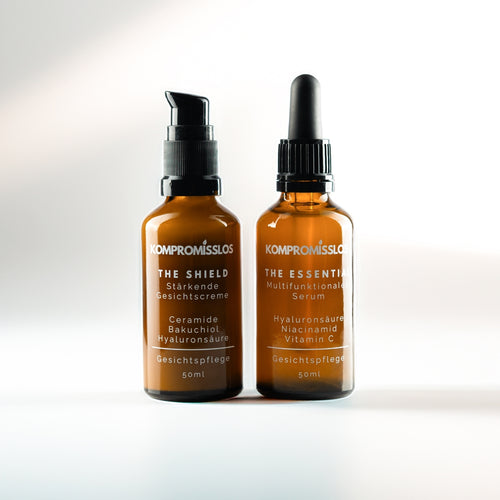
The Duo, made up of The Essential serum and The Shield cream, is built on exactly these criteria: ceramides, squalane, jojoba oil and bakuchiol in the cream; niacinamide, vitamin C and hyaluronic acid in the serum; fragrance-free and with disclosed concentrations. A cream does not have to cover every point on its own. Its core job is lipids and protection, while higher concentrations of active ingredients often come from a serum applied beforehand. How dry your skin is also helps to decide whether a serum is worth it in your 40s.
Which active ingredients are backed by good evidence in your 40s?
In your 40s, the best evidence is for daily sun protection, retinoids and niacinamide, with ceramides and humectants as the foundation for the barrier. For niacinamide, there is a frequently cited study in Dermatologic Surgery: 50 women with signs of photoageing applied 5% niacinamide to one half of the face twice a day for 12 weeks, and a base without the active ingredient to the other half. The niacinamide side showed fewer fine lines and wrinkles, fewer dark spots, fewer red blotches, less sallowness and better elasticity. That is a modest group and not a free pass for every cream with niacinamide somewhere in its INCI list, but it shows the concentration range in which the ingredient has been studied. Retinol and bakuchiol deserve a closer look, because they are often played off against each other:
- Retinoids are among the best-studied active ingredients for visible photoageing, but retinol often needs a settling-in period, and when to start retinol depends more on your skin than on the year you were born.
- In a study with 44 participants in the British Journal of Dermatology, bakuchiol (0.5 per cent, twice a day) performed similarly to retinol (0.5 per cent, once a day) on wrinkle surface area and hyperpigmentation, with more scaling and stinging reported in the retinol group; there is more on this in bakuchiol or retinol for sensitive skin.
- Ceramides, squalane and hyaluronic acid are not anti-wrinkle ingredients in the strict sense, but they keep the barrier stable, and everything else builds on that.
- Sun protection is the one active ingredient no cream can replace; there is more on this in the questions below.
Light or rich texture in your 40s: what suits dry skin and what suits combination skin?
Dry skin in your 40s needs a richer cream with more lipids, while combination skin is better off with a light emulsion that does not leave the T-zone shiny. The difference lies less in the active ingredients than in the balance of water, humectants and oils; the basics are covered in rich vs light moisturiser. When you are choosing a cream in your 40s, three observations are enough. If your skin feels tight again an hour after applying cream, it is more likely lacking oil than water. If your forehead is shiny by midday while your cheeks feel tight, a medium texture makes more sense than a heavy night cream all over your face, and dry patches simply get a little more. And because skin lipids decrease in winter, your skincare can be richer in January than in July. Combination skin often stays combination skin at 40; for many, only the boundary shifts: the cheeks become drier, while the T-zone changes less.
Honest feedback on our own cream shows that even a well-suited cream can reach its limits on dry skin in winter. In her review on Judge.me, Daniela B. writes: “However, the cream does not give my mature, dry skin enough moisture in winter. That is why I combine it with a natural facial oil in the evening […]” (review translated from German). That is a sensible approach: a medium cream plus a few drops of oil in the evening is more flexible than a very heavy cream that is too much in summer.
Don’t judge a texture on the back of your hand in the shop; judge it after two weeks on your face, morning and evening. The skin on your hand is different from the skin on your cheeks and forehead, and a first impression tells you little about how your face will feel after a day in heated rooms.
What do labels such as “40+” and “anti-ageing” on the packaging mean?
Labels such as “40+” or “anti-ageing” are marketing categories, not standardised formulation categories. There is no rule on what a cream has to contain to call itself “40+”. Two creams with the same label can differ completely in lipid content, active ingredients and fragrance, and a cream without an age label may be the better choice for your skin. In cosmetics, “anti-ageing” also does not mean that wrinkles will disappear. Cosmetics may improve the appearance of the skin, but medical claims are off limits. Wording such as “softens the appearance of fine lines” is therefore more honest than “wrinkles gone” or “lifting effect”. Three questions are more useful than any label: which active ingredient does the cream contain, and in what amount; does it contain fragrance; and does the texture suit your skin? Rankings do not do this checking for you either. What a ranking of the best face cream for mature skin does and does not tell you is covered in a separate article; for your decision, what counts is whether the criteria in the table above are met.
What don’t you need yet at 40?
At 40, in most cases you need neither skincare designed for very dry, mature skin nor a shelf full of specialist products. Your skin is changing, but it is usually not yet so dry that a very rich cream would make sense without good reason, and too much oil can encourage shine and clogged pores in combination skin. Nor does every area of the face need its own product. What you can usually skip at 40:
- A very rich cream for mature skin, as long as your skin does not feel tight. What changes a decade later is covered in the article on face cream for over 50s.
- A separate neck cream: your face cream is enough if you take it down over your neck as well.
- Retinol as a mandatory step, just because your 40th birthday is coming up.
- Toner, boosters and primers “for mature skin” on top of serum and cream.
- Creams that promise a Botox or lifting effect: cosmetics do not tighten the skin the way a procedure does.
What you actually need from 40 onwards is a short list: a mild cleanser, a cream that suits your skin, a serum if needed and daily sun protection. If your skin reacts to many things with redness or burning, the article on anti-ageing care for sensitive mature skin will help.
I put bakuchiol in our cream, not retinol. I make skincare for women with sensitive, dry or mature skin, and that is exactly where retinol often needs a settling-in period with flaking and burning. Even so, I do not transfer the study results on bakuchiol one to one to our product. What I can disclose, I want to disclose: 5% niacinamide, 2% vitamin C as 3-O-Ethyl Ascorbic Acid and 1% zinc PCA, calculated for The Duo as a whole. What I do not promise is that a cream will make wrinkles disappear. It can make skin look suppler and plumper and soften the appearance of fine dryness lines, but deeper wrinkles stay. What job each ingredient does is explained on our page on the active ingredients.
Frequently asked questions
What should you look for in a face cream at 45?
At 45, the same criteria apply as at 40, but the emphasis shifts further towards the barrier. In these years, many people notice that their skin becomes drier and reacts more quickly to new products. So pay closer attention to ceramides, squalane and plant oils, to whether a cream is fragrance-free and to a texture that is still rich enough in winter. You do not need a new age label for that.
Does perimenopause already play a role in choosing a cream at 40?
Yes, for many women the hormonal changes begin in their forties, and the skin then often becomes drier and more sensitive. For your cream, that means leaning towards more lipids and fewer irritants. What exactly changes during this phase is explained in the article on perimenopause skin changes.
Does a face cream in your 40s help with first dark spots?
A cream alone will not make dark spots disappear; the most important lever is daily sun protection, so that existing spots do not get darker and fewer new ones appear. Active ingredients such as niacinamide can soften the appearance of an uneven complexion over several weeks. What is realistic is covered in dark spots on the face. Have any spots that change checked by a dermatologist.
Do I need an eye cream as well as a face cream in my 40s?
Usually not: you can apply a well-tolerated, fragrance-free face cream up to the bony rim beneath the eye. A separate product is mainly worth it if your facial skincare stings there or runs into your eyes, as the article on whether you really need an eye cream shows.
Does your day cream need SPF in your 40s?
Your day cream itself does not have to contain SPF, but your skin needs sun protection during the day, whether in the cream or as a separate product. In a randomised trial in the Annals of Internal Medicine with 903 adults under 55, the group using sunscreen every day showed no detectable increase in skin ageing after 4.5 years. Skin ageing was 24 per cent lower than with occasional use.
How long does it take for a new cream to work?
A feeling of tightness often eases within a few days, but you should allow several weeks for visible changes to your complexion, as the realistic timelines in the article on how long skincare takes to work show.
Is The Duo enough skincare for your 40s?
For many people in their 40s, yes, together with a mild cleanser and daily sun protection, because neither is included in the Duo. With its serum and cream, The Duo covers moisture, barrier lipids and active ingredients, fragrance-free and with disclosed concentrations. If your skin is very dry, use a little more cream or add a facial oil in the evening. With a 100-day return policy, you can take your time finding out whether it is enough for your skin.
Sources
- Rogers J, Harding C, Mayo A, Banks J, Rawlings A. Stratum corneum lipids: the effect of ageing and the seasons. Archives of Dermatological Research, 1996. Source
- Bissett DL, Oblong JE, Berge CA. Niacinamide: A B vitamin that improves aging facial skin appearance. Dermatologic Surgery, 2005. Source
- Dhaliwal S, Rybak I, Ellis SR, Notay M, Trivedi M, Burney W et al. Prospective, randomized, double-blind assessment of topical bakuchiol and retinol for facial photoageing. British Journal of Dermatology, 2019. Source
- Hughes MC, Williams GM, Baker P, Green AC. Sunscreen and prevention of skin aging: a randomized trial. Annals of Internal Medicine, 2013. Source