Serum in your 40s: worth it or unnecessary, and how to tell
SKIN AND AGE
A serum in your 40s makes sense for most women, because in this decade skin holds on to moisture less well and a cream on its own barely delivers active ingredients at any meaningful concentration. It only remains unnecessary if your skin is calm, doesn’t feel tight after washing and you are happy with your current routine.
Is a serum in your 40s worth it or unnecessary?
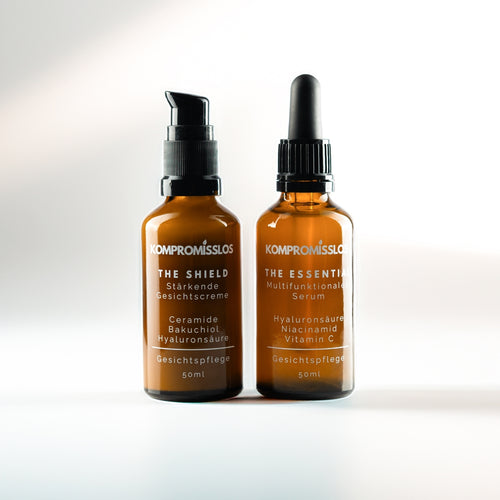
It is worth it as soon as you expect more from your skincare than moisture and protection. A serum is a light, low-oil formula with a high proportion of active ingredients. A cream supplies lipids and a layer that slows moisture loss from the skin’s surface. Those are two different jobs, and in your forties they drift noticeably apart for the first time. Your skin produces less sebum than at 30, binds water less well, and visibly takes longer to recover after a short night. A cream can cushion that, but it carries hardly any active ingredients in amounts that change how your skin looks. That is exactly why Kompromisslos only offers the Duo of serum and cream together: active ingredients first, then something on top to seal them in. A serum does become unnecessary, though, if there is no goal behind it. An extra product with no reason makes your routine more complicated, not better. Why the two steps belong together is shown in our direct comparison.
What actually changes in your skin from 40?
From 40, less changes all at once than advertising suggests, but the sum of the years becomes reliably visible for the first time. The best-documented factor is collagen. In a reference study in the British Journal of Dermatology involving 148 people aged between 15 and 93, the collagen content of forearm skin fell almost linearly by around 1 per cent a year, across the whole of adult life. So nothing tips over on your 40th birthday. What shifts is the accumulated amount: compared with your mid-twenties, around fifteen years of this decline have added up. On top of that come two things many women notice first in this decade. Skin feels tight after cleansing more often than it used to, and pillow creases stay visible for minutes in the morning. In the second half of their forties, many women also begin the hormonal transition, which can increase dryness and sensitivity. Which signs tend to appear first is covered in a separate article.
What skincare does your skin need in your 40s?
Skin in your 40s reliably needs four things: gentle cleansing, moisture, a well-supported barrier and daily sun protection. Everything else is an extra. Skincare in your 40s rarely fails for lack of products, but for lack of consistency. Your cleanser shouldn’t strip your skin, or you will be working against your own barrier, which becomes more permeable at this age anyway. Moisture is best delivered in two steps: a serum that binds water and delivers active ingredients, and a cream that keeps both in place. Sun protection in the morning is the least exciting and at the same time the most effective part, because a large share of the visible signs of ageing on the face comes down to UV exposure. What you can leave out: a separate eye product, a toner, a second night cream and any product you forget about after two weeks. Exactly how much to use and in what order is set out on the page explaining how to use both products, and the full routine is described in our article on caring for mature skin.
How can you tell it’s time for a serum?
It’s time when you notice at least one specific change that your current skincare no longer handles. It isn’t your year of birth that decides, but what you notice when you touch your skin and look in the mirror. Typical triggers in your forties are tightness after cleansing that doesn’t go away within a few minutes, dehydration lines that stay visible for longer in the morning than five years ago, dark spots after the summer, recurring redness on your nose and cheeks, or skin that feels oily and dry at the same time. Each of these has its own cause and asks something different of a serum. A milestone birthday or the feeling that you now have to do something, on the other hand, is not a trigger. Why your skin’s condition matters more than your skin type here is explained in a separate article. The overview below matches the most common observations to their likely cause.
| What you notice day to day | What is usually behind it | What a serum in your 40s should then do |
|---|---|---|
| Skin feels tight after cleansing | Your cleanser strips oil; the barrier is more permeable | Bind water before the cream seals it in |
| Pillow creases linger in the morning | Less collagen, slower recovery | A moisture reservoir in the upper layers of the skin |
| Dark spots after the summer | UV-related changes in pigmentation | An active ingredient for a more even complexion |
| Redness on nose and cheeks | The irritation threshold drops; the barrier is weakened | A gentle formula without fragrance or alcohol |
| Skin feels oily and dry at the same time | Lack of moisture; sebum distribution shifts | A light texture instead of heavy oils |
| None of these; skin stays calm | Your skincare suits you right now | No serum needed; sun protection is enough |
Which active ingredients should a serum deliver in your 40s?
From 40, three groups count: something that binds water, a well-tolerated active ingredient for your complexion, and something that supports the barrier. Anything beyond that is a bonus. In the Duo, 2% hyaluronic acid binds water. For your complexion, niacinamide is the best-researched candidate: in a double-blind split-face study in the journal Dermatologic Surgery, 50 women with visible signs of photoageing applied a preparation containing 5% niacinamide to one half of the face and the ingredient-free base to the other, twice a day for twelve weeks. Compared with the base, there were improvements in fine lines, dark spots, redness and sallowness. Exactly this 5% is in the Duo, along with 2% vitamin C as 3-O-ethyl ascorbic acid, 1% zinc and 0.3% bakuchiol. The barrier is supported by ceramides, squalane, panthenol and jojoba oil, complemented by 2% edelweiss extract and 2% gentian root extract. You will find the full breakdown under ingredients in detail.
All percentages refer to The Duo as a whole, not to either product on its own. How bakuchiol and retinol differ is explained in our article on bakuchiol or retinol for sensitive skin.
When you don’t need a serum in your 40s, and when a specialist is the better choice
You don’t need a serum if your skin stays calm, doesn’t feel tight after washing, isn’t shiny and simply nothing bothers you. In that situation, a second product only adds effort and cost. Nor does it make sense to start in the middle of an irritated phase: if your skin is currently stinging, flaking or itching, calm it down first before adding new active ingredients. And there are situations where cosmetics are the wrong tool. Persistent redness with visible thread veins, weeping or itchy patches, deep, inflamed lumps that leave scars, and a mole that changes in colour, size or outline all need to be checked by a dermatologist. Skincare can influence how your skin looks. It replaces neither diagnosis nor treatment. What shifts a decade later, and why the answer is then clearer, is covered in our article on serum in your 50s.
The forties are the decade in which I get the most questions, and they are almost always about the same worry: not missing out on anything now. I understand that, but I think it’s the wrong motivation. When I developed the Duo, I deliberately didn’t want to build a product for a particular age, but two steps that work together. That’s why I don’t sell the serum on its own. Two products, CHF 109.90, morning and evening, three to six drops of serum and three to six pumps of cream. Depending on how often you use it, a bottle lasts two to four months. If you start at 40 and keep it up, you will get further than with seven half-used jars sitting in the cupboard.
Frequently asked questions
Do you really need a serum in your 40s?
You don’t need one, but for most women it makes sense. What you do need at 40 is gentle cleansing, moisture and daily sun protection. A serum comes in as soon as you notice something specific: tightness after washing, dehydration lines in the morning, dark spots or recurring redness.
What skincare does your skin need in your 40s?
Gentle cleansing, moisture, a well-supported barrier and sun protection every day. That is the foundation, and in your forties it does the most work. A serum with clearly defined active ingredients and a cream that seals everything in complete it. More products rarely bring more results; a routine you stick to does.
Is a good cream alone enough at 40?
For moisture and protection, it is often still enough. As soon as you want to change something about your complexion, it no longer is, because creams can only carry a limited amount of active ingredients at meaningful concentrations. From 40, your skin also holds water less well and so benefits from a second step.
Which serum suits sensitive skin in your 40s?
One without fragrance, without alcohol and without a high concentration of acids. Well-tolerated active ingredients include hyaluronic acid, niacinamide and panthenol, complemented by ceramides and squalane for the barrier. Apply it to slightly damp skin and work gently rather than massaging it in, because friction lowers the irritation threshold.
Is retinol worth it in your 40s, or is there a gentler alternative?
Retinol can soften the look of fine lines, but it often irritates sensitive skin and makes it more sensitive to light. Bakuchiol is considered a gentler alternative and is included in the Duo at 0.3%. In your forties, daily sun protection remains more important than the choice between the two.
How long does it take for a serum to make a visible difference in your 40s?
Allow eight to twelve weeks before judging the result. The study on 5% niacinamide cited above ran for twelve weeks. Tightness and dryness often improve after just a few days; fine lines and uneven pigmentation take considerably longer.
Should you apply a serum in your 40s in the morning, in the evening or twice a day?
Twice a day, morning and evening. In the morning it provides moisture under your cream and sunscreen; in the evening your skin is busy recovering anyway. Three to six drops on slightly damp skin, followed by three to six pumps of cream. If your skin is very sensitive, start with one week of evenings only.