Serum in your 30s: worth it or unnecessary, and how to tell
SKIN AND AGE
A serum in your 30s makes sense if you are using it for a specific goal, and is unnecessary if you are only buying it because of your year of birth. At 30, skin usually still holds on to moisture well. What really matters at this age is daily sun protection and a routine you can keep up for ten years. A serum adds to that routine; it doesn’t replace it.
Is a serum in your 30s worth it or unnecessary?
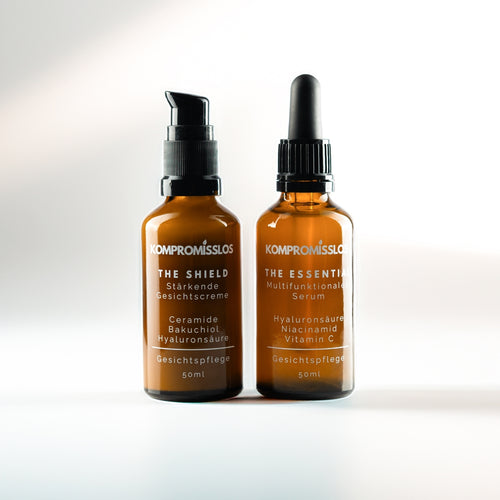
A serum in your 30s is worth it as soon as there is a specific reason behind it: dark spots after the summer, an uneven complexion, redness, or dehydration lines that linger longer in the morning than they used to. It is unnecessary if the only reason is the number in your passport. A serum is a light, low-oil formula with a high proportion of active ingredients. A cream, by contrast, supplies lipids and a layer that slows moisture loss from the skin’s surface. At 30, that layer still works well for most women: the skin produces enough of its own sebum and recovers quickly. So a serum at this age is not an obligation but a decision that needs a reason. If you do make it, though, do it properly: active ingredients first, then something on top to seal them in. That is exactly why Kompromisslos only offers the serum and cream together. Why the two steps belong together is explained in our article comparing serum and cream side by side.
What actually changes in your skin from 30?
From 30, what changes is mainly the pace at which your skin renews itself, not its basic make-up. The most measurable factor is collagen. In a reference study in the British Journal of Dermatology involving 148 people aged between 15 and 93, the collagen content of forearm skin fell almost linearly by around 1 per cent a year across the whole of adult life. That is not a sudden drop at 30 but a slow process that started earlier. Even so, it becomes visible in your thirties: pillow creases stay longer in the morning, fine lines around the eyes no longer disappear straight away, and after short nights your skin looks tired more quickly. What usually doesn’t change yet is its ability to hold moisture. So the question is less what you need to repair now, and more what you will do consistently from now on. Which measures genuinely make a difference is covered in our article on slowing down skin ageing.
What skincare does your skin need in your 30s?
Skin in your 30s reliably needs three things: gentle cleansing, moisture and daily sun protection. Sun protection is not the dullest part but the most effective one. A study in Clinical, Cosmetic and Investigational Dermatology compared 298 women aged between 30 and 78: 157 with pronounced sun-seeking behaviour and 141 who consistently avoided the sun. The visible signs of ageing differed markedly in every age group, and the authors attribute around 80 per cent of the visible signs of facial ageing to UV exposure. For your thirties, that means a serum without daily sun protection is the wrong way round. Protection first, then the extras. After that, the routine stays simple: serum on slightly damp skin, cream on top, morning and evening. Exactly how much to use and in what order is set out on the page explaining how to use both products. And why your skin’s condition matters more than your skin type is covered in a separate article.
When is a serum in your 30s worth it, and when not?
A serum in your 30s is worth it whenever you want to change something specific, and not worth it if your skin is calm and you are happy with it. That distinction sounds obvious, but it saves money and disappointment. Typical reasons in your thirties are dark spots after the summer, blemishes that come and go with your hormones, recurring redness on the nose and cheeks, or skin that feels tight after washing. In these cases, a serum delivers active ingredients at a concentration a cream can’t carry in the same way. A birthday, an advertising promise or the feeling that you now have to do something because you are 30 are not reasons. Nor does it make sense to start in the middle of an irritated phase. If your skin is currently stinging or flaking, calm it down first before adding new active ingredients. The overview below shows what each starting point in your thirties calls for.
| Starting point at 30 | Is a serum worth it? | What matters first |
|---|---|---|
| Skin calm, no concerns | Not needed | Gentle cleansing, cream, daily sun protection |
| Dark spots after the summer | Yes | An active ingredient for your complexion plus consistent UV protection |
| Tightness after washing | Yes | Bind moisture, review your cleanser |
| Blemishes that fluctuate with your hormones | Usually yes | Light texture without heavy oils |
| Skin currently irritated or red | Not right now | Calm it first, then add to your routine |
Which active ingredients should a serum contain in your 30s?
From 30, three groups count: something that binds water, a well-tolerated active ingredient for your complexion, and something that supports the skin barrier. Anything beyond that is a bonus. In the Duo, 2% hyaluronic acid binds water. For your complexion there is 5% niacinamide, 2% vitamin C as 3-O-ethyl ascorbic acid and 1% zinc. On top of that comes 0.3% bakuchiol as a gentler alternative to retinol, which in your thirties is often a better place to start than a high-strength retinoid. The barrier is supported by ceramides, squalane, panthenol and jojoba oil, complemented by 2% edelweiss extract and 2% gentian root extract. All percentages refer to The Duo, our serum and cream, as a whole, not to either product on its own. You will find the full breakdown under ingredients in detail. How bakuchiol and retinol differ is explained in our article on bakuchiol or retinol for sensitive skin.
When you don’t need a serum at 30, and when a specialist is the better choice
You don’t need a serum at 30 if your skin stays calm, doesn’t feel tight, isn’t shiny and nothing bothers you. In that situation, a second product only adds effort and cost. Nor do you need an eight-step routine, a separate eye product or a high-strength retinoid at this age just because they are recommended everywhere. In your thirties, less – but every day – almost always beats a big collection. And there are situations where cosmetics are the wrong tool. Deep, inflamed lumps that leave scars, persistent redness with visible thread veins, weeping or itchy patches, and a mole that changes in colour, size or outline all need to be checked by a dermatologist. Skincare can influence how your skin looks. It replaces neither diagnosis nor treatment. What applies a decade later, and why the answer shifts then, is covered in our article on serum in your 50s.
I regularly get this question from women in their early thirties, and it almost always sounds the same: am I starting too early? My honest answer is usually no, you are not too early – but you need less than you are being sold. I deliberately didn’t design the Duo as an anti-ageing product for a particular age. Two products, CHF 109.90, morning and evening, three to six drops of serum and three to six pumps of cream. Depending on how often you use it, a bottle lasts two to four months. If you start at 30 and keep it up, that will do more for you than any product you try for the first time in ten years’ time.
Frequently asked questions
Do you really need a serum from 30?
You don’t need one, but it can make sense. What you do need at 30 is gentle cleansing, moisture and daily sun protection. A serum comes in when you have a specific concern: dark spots, redness, an uneven complexion or dehydration lines that linger longer in the morning.
What skincare does your skin need in your 30s?
Gentle cleansing, moisture and sun protection every day. That is the foundation, and in your thirties it does the most work. A serum with clearly defined active ingredients and a cream that seals everything in are sensible additions. More products rarely bring more results; a routine you stick to consistently does.
Is a cream alone enough at 30?
For many people, yes. A good cream covers moisture and protection, and at 30 skin usually still holds on to both well. As soon as you also want to change something about your complexion, it is no longer enough, because creams can only carry a limited amount of active ingredients at meaningful concentrations.
Does skin need a serum from 25?
Generally not. At 25, skin recovers quickly and holds moisture well. A serum is only worth it at this age for a specific concern such as blemishes or dark spots. It makes more sense to start using daily sun protection early and stick with it.
Is retinol worth it at 30, or is it too early?
It isn’t too early, but it isn’t essential either. Retinol can soften the look of fine lines, but it often irritates sensitive skin and makes it more sensitive to light. Bakuchiol is the gentler alternative and is included in the Duo at 0.3%. In your thirties, daily sun protection remains more important than either.
Which serum suits blemish-prone skin at 30?
One with a light texture, no heavy oils and no fragrance. Niacinamide and zinc are considered well-tolerated active ingredients for a more even complexion here; the Duo contains them at 5% and 1%. If deep, inflamed spots persist, they need a dermatologist’s assessment rather than a skincare routine.
How long does it take for a serum to make a difference in your 30s?
Tightness and dryness usually improve within a few days. For changes to your complexion, such as fine lines or uneven pigmentation, allow eight to twelve weeks. Don’t judge the result any sooner, or you will switch away from a product that hasn’t had a chance yet.
Sources
- Shuster S, Black MM, McVitie E. The influence of age and sex on skin thickness, skin collagen and density. British Journal of Dermatology, 1975. Source
- Flament F, Bazin R, Laquieze S, Rubert V, Simonpietri E, Piot B. Effect of the sun on visible clinical signs of aging in Caucasian skin. Clinical, Cosmetic and Investigational Dermatology, 2013. Source