How to slow down skin ageing: what the evidence shows and what you can skip
SKIN AND AGE
You can slow down skin ageing above all through consistent sun protection, not smoking and skincare that supports the skin barrier. Around 80% of the visible signs of ageing on the face are attributed to UV radiation. Chronological ageing itself cannot be stopped, but the external part can be slowed considerably. What counts is what you do every day, not what goes on your skin once a month.
Slowing down skin ageing: which part can you actually influence?
Skin ageing has two components that behave in completely different ways. The first is chronological ageing: the skin renews itself more slowly, produces less collagen and holds moisture less well. You have no control over this part; it happens to everyone, and no list of active ingredients changes that. The second component comes from everything that acts on the skin from outside – above all sun, smoke, mechanical irritation and periods when the skin barrier is overwhelmed. This second component is the big lever, because it can be changed through behaviour. So if you want to slow down skin ageing, it is never about stopping the clock. It is about reducing the additional damage that comes on top. That also explains why two people of the same age can look very different, even though their cells are the same age. The good news: the part you can influence is the larger of the two.
What speeds up skin ageing the most?
The sun, by a clear margin ahead of everything else. A clinical study of women with very different sun habits concludes that around 80% of the visible signs of ageing on the face are due to UV exposure. This mainly concerns fine lines, uneven pigmentation and skin texture. The authors attribute loss of firmness more to gravity, which is a useful reminder that not every sign of ageing has the same cause. Switzerland has an additional factor: according to MeteoSwiss, the strength of UV radiation increases by 10 to 12% per 1000 metres of altitude, and snow reflects a considerable share of it back. A day’s skiing in February therefore exposes your skin to more radiation than a cloudy July day on the Swiss Plateau. If you spend a lot of time trying to calm an unsettled complexion with skincare but skip sun protection, you are working against yourself.
How much difference does sun protection really make?
Enough to be measurable. In a randomised study in Australia, adults under 55 were either asked to use sunscreen daily or applied it at their own discretion, over four and a half years. At the end, the daily-use group showed around 24% less skin ageing than the comparison group. A supplement that was also tested, by contrast, made no discernible difference. This is one of the few robust figures in a field full of promises, and it says something inconvenient: the most effective step against visible skin ageing costs little and is fairly boring. What matters is regularity, not the highest number on the packaging. Daily use in everyday life beats a very high sun protection factor that you only apply twice a summer. Kompromisslos does not sell sunscreen itself, so this is not a product recommendation – simply the most honest answer to the question.
What can skincare do, and where does its influence end?
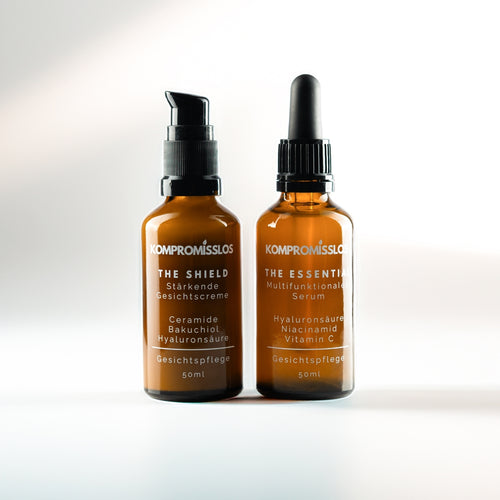
Skincare works on the appearance and function of the uppermost layers of the skin, not on the structure beneath. A cream does not rebuild connective tissue or smooth away a deep wrinkle. What it can do is support the skin barrier, improve moisture levels and so make the complexion look more even. Dehydration lines, for example, are often not true wrinkles but a result of missing moisture, and skincare responds well to that. For this, our Duo of serum and cream contains 2% hyaluronic acid, 5% niacinamide, 2% vitamin C as 3-O-Ethyl Ascorbic Acid and 0.3% bakuchiol, plus ceramides and squalane. All figures refer to the Duo as a whole, not to a single product. If you are interested in the order of the active ingredients, the article on whether vitamin C or niacinamide goes on first will help.
Which habits besides the sun make a difference?
In the specialist literature, smoking regularly comes straight after the sun, followed by chronic lack of sleep and ongoing stress. Then there are two points that are rarely mentioned: mechanical irritation and over-treating the skin. Vigorous rubbing when removing make-up, daily exfoliation or switching products every week irritate the skin with no discernible benefit to show for it. Irritated skin does not look younger; it looks more tired. Nor does it help to layer six products on top of each other when two of them do the same thing. Plant-based gentian root extract is a good example of an ingredient that works quietly rather than spectacularly. In the end, what counts with skin ageing is the sum of many unremarkable days, not a single intensive treatment. What such a routine looks like in practice and how to dose it is on our page about how to use the serum and cream. The overview below sorts the usual measures by what the evidence supports.
| Measure | Acts on | Strength of evidence | Effort |
|---|---|---|---|
| Daily sun protection | Fine lines, uneven pigmentation, skin texture | Randomised study over four and a half years | One extra step in the morning |
| Stopping smoking | Overall appearance of the skin | Widely studied as a risk factor | Hard, but effective for good |
| Consistent basic skincare | Moisture, tightness, evenness | Well researched on the ingredient side | Two minutes morning and evening |
| Constantly changing products | Mostly just your budget | No evidence of any benefit | High, with uncertain returns |
When is a professional a better choice than a skincare product?
As soon as it is no longer about appearance but about symptoms. Cosmetics may and should care for the skin, but they are not intended for diagnosing or treating skin conditions. See a dermatologist if a dark spot changes in shape, colour or size, if a patch weeps, bleeds or does not heal, if redness persists and hurts, or if you suddenly react to products you have tolerated for years. That applies at any age. And if structural changes such as pronounced wrinkles bother you, a specialist is the right place for a realistic assessment, because there are procedures there that a skincare duo for CHF 109.90 cannot replace. Skincare and dermatology are not in competition; they answer different questions. You can read what others have experienced with our skincare in the reviews from our customers.
For our Duo, I deliberately chose bakuchiol rather than retinol – precisely because of this calculation. Retinol has been studied more, but it requires a period of adjustment and can make the skin more sensitive to the sun. That is why many people put it away again after a few weeks. An active ingredient you stop using does nothing for you. Bakuchiol at 0.3% in the Duo is the quieter route, but one you can stick with morning and evening. The same thinking lies behind two products instead of eight. I could sell you a bigger routine, but the longest list of active ingredients is no use if it stays in the cupboard on the third evening. With skin ageing, consistency is the most underestimated factor.
Frequently asked questions
At what age should I start trying to slow down skin ageing?
With sun protection, as early as possible, because UV exposure adds up over the years. Skincare with active ingredients is worth it as soon as you notice the first changes – for many people, from their late thirties. There is no fixed age to start; what matters is the condition of your skin, not the number in your passport.
Can a cream get rid of wrinkles?
No. A cream works on the uppermost layers of the skin and can soften the look of fine lines by binding moisture and supporting the skin barrier. Dehydration lines respond well to this; deep structural wrinkles do not. Anyone who promises you otherwise is selling you an expectation the product cannot fulfil.
Do I need sunscreen on my face in winter too?
On sunny days, yes, especially in the mountains. UV radiation increases with altitude and is also reflected by snow, while the cold makes it easy to forget. On dull winter days on the Swiss Plateau, on the other hand, exposure is low. The UV index is a better guide than the thermometer.
Can too much skincare make your skin age faster?
Too much skincare does not directly speed up ageing, but it can overwhelm the skin barrier. Frequent exfoliation, harsh cleansing and constantly changing products lead to irritation, and irritated skin looks duller and more unsettled. Fewer steps, used consistently, usually give the better result day to day.
What is the difference between skin ageing and photoageing?
Skin ageing refers to the whole process; photoageing only to the part caused by UV radiation. Chronological ageing happens regardless of behaviour; photoageing comes on top and can be reduced through protection. That is exactly why it is the part where the effort pays off.
Is bakuchiol as effective as retinol?
Retinol has been studied more and is considered stronger. Bakuchiol is used as a gentler alternative because it is generally well tolerated and does not require a period of adjustment. For sensitive skin, that can be the more practical route, because skincare only works for as long as you actually use it.
How long does it take before I see a difference?
For moisture and skin feel, usually a few days to two weeks. For visible changes in your complexion, allow eight to twelve weeks, because that is the rhythm in which the skin renews itself. With sun protection, you will not see a short-term effect; the benefit only shows over years.
Sources
- Flament F. et al., Effect of the sun on visible clinical signs of aging in Caucasian skin, Clinical, Cosmetic and Investigational Dermatology, 2013. Source
- Hughes M.C.B. et al., Sunscreen and Prevention of Skin Aging: A Randomized Trial, Annals of Internal Medicine, 2013. Source
- MeteoSwiss, UV-Index, Wetter und Klima von A bis Z. Source