Do you need a night cream, or is one cream for day and night enough?
ROUTINE
In most cases, you do not need a night cream. What matters is that you look after your skin in the evening at all, not that the tube says ‘night’. A cream with humectants and skin-identical lipids, but without UV filters, can be the same one morning and evening. The real difference between day and night is UV protection, and a separate sunscreen provides it more reliably than a day cream with SPF. Very dry or mature skin sometimes simply needs a little more product in the evening, not necessarily a second product.
Do you need a night cream, or is your day cream enough?
For most skin types, one good cream used morning and evening is enough, as long as it contains no UV filters and your skin does not feel tight by morning. The split into day and night cream is mainly a way of organising product ranges. The term night cream does not stand for a fixed formula, and in some ranges the day and night versions differ in only a handful of ingredients. What counts is what your skin needs in the evening: moisture that is held in the skin, lipids that keep the outer layer supple and a film that slows down water loss. If your current cream does that, a second product does not take you any further. If, on the other hand, you use a day cream with SPF, it is the wrong choice for the evening – not because it is harmful, but because the filters have nothing to do at night.
The night cream question is therefore a variation on the bigger question of how many products your skin really needs. The honest answer is usually: fewer than the shelf suggests.
What is in a night cream that a day cream does not have?
A typical night cream mainly contains more fat and pays less attention to how it sits under make-up, often along with active ingredients that do not go well with sunlight – but hardly anything that a well-formulated daytime cream without SPF could not contain as well. A review in Clinical Medicine & Research divides moisturisers into lipid-rich emollients, humectants such as glycerin, panthenol or hyaluronic acid, and occlusives that slow down water loss. According to the authors, humectants often need to be combined with occlusives, because they draw water up from deeper layers to the surface, where it would otherwise evaporate easily. A night cream usually shifts the balance towards lipids and occlusives, a day cream towards a lighter texture. That is a difference in dosage, not in function.
| Ingredient | Job | Useful by day | Useful at night |
|---|---|---|---|
| Humectants (glycerin, panthenol, hyaluronic acid) | Binding water in the outer layer of the skin | Yes | Yes |
| Skin-identical lipids (ceramides, squalane, plant oils) | Keeping the outer layer supple, supporting the barrier | Yes | Yes, rather more for dry skin |
| Occlusive ingredients (waxes, petroleum jelly, butters) | Slowing down water loss | In small amounts | For very dry skin |
| UV filters | Protecting against UV radiation | Yes, better as a separate product | No |
| Light-sensitive active ingredients (e.g. retinoids, acids) | Targeted effect depending on the ingredient | Only with consistent sun protection | The usual time to use them |
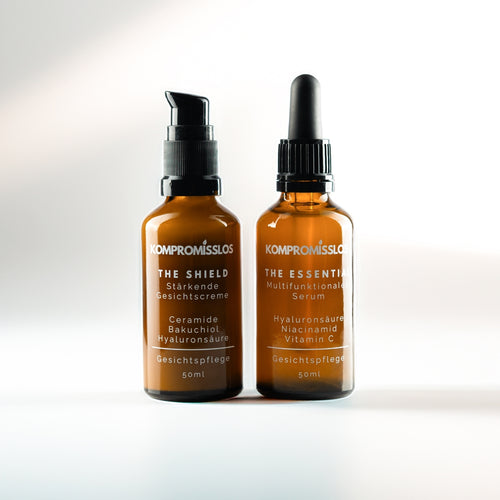
The table shows why two creams are rarely necessary: you need humectants, lipids and occlusives in the morning and the evening alike – only the amount shifts. That is why The Duo of serum and cream is designed to be used identically morning and evening, applied the same way at both times. In the morning, the only addition is a separate sunscreen.
Does skin regenerate differently at night than during the day?
Yes, skin follows a daily rhythm, and some processes really do run differently at night – but that does not mean you need a separate product for them. A review in the International Journal of Molecular Sciences sums up that cell division of keratinocytes in the human epidermis has been measured to be 30-fold higher at night than at midday. The same review describes water loss through the skin as higher in the afternoon and evening than in the morning, but also notes that the results vary depending on study design. A study in the Journal of Investigative Dermatology with 16 healthy volunteers concluded that skin is more permeable in the evening and at night than in the morning.
In practice, this means the evening is a good time for skincare, because your skin is losing more water then and there is no sun, make-up or sunscreen on top. But the rhythm runs regardless of what it says on the packaging. A cream without a night label meets exactly the same skin at exactly the same time.
Can I use a day cream at night?
Yes, you can use a day cream at night, as long as it contains no SPF and your skin does not feel tight with it in the morning. A plain moisturising cream without filters is just as useful in the evening as in the morning. Day creams with SPF are a different matter: the filters bring no benefit at night, and if your skin is sensitive, they simply mean extra ingredients on it. What is more, such a cream rarely replaces sunscreen during the day either, because it is applied far more thinly than when the protection factor is measured. The article on why a day cream with SPF is often not enough explains why. The cleaner solution is therefore one cream without SPF for morning and evening, plus a separate sunscreen in the morning.
What matters in a daytime cream when your skin is sensitive is covered in the guide to vegan day cream for sensitive skin. What it says about the morning also applies to the evening, as long as the cream contains no filters.
In the evening, skincare only works as well as the cleansing before it. If you wear sunscreen or make-up during the day, remove that layer first – otherwise the cream ends up on the leftovers of the day rather than on your skin.
Does mature skin over 50 need richer care at night?
Mature skin often needs more lipids in the evening, but that can mean more of the same cream rather than automatically a separate night cream. The barrier really does become slower over the years. A study in the Journal of Clinical Investigation compared young adults aged 20 to 30 with people over 80: after the skin barrier had been deliberately disrupted, it had recovered by 50 per cent within 24 hours in the younger group, but only by 15 per cent in the older group. Drawing partly on lipid measurements in a mouse model, the researchers attributed this to a general deficiency of lipids in the outer layer of the skin. This is not a finding about 50-year-olds, but it shows the direction of travel: with age, skin-identical lipids such as ceramides and squalane become more important in skincare.
Whether you need a second cream for this is something your skin tells you in the morning. If it feels soft when you get up, your skincare is enough. If it feels tight, a slightly larger amount is the first thing to try. If it stays dry, an extra thin layer of facial oil is a pragmatic addition. That is exactly what one customer does. In her review on Judge.me, Daniela B. writes: ‘However, the cream does not give my mature, dry skin enough moisture in winter. That is why I combine it with a natural facial oil in the evening, so that my skin is better nourished’ (review translated from German). What else skincare needs to do at this stage of life is covered in the guide to face cream over 60.
Is moisturising once a day enough, or should it be twice?
For dry, sensitive or mature skin, twice a day – morning and evening – is the sensible rule of thumb; for robust or oily skin, once can be enough. The review in Clinical Medicine & Research gives a sober reason: after eight hours, only half of the moisturiser applied is still on the skin’s surface. Depending on how dry the skin is, the authors therefore recommend applying it one to three times a day. If you only moisturise once, the evening is the better time, because your skin is losing more water then and the skincare can work undisturbed. Sunscreen is still a must in the morning. Whether you apply a serum and a cream each time or just a cream is a separate question. The guide on that topic explains whether you really need both a serum and a cream.
Your skin will show you over the course of the day whether once is enough:
- A tight feeling by late morning, especially on the cheeks and around the mouth
- Fine flakes or roughness that you notice when you run your fingers over your skin
- Make-up that settles into dry lines by the afternoon
- Skin that feels rough or tight shortly after cleansing in the evening
If one of these applies regularly, a second application during the day makes more sense than a richer cream just for the night.
I deliberately did not make a night cream. Our range consists of two products instead of eight, and The Shield is one cream for morning and evening. What it does not contain is a sun protection factor. An SPF would have no job at night, and during the day it would promise protection that barely materialises with the amount people usually apply. That is why I say it openly: in the morning, you also need a separate sunscreen, and you will not buy it from us. I prefer that to a day cream with a token filter. If your skin is very dry, use a little more morning and evening. How serum and cream are applied the same way at both times of day is explained in the instructions for use.
Frequently asked questions
Can I use a night cream during the day?
Yes, if it absorbs well and does not smear or pill under sunscreen and make-up. Very rich night creams often leave skin noticeably shiny during the day and make the sunscreen on top go on less evenly. A night cream never replaces UV protection; that always comes as a separate final step in the morning.
Does a night cream with SPF make sense?
No, an SPF has no job at night. The filters protect against UV radiation, and there is none in your bedroom. If your cream contains an SPF, it is meant for the morning. In the evening, you are better off choosing a cream without filters, so that the only ingredients left on your skin are ones that actually do something at that time.
Should I apply anything in the evening if my skin is oily?
Yes, a small amount of a light cream makes sense even for oily skin, because sebum and moisture are not the same thing. Oily skin can still lose water, especially after cleansing. If it feels balanced in the morning, the amount is right. If it looks very shiny or feels weighed down, reduce the amount before you leave out skincare altogether.
How long before bed should I apply my cream?
Fifteen to thirty minutes before going to sleep is a practical guideline, not a scientifically established interval. In that time, the cream is absorbed instead of ending up on your pillow. If you apply your skincare straight after cleansing in the evening and then read or watch TV, you already have that window. More important than the exact minute is that the cream goes onto freshly cleansed skin.
Does dry skin need a rich cream at night?
Not necessarily – often a little more of your usual cream in the evening is enough. Whether a lighter or richer texture suits your skin is explained in the guide to rich vs light moisturisers.
What happens if I skip moisturiser in the evening?
A single evening without cream is not a problem. If it becomes the rule, dry or mature skin in particular loses water overnight without humectants and lipids being replenished. Typical results are a tight feeling, roughness and fine dry lines in the morning. A weakened skin barrier also becomes irritated more quickly by cleansing, wind or dry central-heating air.
Do I need a night cream if I use The Duo?
No. The Duo is applied the same way morning and evening: cleanse your face with water, then apply 3 to 6 drops of serum, followed by 3 to 6 pumps of cream. If your skin is dry, use a little more each time. An additional night cream is not part of the plan. In the morning, the only addition is a separate sunscreen, because The Duo contains no sun protection factor.
Sources
- Matsui MS, Pelle E, Dong K, Pernodet N. Biological Rhythms in the Skin. International Journal of Molecular Sciences, 2016. Source
- Yosipovitch G, Xiong GL, Haus E, Sackett-Lundeen L, Ashkenazi I, Maibach HI. Time-dependent variations of the skin barrier function in humans: transepidermal water loss, stratum corneum hydration, skin surface pH, and skin temperature. Journal of Investigative Dermatology, 1998. Source
- Ghadially R, Brown BE, Sequeira-Martin SM, Feingold KR, Elias PM. The aged epidermal permeability barrier. Structural, functional, and lipid biochemical abnormalities in humans and a senescent murine model. Journal of Clinical Investigation, 1995. Source
- Purnamawati S, Indrastuti N, Danarti R, Saefudin T. The Role of Moisturizers in Addressing Various Kinds of Dermatitis: A Review. Clinical Medicine & Research, 2017. Source