Day cream with SPF: why it’s often not enough in everyday life
ROUTINE
A day cream with SPF is usually not enough for everyday protection. The sun protection factor printed on the pack only applies at two milligrams of product per square centimetre of skin. Moisturisers are applied much more thinly, often at just a quarter of that. If you want reliable protection, keep skincare and sun protection separate and apply the sunscreen on top.
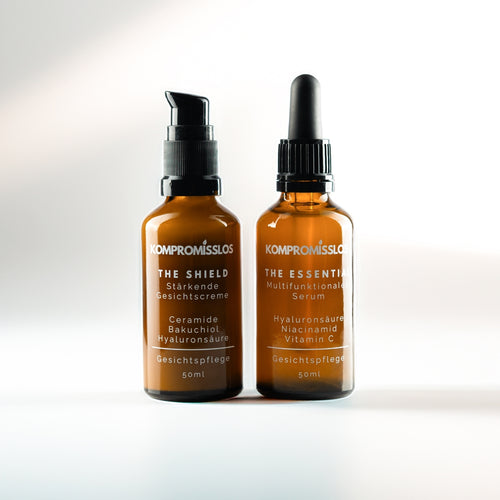
Our skincare deliberately contains no SPF, so you combine it with a separate sunscreen: The Duo – Serum & Face Cream without SPF.
Why the SPF on the pack rarely reaches your skin
The sun protection factor on a day cream is a laboratory figure, not an everyday one. It is determined by a standardised method in which two milligrams of product are applied per square centimetre of skin. Studies of how people actually apply it, by contrast, show amounts of around 0.39 to 1.0 milligrams per square centimetre – roughly a fifth to a half of the test amount. And protection does not fall in a straight line. In its recommendation on sunscreen products, the European Commission states that applying just half the amount can reduce the protective effect by as much as two thirds. An advertised SPF 30 can therefore quickly become a single-digit figure on your skin. With a moisturiser the problem is worse, because it is applied according to how it feels, not according to the amount needed for protection. If you are interested in what UV radiation does in the long term, you will find the background in our article on what the evidence says about slowing skin ageing.
Then there is the question of coverage. Sun protection needs an even, continuous layer. A day cream is patted in, rubbed in and partly smudged again by make-up. The very areas that get the most light – the bridge of the nose, the cheekbones and the ears – often end up with only a thin layer. How to solve this in everyday life is explained in detail in our guide to sunscreen for the face.
How much day cream would you need to apply for the SPF to be accurate?
For an adult’s whole body, the EU recommendation gives around six teaspoons of sunscreen, or about 36 grams. Scale that down to the face and neck and you are left with considerably less, but still many times more than a pea-sized amount of day cream provides. That is where the conflict lies. A moisturiser is formulated to spread thinly and absorb quickly. A sunscreen is formulated to sit on the skin in a thick layer. If you apply a day cream in the amount needed for sun protection, you end up with a face that is shiny, sticky and does not work under make-up. Most people then instinctively use less and lose the protection. That is not a mistake in how you apply it; it is a built-in conflict of aims between a skincare product and a protective product. A sunscreen is allowed to sit noticeably on the skin, because that layer is precisely what provides the protection. A day cream is not, or you would not buy it a second time.
| Criterion | Day cream with SPF | Separate sunscreen |
|---|---|---|
| Amount applied | dosed by how it feels | deliberately dosed as a protective layer |
| Protection achieved | usually well below the label | closer to the declared value |
| Reapplying during the day | hardly practical | planned for and usual |
| Makes sense for | short trips, overcast days | longer periods outdoors |
When a day cream with SPF still makes sense
A day cream with SPF is better than no protection at all, and that is no small point. If your day consists of the office, the car and a ten-minute walk, it covers a real part of your exposure. It is also a sensible choice as a base layer on overcast days in the colder half of the year, as long as you do not mistake it for protection on a day at the beach. Tinted versions have an additional practical advantage: pigments scatter visible light, and because a tinted day cream with SPF is usually applied more generously than a clear one, more product often ends up on the skin. Even so, you should not rely on it. As soon as you know you will be outdoors for longer, a dedicated sunscreen belongs on top, in an amount you can feel on your skin. A second point speaks for combining the two: two layers together put more product on the skin than one. If you regularly notice uneven pigmentation, you will find the connections explained in our article on where age spots come from.
Before buying, one customer wrote to tell us that she had always used a day cream with SPF 30 and wanted to know whether she could replace it with The Duo. The honest answer was no, at least not like for like. Our skincare does not replace sunscreen, and her previous cream probably only provided it in part. In the end, the solution was simpler than she had expected: skincare in the morning, sunscreen on top, done. You can see which active ingredients we use and in what concentration in the full ingredient list.
What order actually works in the morning?
Sunscreen is the last skincare step before make-up, and everything that is meant to absorb goes on before it. There is a simple reason for this order: the protective film should sit evenly on top and not be thinned or smudged by products applied afterwards. Hydrating active ingredients such as hyaluronic acid or niacinamide, on the other hand, need contact with the skin and belong underneath. In our Duo, that means 2 per cent hyaluronic acid and 5 per cent niacinamide, each relative to the Duo as a whole. These ingredients do their work when serum and cream go directly onto cleansed skin. If you then give the sunscreen one to two minutes to set, it smudges much less under make-up. The widespread idea that sunscreen needs half an hour before it works is not quite right. It works immediately; the waiting time is about adhesion. You will find the exact amounts of serum and cream on our how-to-use page.
- Cleanse and pat dry.
- Apply the serum, 3 to 6 drops.
- Apply the cream, 3 to 6 pumps.
- Let it absorb briefly.
- Apply sunscreen on top as a continuous layer.
- Only then apply make-up.
If you only use two products in the morning anyway, this routine becomes very short. That is exactly what our serum and cream routine is designed for: few steps, so that the most important additional step is not dropped for lack of time.
How to recognise a decent face cream with UV protection
Two details on the pack matter more than any advertising claim: the sun protection factor and the UVA logo in a circle. The Swiss Cancer League (Krebsliga Schweiz) recommends SPF 30 or higher for everyday use and at least 50 for outdoor activities. A product may only carry the UVA logo if its UVA protection reaches at least a third of the stated sun protection factor. Without this logo, the SPF figure alone says little about protection against longer-wave radiation – and that is exactly the radiation that plays a role in premature skin ageing. It is also worth looking at the texture, because runny products tend to be applied more sparingly. Stay level-headed about test reports: a “test winner” label tells you how a product performed in a particular test set-up, not how much of it ends up on your skin. Switzerland also applies the EU list of approved UV filters, so the choice hardly differs from that in neighbouring countries.
You do not need to switch products if your day cream with SPF suits you and you also use a separate sunscreen. Doubling up does no harm. It only becomes a problem if the day cream remains your only protection. Which type of filter is right for you is covered in our comparison of mineral and chemical filters.
I deliberately did not formulate The Duo with a sun protection factor, and it is one of the decisions I have to explain most often. The reason is exactly this article. An SPF in a moisturiser promises protection that the amount people actually apply in everyday life does not deliver. So I would have to ask you to apply our cream in an amount that feels unpleasant, just so that a number on the pack is accurate. I did not want that. I would rather say it plainly: our skincare is skincare. For sun protection, use a product that has no other job to do.
Frequently asked questions
Is a day cream with SPF enough on its own?
No, as a rule it is not. The sun protection factor only applies at two milligrams of product per square centimetre of skin, and moisturisers are applied much more thinly. For short trips on overcast days, it is a usable base layer. As soon as you know you will be outdoors for longer, a separate sunscreen belongs on top.
How much sunscreen do you really need for the whole body?
The EU recommendation gives around six teaspoons, or about 36 grams, for an average adult body. This corresponds to the amount applied when sun protection factors are determined in testing. If only half is applied, the protective effect can fall by as much as two thirds.
Is a tinted day cream with SPF better than a clear one?
It has a practical advantage, because it is usually applied more generously and its pigments also scatter visible light. That still does not make it a full replacement for sunscreen. The amount you apply continues to be guided by the colour result you want, not by the protective layer you need.
What SPF is recommended in Switzerland?
The Swiss Cancer League (Krebsliga Schweiz) recommends sunscreen with SPF 30 or higher, and at least 50 for outdoor activities. The product should also carry the UVA logo in a circle. This logo is only permitted if the UVA protection reaches at least a third of the stated sun protection factor. For children and sun-sensitive skin, higher protection is considered sensible.
In what order do skincare and sunscreen go on?
Skincare first, sunscreen last, make-up afterwards. Serum and cream need direct contact with the skin; the sunscreen should sit on top as an even layer. Give the sunscreen one to two minutes to set before applying make-up. That way the protective layer smudges less and stays more evenly spread.
Does The Duo contain SPF?
No, The Duo deliberately contains no sun protection factor. Serum and cream are formulated as skincare, with 5 per cent niacinamide, 2 per cent hyaluronic acid and 2 per cent vitamin C as 3-O-Ethyl Ascorbic Acid, each relative to the Duo as a whole. With us, sun protection goes on top as a separate product.
Can you combine a day cream with SPF and sunscreen?
Yes, that is no problem. The two sun protection factors do not add up, but the extra layer increases the amount of product actually applied. Apply your skincare first and the sunscreen on top. There is no need to switch products if your current day cream suits you.
Sources
- European Commission, Empfehlung über die Wirksamkeit von Sonnenschutzmitteln und diesbezügliche Herstellerangaben (2006/647/EG), 2006. Source
- Petersen B, Wulf HC, Application of sunscreen, theory and reality. Photodermatology, Photoimmunology and Photomedicine, 2014. Source
- Krebsliga Schweiz, Sonnenschutzmittel und Sonnencreme, 2025. Source