Sunscreen before or after moisturiser: which layer goes last and how long to wait
ROUTINE
Sunscreen goes on after moisturiser, as the last skincare step in the morning and before make-up. The reason: sunscreen works as a film on the skin’s surface that should be as even as possible, and anything you rub in firmly afterwards can shift or thin out that film. So apply your serum and moisturiser first, wait until the cream no longer looks wet and shiny, and then spread on your sunscreen. This applies to mineral and chemical filters alike, and to sprays and sticks as well.
Does sunscreen go on before or after moisturiser?
Sunscreen goes on after your moisturiser, not underneath it. In skincare, the rule of thumb is “thinnest to thickest”, but with sun protection something else matters: it only does its job as a continuous layer on top. The UV filters do not need to sink into the skin for this; they work within the film that the sunscreen forms on the surface. How well this film protects depends heavily on its thickness and evenness. A laboratory study in the Journal of Biomedical Optics showed that the distribution of film thickness explains why sunscreens with the same filters reach different levels of protection. If you massage in a moisturiser after your sunscreen, you risk shifting that film again as you rub. So the order is: serum and cream first, then sun protection, then make-up. Where the remaining steps belong, from cleansing to night care, is covered in the article on the skincare order for morning and evening.
There is reassuring news from a study in Photodermatology, Photoimmunology & Photomedicine: in 25 volunteers, a moisturiser applied shortly before or shortly after sunscreen did not significantly change its protective effect in UV photography. So if you get the order wrong once, all is not lost. However, the testing was done on the back, under controlled conditions and with careful application. In everyday life in front of the mirror, with quick rubbing in and several layers, sunscreen as the last skincare layer is the more reliable choice.
| Product | Position in the morning | Why there |
|---|---|---|
| Serum | Straight after cleansing | Runny, so it should go onto the skin first |
| Moisturiser | After the serum | Holds in moisture and completes your skincare |
| Face oil or balm | After the cream, sparingly, or better in the evening | Stays on the skin as a layer for a long time |
| Sunscreen, spray or stick | Last skincare step | Only protects as an undisturbed film on top |
| Make-up | After sunscreen | Not part of skincare, so it goes on last |
Does the order also apply to mineral sunscreen?
Yes, mineral sunscreen also goes on after moisturiser. There is a persistent belief that mineral filters have to sit directly on bare skin as a “mirror”, while chemical filters first have to be absorbed into the skin. Neither is really true. A measurement study in Photodermatology, Photoimmunology & Photomedicine found that zinc oxide and titanium dioxide reflect on average only 4 to 5 per cent of radiation in the UV range and otherwise provide their protection through absorption. So mineral and organic filters both work as a layer on the skin’s surface, and both need to be spread evenly to do so. How the filter types differ in texture, white cast and tolerability is explained in the article on mineral or chemical sunscreen. For the order, the type makes no difference. In practice there is one small difference: mineral textures are often thicker and harder to spread over a cream that is still damp. They then tend to leave streaks and white edges around the nose and hairline. This is where it is particularly worth letting your moisturiser absorb fully and applying the sunscreen in several small amounts rather than one large dollop that you have to spread for a long time.
How long should you wait between moisturiser and sunscreen?
Wait until your moisturiser no longer feels damp – with most light creams, that takes a few minutes. Studies do not give a fixed number of minutes for this in-between step, but the test is simple: once your finger no longer glides over your cheek on a damp film, your skin is ready. The reason for the pause is spreading. On a wet base, sunscreen slides around, and you rub for longer and with more pressure. That is exactly what reduced protection in the laboratory study in the Journal of Biomedical Optics mentioned above: a long spreading time reduced the film thickness and the measured sun protection factor, and more pressure during application lowered the sun protection factor as well. Rich creams need longer than light fluids, and if you use more cream because your skin is dry, the pause gets longer accordingly. After sunscreen, it is worth waiting briefly again before applying make-up so that the film is not smudged straight away. How to choose the skincare underneath is covered in the article on skincare before make-up.
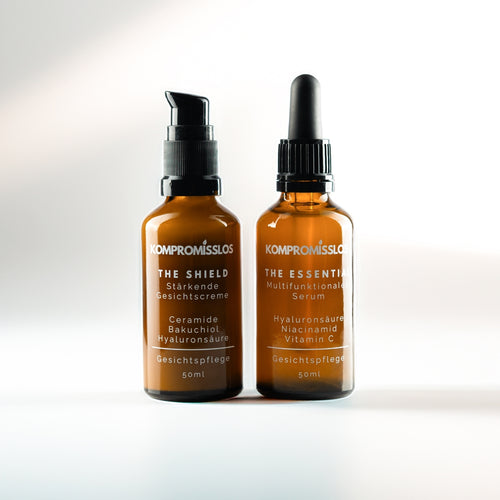
This is what your morning looks like with The Duo, which itself contains no SPF:
- Cleanse your face with water.
- Massage 3–6 drops of The Essential into your skin from the centre of your face outwards and over your neck.
- Massage in 3–6 pumps of The Shield in the same way, from the centre of your face outwards and over your neck, using a little more if your skin is dry.
- Wait until the cream has absorbed and no longer looks shiny.
- Apply a separate sunscreen – do not rub it in until nothing is visible, but spread it evenly.
- If you wear make-up, apply it only after that.
If you are short of time in the morning, do not reverse the order – use the waiting time instead: serum and cream straight after washing, then brush your teeth or put the coffee on, and make sunscreen the last thing you do before you leave the bathroom.
Can a face oil or balm go under sunscreen?
A face oil or balm can go under sunscreen, but sparingly and with time to absorb. Oils and rich balms stay on the skin as a shiny layer for longer than a cream, which is a mixture of water and lipids. If you apply sunscreen on top, the two layers mix more easily as you spread, and the sun protection can become uneven. How much this happens depends on the oil, the amount and the sunscreen; there are hardly any reliable measurements of this exact combination. The honest trade-off is therefore this: if your skin really needs extra lipids in the morning, use two or three drops, press them in with your palms rather than rubbing, and give them a few minutes. If you mainly use the oil out of habit, it is better placed in your evening routine, where no sunscreen has to go on top. A balm that leaves your skin shiny all day is the worst possible base for sunscreen, because it never properly sets.
Does retinol from the night before change your morning routine?
Retinol from the night before does not change the order, but it does make sun protection more important. Retinol and other retinoids go on in the evening; in the morning, the usual sequence of cleansing, serum, cream and sunscreen follows. Especially in the first few weeks, however, skin often reacts to retinoids with dryness, fine flaking and redness. That is why experts recommend daily, consistently applied sun protection alongside any retinoid routine, even on days when you are only outside briefly. If your skin feels tight after a night with retinol, a richer cream under your sunscreen makes more sense than skipping that step and applying sunscreen straight onto dry skin. If sunscreen stings on irritated skin, a fragrance-free formula may be gentler. If the redness and stinging persist anyway, it is a question for your dermatologist, and the retinoid may need a break.
Does the order also apply to spray or stick sunscreen?
Yes, sunscreen sprays and sticks also go on as the last skincare step, over moisturiser that has absorbed. The format does not change the fact that protection forms as a film on top. It does, however, change how you apply it. A spray aimed straight at your face spreads unevenly, some of it ends up in the air, and you can breathe it in. It is better to spray it into your palm and spread it like a cream. A stick needs a dry base: on cream that is still damp, it pushes the skincare around instead of leaving a layer of its own. Draw several strokes over each area of your face and briefly blend the edges with your fingers. A stick is handy on the go, but as your only sun protection in the morning it falls rather short. How much sunscreen your face needs and when to reapply is covered in the article on sunscreen for your face. And if you are thinking of replacing sunscreen altogether with a day cream with SPF, read why SPF in a day cream is often not enough.
In her review on Judge.me, Irène S. writes about The Duo: “I do miss the sun protection a little” (review translated from German). It is a fair point, and the gap is intentional.
I deliberately did not build an SPF into The Shield. An SPF in a day cream looks good on the packaging, but in everyday life hardly anyone applies enough cream for the stated level of protection to actually reach the skin. The sun protection then becomes a fig leaf. I would rather you applied a proper sunscreen in a sufficient amount as a separate final step. To be honest about what that means: without this separate sunscreen, the Duo does not protect you from UV radiation during the day. I do not sell sun protection myself, so you can keep the sunscreen you already trust. How to apply the serum and cream stays the same; in the morning, sunscreen simply goes on top as a step of its own.
Frequently asked questions
Can I mix sunscreen and moisturiser?
Better not. If you mix the two in your hand, you dilute the UV filters and distribute them unevenly. Protection depends heavily on how thick the layer is: a study in Clinical and Experimental Dermatology found that people apply about 1 mg/cm² in everyday use, whereas the sun protection factor is determined at 2.0 mg/cm². Mixing widens this gap. Apply the two products one after the other.
Does moisturiser dilute sunscreen?
Hardly, if the moisturiser goes underneath and has absorbed. In a study in Photodermatology, Photoimmunology & Photomedicine, a moisturiser applied shortly before or after sunscreen did not significantly change its effect. Long, vigorous rubbing is more of a problem: in a laboratory study, it reduced the measured protection. That is why sunscreen goes on last and is only spread over the skin.
Do I still need a moisturiser if I use sunscreen?
Not necessarily. Many sunscreens also offer some care, and for oily or uncomplicated skin that can be enough in the morning. With dry, sensitive or mature skin, a cream underneath is usually more comfortable, because sunscreens are designed for UV protection, not for care. What matters is how your skin feels by lunchtime.
Is the order different for dry skin?
No, the order stays the same: serum, cream, sunscreen. With dry skin, you usually use more cream or a richer texture, so it takes a little longer to absorb. Allow for those extra minutes rather than rubbing sunscreen over it straight away. If you want to add an oil for dry skin, it is better kept for the evening.
Can I apply sunscreen straight after serum?
Yes, if your skin does not need an additional cream and the serum has absorbed. A watery serum usually only needs a moment. If you apply sunscreen over serum that is still damp, the same applies as with cream: it slides around and you rub for longer than necessary. If your skin is dry, leaving out the cream often means it misses out on care.
Does the order also apply to tinted sunscreen?
Yes, a tinted sunscreen is first and foremost sun protection, so it also goes on as the last skincare step, over moisturiser that has absorbed. The tint does not change that. If you wear powder or foundation on top, they only go on afterwards. Do not apply tinted sunscreen more thinly just because it would otherwise give too much coverage.
Where does sunscreen go if I use The Duo?
Right at the end. After cleansing with water, you apply The Essential first, then The Shield. As soon as the cream has absorbed, your separate sunscreen follows, then make-up if you wear it. The Duo deliberately has no SPF, so it does not replace sun protection in the morning.
Sources
- Gálvez MV, Aguilera J, Leal M, Sánchez-Roldán C, Herrera-Ceballos E. Sunscreens effectiveness are not altered by concomitant use of moisturizing creams: An ultraviolet reflectance photography study. Photodermatology, Photoimmunology & Photomedicine, 2022. Source
- Sohn M, Hêche A, Herzog B, Imanidis G. Film thickness frequency distribution of different vehicles determines sunscreen efficacy. Journal of Biomedical Optics, 2014. Source
- Teramura T, Mizuno M, Asano H, Naito N, Arakane K, Miyachi Y. Relationship between sun-protection factor and application thickness in high-performance sunscreen: double application of sunscreen is recommended. Clinical and Experimental Dermatology, 2012. Source
- Cole C, Shyr T, Ou-Yang H. Metal oxide sunscreens protect skin by absorption, not by reflection or scattering. Photodermatology, Photoimmunology & Photomedicine, 2016. Source