Skincare order of application: which step goes where, morning and evening
ROUTINE
The skincare order of application follows one simple rule: thin to thick, meaning from watery textures to richer ones. After cleansing comes a toner if you use one, then your serum, followed by eye cream and moisturiser. In the morning, sunscreen always goes on last; in the evening, you leave it out. Exfoliants and masks are not part of your daily routine – they belong in the occasional evening, straight after cleansing.
What order should you apply skincare in?
Apply your skincare in this order: cleanser, toner or essence, serum, eye cream, face oil, cream and, in the morning, sunscreen as the final step. Each step has a job that builds on the one before it. Cleansing clears the skin so that the products that follow sit on clean skin rather than on sebum, make-up or yesterday’s sunscreen. Watery products deliver moisture and dissolved active ingredients. Richer products hold that moisture in the skin and smooth its surface. Sunscreen should sit on top as an even film, so that nothing else gets rubbed over it. Bear in mind that this list describes the maximum, not a requirement. Most routines get by with a cleanser, a serum, a cream and sunscreen during the day. Toner, essence, eye cream and oil are extra steps that you only add if they fill a real gap. So before you buy one of them, it is worth asking which job it would take on that would otherwise be left undone.
- Cleansing: with water or a mild cleanser.
- Toner or essence: optional, and only if it has a purpose of its own.
- Serum: the lightest texture with the most active ingredients.
- Eye cream and face oil: optional, depending on your skin and the product.
- Cream: rounds off your skincare.
- Sunscreen: mornings only, always as the last layer.
Why does the ‘thin to thick’ rule apply, and when are there exceptions?
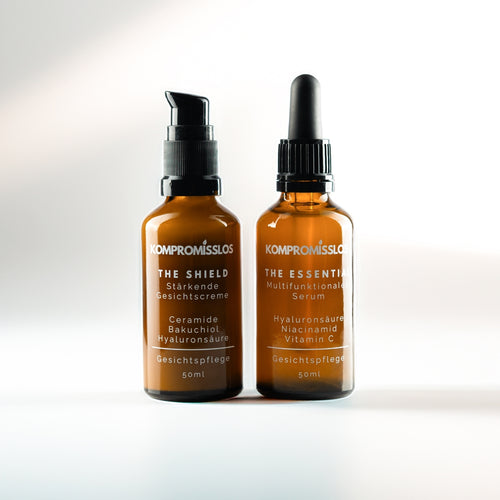
The ‘thin to thick’ rule applies because watery textures reach the skin more easily as long as there is no oily layer on top. A serum usually consists mostly of water and moisture-binding ingredients. According to a review in Clinical Medicine & Research, these moisture-binding ingredients, known technically as humectants, draw water into the stratum corneum, the skin’s outermost layer. Oils and waxes, by contrast, form a layer on the surface of the skin that physically slows down evaporation. If you apply a rich cream first, that layer is already sitting exactly where the serum was meant to go. The other way round, the cream holds in the moisture the serum has delivered. That is also how The Duo is designed: the light serum first, then the richer cream. Whether you massage it in or pat it on is explained in the guide on how to apply moisturiser. Whether you need both in the first place is covered in the article on serum and cream.
There are two exceptions, and both are about function rather than texture. Depending on the product, a face oil can go before or after your cream. Sunscreen, on the other hand, is always the last layer, even if a sun fluid is thinner than the cream underneath. How to settle the oil question for yourself is explained in the article Serum or face oil. Prescription creams should be applied exactly as your doctor or healthcare professional has told you.
What is the right skincare order in the morning?
In the morning, the order is: cleanse, serum, cream and finally sunscreen. Mornings are mainly about moisture and protection for the day ahead. After a night’s sleep, lukewarm water is often enough for cleansing, because all that is left on your skin is some residue from your evening skincare and a little sebum. Then comes the serum, followed by the cream and, as the last step, sunscreen. Whether sunscreen goes before or after your day cream and how long to wait in between is answered in a separate article: sunscreen before or after moisturiser. The amount you use also matters. The stated sun protection factor is measured with 2 mg of product per square centimetre of skin. A study by Faurschou and Wulf in the British Journal of Dermatology showed that when you use less product, protection does not fall proportionally but exponentially: at 1 mg per square centimetre, it drops to roughly the square root of the stated value. Antioxidant ingredients such as vitamin C fit well into the morning; the article on vitamin C serums explains when vitamin C makes sense in the morning.
What is the right skincare order in the evening?
In the evening, the order is: cleanse thoroughly, serum, eye cream or oil if you use them, cream – and no sunscreen. The biggest difference from the morning is the cleansing. In the evening, you are removing sunscreen, make-up and the grime of the day, and that often takes more than water. If you wear waterproof sunscreen or make-up, you may want to double cleanse: first with an oil or balm, then with a water-based cleanser. The evening is also the place for active ingredients that are sensitive to light or more demanding on the skin, such as retinoids or acids. This applies to retinol in particular; the article on retinol combinations explains why retinol belongs in your evening routine.
A study in the Journal of Investigative Dermatology took measurements of skin barrier function every two hours over 24 hours in 16 healthy people. The authors conclude that the skin is more permeable in the evening and at night than in the morning. That is no reason to use more products in the evening, but it is an argument for keeping your evening routine simple and gentle.
| Step | Morning | Evening | With The Duo |
|---|---|---|---|
| Cleansing | Water or a mild cleanser | Thorough, double cleanse if needed when wearing make-up | Cleanse with water |
| Toner, essence | Optional | Optional | Not needed |
| Serum | Yes | Yes | 3–6 drops of The Essential |
| Eye cream | Optional | Optional | Not needed |
| Face oil | Rarely | Optional for very dry skin | Add only if needed |
| Cream | Yes | Yes | 3–6 pumps of The Shield |
| Sunscreen | Always last | No | Separate – The Duo contains no SPF |
Where do face oil, eye cream and treatment serums go?
Treatment serums go straight after cleansing or after a toner if you use one, eye cream goes after the serum and before your face cream, and face oil goes before or after the cream, depending on the product. Serums come early in the order because they have the lightest texture and usually the highest concentration of active ingredients. If you use more than one, thin to thick applies here too; the details are in the article on layering multiple serums. Which active ingredient works better in the morning and which in the evening, and which ingredients work together, is a separate question that the order of application does not settle. Eye cream is essentially a cream for a small area. You pat it on after your serum, before your face cream covers the rest of the face. Many people manage without it if their face cream is well tolerated around the eyes.
Where a face oil goes depends on what it is meant to do. As the richest layer, a pure oil often goes on last, over your cream in the evening. If you only want to make your cream a little richer, mix a drop into it. In her review on Judge.me, Daniela B. writes: “As I have rather dry, mature skin, I would like the face cream to be a little richer, so I supplement it with a facial oil from another brand” (review translated from German). This is exactly the kind of case in which an oil is a sensible addition – and the only kind in which the question of where it goes even arises.
Where do exfoliants and face masks fit into your weekly routine?
Exfoliants and masks belong in the evening, straight after cleansing and before your serum – not every day, but only now and then, depending on your skin and the product. An exfoliant removes dead skin cells. Afterwards, the skin is more receptive, but also more sensitive. That is why it should only be followed by your usual skincare, with no additional strong active ingredient on the same night. With acid exfoliants, the sun comes into play: a study in Photodermatology, Photoimmunology & Photomedicine found that 10% glycolic acid, applied six days a week for four weeks, made the skin more sensitive to UV light. One week after stopping, no difference could be measured any more. So if you use acids, you need to be particularly consistent with sunscreen the following morning. Rinse-off masks follow the same logic as exfoliants: apply after cleansing, rinse off, then follow with serum and cream. How often a mask is worthwhile is covered in how often to use a face mask. A sleeping mask, on the other hand, is a rich cream and replaces the last step on that evening. If you use several exfoliants or acid toners in the same week, add them up rather than looking at each one on its own.
If you are not sure where a product belongs, look at its texture and its job. Watery and rich in active ingredients goes on early, oily and protective goes on late, and sunscreen always goes on last.
Our routine has exactly one order, and it is the same morning and evening: serum first, because it is lighter, then cream, because it is richer. I deliberately did not put a sun protection factor in the cream. To be honest, that also means The Duo is not the last step in the morning. During the day, a separate sunscreen goes on top as the final layer – and it is not something we sell ourselves. You do not need a toner, essence or eye cream alongside the two products, and I have not added them to our range just to make a routine look as if it has more steps. How much serum and cream to use and how to massage them in is explained in how to apply the serum and cream.
Frequently asked questions
Where does toner go in a skincare routine?
Toner goes straight after cleansing and before your serum, because it is the thinnest texture in your routine. Whether you need one at all depends on whether it serves a purpose of its own. What modern toners actually do is explained in the article Do you need a toner?
What should I do if my skincare layers start pilling?
If your skincare pills, you are usually using too much product or the textures of the layers do not get on with each other. Start by using less and let each layer sink in briefly before you apply the next. Other causes and solutions are covered in the article on skincare pilling.
When do I apply face oil?
Apply face oil after your serum and, depending on the product, before or after your cream. In the morning, it never goes over sunscreen, because sunscreen should remain the top layer. For very dry skin, the evening is the usual time for it.
Can I use the same serum morning and night?
Yes, you can use a hydrating or nourishing serum morning and night as long as your skin tolerates it well. Serums with retinoids or strong acids are a different matter. They belong in the evening, because they can make the skin more sensitive to light or are themselves sensitive to light.
Is the skincare order different at night?
The basic order at night is the same as in the morning: cleanser, serum, cream. In the evening, however, you leave out sunscreen, and cleansing is more thorough, because the day’s sunscreen and make-up need to come off. Exfoliants, masks and retinoids also have their place in the evening.
How many skincare steps are too many?
You have too many steps as soon as a product only does a job that another one already covers. How to pare your routine back to the essentials is explained in our article on building a minimalist skincare routine.
In what order do I use The Duo?
Serum first, then cream, the same morning and evening. Cleanse your face with water, apply 3–6 drops of The Essential and then 3–6 pumps of The Shield, working from the centre of your face outwards and down over your neck. In the morning, follow with a separate sunscreen, because The Duo contains no sun protection factor.
Sources
- Purnamawati S, Indrastuti N, Danarti R, Saefudin T. The Role of Moisturizers in Addressing Various Kinds of Dermatitis: A Review. Clinical Medicine & Research, 2017. Source
- Faurschou A, Wulf HC. The relation between sun protection factor and amount of suncreen applied in vivo. British Journal of Dermatology, 2007. Source
- Yosipovitch G, Xiong GL, Haus E, Sackett-Lundeen L, Ashkenazi I, Maibach HI. Time-dependent variations of the skin barrier function in humans: transepidermal water loss, stratum corneum hydration, skin surface pH, and skin temperature. Journal of Investigative Dermatology, 1998. Source
- Kaidbey K, Sutherland B, Bennett P, Wamer WG, Barton C, Dennis D, et al. Topical glycolic acid enhances photodamage by ultraviolet light. Photodermatology, Photoimmunology & Photomedicine, 2003. Source