How to apply moisturiser: massage or pat, and which direction
ROUTINE
To apply moisturiser properly, spread a small amount between your fingertips, dot it onto several points on your face and then smooth it outwards from the centre with light pressure. Whether you massage it in or pat it in matters less. What counts is that the cream reaches every part of your face and that you neither drag your skin nor rub hard. The rule of ‘always upwards’ is a tradition: no application technique can firm your skin.
How do you apply moisturiser properly?
The best way to apply moisturiser is in three movements: spread, dot, smooth. First spread it briefly between your fingertips so that it does not land on your cheek as a single blob, then dot it onto five points (forehead, both cheeks, nose, chin) and smooth it outwards from there with flat fingers until no white streaks are left. The whole thing takes less than a minute and needs no tools. The most common mistake is not the wrong movement but a blob that starts on one cheek and stays too thick there, while your forehead barely gets any. Where the cream belongs in your routine is a separate question: the guide to the right skincare order, morning and evening covers it in detail, and how much face cream you need per application has a guide of its own.
- Wash and dry your hands so that nothing from your fingers gets into your skincare.
- Spread the cream briefly between your fingertips rather than rubbing it across your whole palm.
- Dot a little onto your forehead, each cheek, your nose and your chin.
- Smooth it outwards from the centre with flat fingers, without dragging your skin along.
- Finally, go over your hairline, the sides of your nose and your jawline with what is left on your fingers.
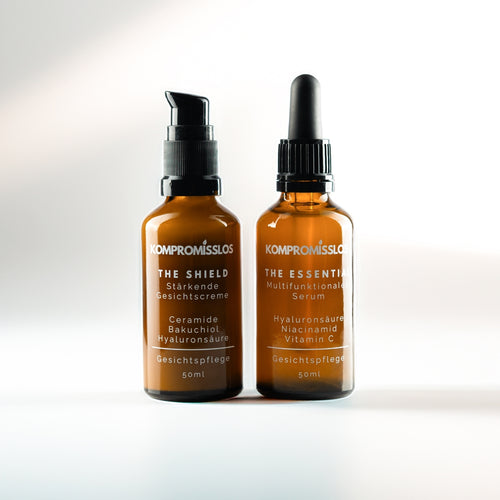
With The Duo of serum and cream, the technique is just as simple: after cleansing with water, apply 3 to 6 drops of serum, followed by 3 to 6 pumps of cream, each massaged in from the centre of the face outwards and over the neck. In her review on Judge.me, Kristin E. writes about the serum and cream: ‘Both are really easy to apply and leave a lovely, pleasant feel on the skin’ (review translated from German).
Massage or pat: which technique is better?
Neither technique is better in principle – they do different jobs. Massaging in, in the sense of gently smoothing, spreads the cream most efficiently over a large area. Patting or dabbing hardly moves the cream sideways, but it is kinder to your skin and least likely to disturb a layer underneath. In practice, a combination works best: smooth first until the area is covered, then press lightly on spots with little product or on sensitive areas. The word ‘massage’ suggests more than is needed. A cream does not have to be worked in to reach your skin; all it needs is an even film. Rubbing hard has a second drawback: if there is already a serum underneath, the film can break up. A study in Skin Research and Technology found the most pilling with circular and linear rubbing – more on this in the article on why skincare pills and how to stop it. For the same reason, sunscreen on top of a cream is spread rather than rubbed in, as explained in the guide to sunscreen before or after moisturiser.
| Technique | What it does | Works well for | What to watch out for |
|---|---|---|---|
| Smoothing (gentle massage) | Spreads the cream quickly over large areas | Forehead, cheeks, chin, jawline | Flat fingers, no dragging of the skin |
| Patting or dabbing | Gets cream onto one spot without rubbing | Sensitive, reddened areas, the area around the eyes | Barely spreads, not suitable for the whole face |
| Pressing in with flat palms | Evens out the film without shifting it | The final step over a serum | Only useful on cream that is already spread |
| Circular rubbing with pressure | Spreads, but puts mechanical strain on the skin | Hardly ever the right choice | Can encourage pilling and redness |
Which direction should you apply moisturiser in, and does ‘upwards’ help against sagging?
The most sensible direction is from the centre of your face outwards, for a practical reason: that is where you dot the cream, and from there, what is left on your fingers reaches your hairline, temples and jawline. No direction helps against sagging. The oft-repeated rule of always applying cream upwards so that your skin is not ‘pulled down’ is a skincare tradition, not a proven effect. A review in the Aesthetic Surgery Journal describes facial ageing as an interplay of changes in bone, muscle, fat pads and skin: the facial skeleton remodels, fat pads shrink or shift, and the skin becomes thinner. A few seconds of stroking the surface will not reach these layers, whether you go upwards or downwards. What the rule does get right is that you should not tug your skin firmly downwards while applying cream. But that is a question of pressure, not direction. The same goes for the neck: how to apply cream there properly is covered in a separate guide to neck and décolleté care.
Gua sha, facial rollers and face yoga belong to a different category from applying a cream and are not necessary for good skincare.
How much pressure can your skin take when you apply moisturiser?
When you apply moisturiser, use so little pressure that your skin does not visibly shift under your fingers. The cream should glide over your skin, not your skin over the tissue beneath it. A study in Acta Dermato-Venereologica shows that mechanical strain really does affect the skin barrier: in 16 healthy volunteers, transepidermal water loss on the forearm rose significantly after the skin had been stretched with a suction cup at 400 and 600 mbar. That is not applying cream but a lab experiment with considerably more force. It does show, however, that the outermost layer of the skin reacts to mechanical stress. Gentle rather than vigorous is therefore the sensible ground rule, especially for sensitive, easily reddened or dry skin, where dabbing and pressing are a better choice than circular rubbing. A rule of thumb for everyday use: if your skin is red and blotchy or stings after you apply cream, either the pressure was too high or an ingredient does not suit you. The first you can change straight away by only smoothing with flat fingers and taking a little more time over it.
Your ring finger usually presses the least. If you are unsure how hard you are pressing, spread the cream on sensitive areas with your ring finger and use your index and middle fingers only for your forehead and cheeks.
How do you spread moisturiser evenly without missing spots?
To spread moisturiser evenly, follow a fixed sequence rather than going by feel, and finish by deliberately going over the edges. A study in PLOS ONE shows how misleading that feel can be: 84 participants applied a moisturiser with SPF the way they normally would, and a UV camera revealed where none had landed. On average, 16.6 per cent of the face was left uncovered, and in the eyelid area it was 20.9 per cent. When asked afterwards, the participants were unaware of their gaps. With a moisturiser, a gap is no disaster, but it does explain why some areas stay dry despite daily application. These are the areas that typically get missed:
- Hairline and temples, because your fingers stop short of your hair.
- The sides of your nose and the crease next to them, because flat fingers skip over them.
- Your chin and the underside of your jawline, because the movement usually ends at the cheek.
- The skin in front of your ears, because the cream has run out by the time you get there.
- The area around your eyes, because many people leave it out to be on the safe side.
It helps to always work in the same order and to go over the edges with the last of the cream on your fingers rather than taking more.
Fingers, palms or spatula: what is the most hygienic way to apply moisturiser?
The most hygienic option is clean fingers combined with packaging you do not have to dip into. There is nothing wrong with using just your fingers, as long as your hands are freshly washed. It becomes a problem with a jar if you keep dipping your fingers into it. An older study in Applied and Environmental Microbiology had volunteers use a deliberately unpreserved skin lotion for two weeks in containers with different closures. Afterwards, 71 per cent of the products with a screw cap were microbially contaminated, compared with 39 per cent with a flip-top cap and 10 per cent with a pump dispenser. Modern creams are preserved and considerably more robust, but the direction of the result still makes sense: the less contact between your hand and the contents, the better. If you use a jar, take the cream out with a clean spatula, close the jar straight away and never dip used fingers in a second time. Your palms are good for pressing the cream in, less so for spreading it, because a lot of it ends up on the skin of your hands rather than on your face. With any skincare product, look out for the PAO symbol on the packaging, which tells you how long it keeps once opened.
Our application page does not describe a massage ritual, just one sentence: massage in from the centre of the face outwards and over the neck. That is deliberate. I built Kompromisslos with two products instead of eight, and in the same spirit, applying them should be quick to do in everyday life, without tools and without moves you first have to learn. To be honest, even the most elegant technique cannot firm your skin or lift your contours – neither my creams nor anyone else’s can do that through the way they are applied. What I can influence is what you smooth onto your face twice a day: both products are fragrance-free, so when you massage them in, you are not rubbing any fragrance over your skin. How the serum and cream are applied step by step is deliberately kept short.
Frequently asked questions
Does moisturiser need to sink in completely?
No, a light, even film after a few minutes is normal and intended. If your skin still looks wet or feels sticky after ten minutes, you probably used too much. If you put on make-up afterwards, it is worth checking which skincare to use before make-up and how long to wait so that your foundation does not slide.
Should I warm the cream in my hands first?
Spreading it briefly between your fingertips helps, because the cream becomes softer and easier to smooth on. Rubbing it across your whole palms, on the other hand, is unnecessary. A good part of the cream then stays on your hands instead of reaching your face.
How do I apply cream around my eyes?
Around your eyes, it is best to apply skincare with your ring finger in a gentle dabbing motion, keeping some distance from the lash line so that nothing gets into your eyes. Leave out rubbing and pulling completely here. If it stings, skip the area. A separate guide looks at whether you really need an eye cream.
Should I apply moisturiser to damp or dry skin?
Many creams spread more easily on slightly damp skin, and humectants such as glycerin or hyaluronic acid find water there that they can bind. Your skin should not be wet, though, or the cream gets diluted and slides around. A quick pat with a towel is enough. What matters more than damp or dry is not waiting long after washing.
Does a long facial massage make moisturiser work better?
A longer massage does not push the cream deeper into your skin or boost its effect. Once the film is evenly spread, the movement has done its job. If you enjoy a massage, there is nothing wrong with gentle stroking, as long as your skin is not red afterwards. It is not a skincare step, though.
What should I do if my cream pills when I massage it in?
First stop rubbing and carefully lift off the little balls rather than spreading them further. Next time, simply pressing the last layer on instead of rubbing it in often helps. If that changes nothing, the amount, the waiting time or the combination of products is the more likely cause – these are covered in the article on pilling linked above.
How do I apply The Duo properly?
Morning and evening, after cleansing with water, apply 3 to 6 drops of serum, followed by 3 to 6 pumps of cream, each massaged in from the centre of the face outwards and over the neck. If your skin is dry, you can use a little more. You do not need a special technique or tool for The Duo – gentle smoothing is enough.
Sources
- Swift A, Liew S, Weinkle S, Garcia JK, Silberberg MB. The Facial Aging Process From the “Inside Out”. Aesthetic Surgery Journal, 2021. Source
- Pedersen L, Jemec GB. Mechanical properties and barrier function of healthy human skin. Acta Dermato-Venereologica, 2006. Source
- Lourenco EAJ, Shaw L, Pratt H, Duffy GL, Czanner G, Zheng Y, et al. Application of SPF moisturisers is inferior to sunscreens in coverage of facial and eyelid regions. PLOS ONE, 2019. Source
- Brannan DK, Dille JC. Type of closure prevents microbial contamination of cosmetics during consumer use. Applied and Environmental Microbiology, 1990. Source
- Lua BL, Ruan L, Lyu Y, Liu S. Understanding the causes of skincare product pilling. Skin Research and Technology, 2024. Source