Skincare before makeup: which products to use underneath and how long to wait
ROUTINE
The best skincare before makeup is light, absorbs fully and leaves no wet or tacky film behind. In practice, that means a fluid serum for hydration, a cream in an adjusted amount for suppleness, and then sunscreen as a separate step. Hold off on foundation until your skin no longer feels damp, and press it in rather than rubbing it. Most problems with flaking, pilling or shiny makeup can be solved through the amount you use and your technique, not with extra products.
Which skincare works best under makeup?
The skincare that works best under makeup hydrates without leaving a layer on the skin that makes your foundation slide around. The most reliable way to achieve this is with two textures: first a watery serum with humectants, then a cream that holds in that moisture and smooths the surface. The article on whether you really need both serum and cream explains in detail why this split makes sense. Under makeup, the amount is what matters most. Too little skincare leaves dry patches that pigments cling to. Too much mixes with your foundation and makes it migrate over the course of the day. For sensitive skin, the same rules apply as without makeup: a short formula and no fragrance. What a vegan day cream for sensitive skin needs to do beyond that is set out in detail in that article.
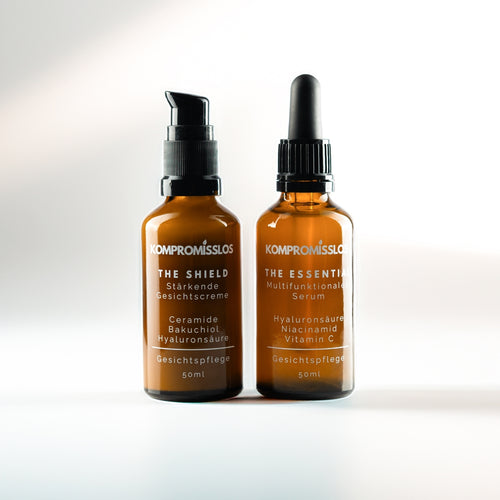
Sunscreen goes on as a separate step after your skincare and before your makeup. Exactly which layer comes last is covered in the article on sunscreen before or after moisturiser. One example of a streamlined base of serum and cream is The Duo as a two-step routine, free from silicones and fragrance. In her review on Judge.me, Evelyn S. writes: ‘Makeup goes on well after using it and stays nicely on the skin’ (review translated from German).
How long should you wait after moisturiser before applying makeup?
After your cream, wait until your skin no longer feels damp or tacky when you touch it lightly – with most textures, that takes a few minutes. There is no study that establishes a fixed number of minutes. The reason for the pause, however, is well described: a study on pilling in Skin Research and Technology identifies a likely cause: sunscreen and foundation form a film on the skin that can break when the next product is rubbed in. Incidentally, most of the pilling in that study had already occurred at the sunscreen stage, not just once foundation went on. If the layer underneath is still damp, your foundation easily drags it along and pushes it into little balls or streaks. In line with this, the study protocol only applied each new layer once the previous products had absorbed. You do not have to sit and wait it out. Do your hair or have your coffee in the meantime, and you will not lose a minute in the morning.
- Cleanse your face and briefly pat it dry.
- Apply your serum and let it absorb – that usually happens quickly.
- Apply your cream in the amount that suits each area of your face.
- Apply sunscreen separately on top and let it set.
- Press or pat your foundation into the skin instead of rubbing it in.
Why does makeup flake on dry skin?
Makeup flakes on dry skin because the pigments collect on raised flakes of dead skin and highlight their edges instead of covering a smooth surface. Foundation does not create the flakes; it only reveals them. That is why adding more foundation on top does little to help – it only emphasises the texture further. The study in Skin Research and Technology involving 528 women aged 20 to 49 fits this picture: those who experienced pilling with both sunscreen and foundation had lower skin hydration and less sebum, a higher pH and a smoother skin texture than the comparison group. So dry skin is not only prone to visible flakes, it is also more likely to see layers of product pill on top of it. The solution usually lies in how much you apply: a touch more cream on dry areas such as the cheeks and the sides of the nose, and less where your skin gets shiny on its own. If it is your skincare itself that pills rather than your foundation, the cause lies elsewhere. The article on why your cream balls up on your face covers that separately.
Why does makeup settle into fine lines on mature skin?
Makeup settles into fine lines on mature skin because facial movement pushes foundation into the creases over the course of the day, where it collects and traces each line. A study in the International Journal of Cosmetic Science shows that this can be measured. It involved 270 Japanese women aged 30 to 54, who took selfies before, immediately after and five hours after applying their own foundation. The wrinkles around the eyes were rated as more pronounced in all age groups, both immediately after application and after five hours, and the nasolabial folds after five hours. The changes were small but measurable. Skincare can do one thing in particular here: make lines caused by dryness look less deep. Whether you are dealing with dehydration lines or wrinkles determines how much skincare can achieve. Around the eyes, the rule is thin layers and very little product, because any excess settles there first.
Do you need a primer if you get your skincare right?
You do not need a primer if your skincare leaves your skin supple and your foundation lasts well through the day. A primer is a makeup product with a different job from skincare. Many primers rely on silicones, which lay a smooth film over the skin, visually blur pores and fine lines and give foundation an even base. That is a surface effect, and it disappears again when you take your makeup off. A primer makes sense if you need long wear, for example on a wedding day, or if you want exactly that blurring effect. For everyday use, the right amount of skincare and a little patience while it absorbs is enough in most cases. A silicone-free cream gives makeup less slip and does not smooth the skin visually, but in return there is no extra layer between your skin and your foundation.
How do you prevent shine with a rich cream underneath?
The most effective way to prevent shine with a rich cream underneath is to dose the cream by zone instead of giving your whole face the same amount. For many people, the forehead, nose and chin produce more sebum than the cheeks. If a full portion of cream goes on there as well, sebum, skincare and foundation mix and your face looks shiny within a few hours. Sebum affects more than just shine: in a laboratory study in the International Journal of Cosmetic Science, artificial sebum was mixed into liquid foundation. As a result, the foundation darkened, accompanied by higher light transmission – in other words, less coverage. So if your makeup looks darker by midday, sebum may be playing a part. A thinner layer of cream helps in the T-zone, while your cheeks keep the usual amount. If you still get shiny, remove the excess during the day with blotting paper instead of applying more foundation.
| What you see | Common cause in your skincare | What to adjust |
|---|---|---|
| Makeup flakes on the cheeks or nose | Too little moisture on dry areas | A little more cream there, foundation applied thinly |
| Foundation pills | Skincare still wet or foundation rubbed in | Wait longer, pat instead of rubbing |
| Makeup collects in fine lines | Too much product around the eyes, dry lines | Use sparingly, hydrate beforehand |
| Shine and darker patches in the T-zone | A full portion of cream meets sebum | Use less cream in the T-zone |
Always test one change at a time: first the amount, then the waiting time, then your application technique. If you change everything at once, you will not know afterwards what helped.
The Kompromisslos serum and cream are formulated without silicones, and you will notice that under makeup. The Shield cannot deliver the blurring effect of a silicone primer, and I do not sell the cream that way either. It cares for your skin; it does not conceal. That also means that if your makeup slides or turns shiny on top of it, you are usually using too much. On makeup days, the lower end of the recommended number of pumps is often enough for the T-zone, while dry cheeks can take more. I deliberately left SPF out of the cream; sunscreen goes on separately before your makeup. How much serum and cream to use is set out in the application guide with recommended amounts.
Frequently asked questions
Can I apply makeup straight after serum?
Yes, as long as the serum has fully absorbed and your skin manages without cream. For most skin types, though, that skips the step that holds in moisture, and dry patches show up under your foundation as the day goes on. The more sensible order is serum, cream, sunscreen and only then makeup.
Is a rich cream too heavy under makeup?
Not necessarily; what matters is the amount and your skin type. Under makeup, dry and mature skin often benefits from a richer cream, because the foundation then flakes less. It becomes too heavy if the cream still looks shiny after a few minutes. In that case, reduce the amount, especially in the T-zone.
Why is my foundation pilling?
Foundation usually pills because the layer underneath, often sunscreen, has not yet absorbed, or because it is rubbed in rather than patted on. In a study in Skin Research and Technology, rubbing in circular and linear motions led to the most cases of pilling. If your skincare pills on its own, the article on why cream balls up and how to stop it will help.
Do I need a day cream with SPF under makeup?
A day cream with SPF usually does not replace a separate sunscreen, because it is applied much more thinly than when the protection factor is measured. Why a day cream with SPF is often not enough in everyday life, and what a good sunscreen for your face should offer, is covered in these two articles.
Which skincare works under makeup for combination skin?
With combination skin, apply serum to your whole face and dose your cream by zone: the normal amount on your cheeks, a thin layer in the T-zone. That way, dry areas get enough care, and there is less shine under your foundation on the forehead, nose and chin.
Does hyaluronic acid help under makeup?
Hyaluronic acid binds water in the upper layers of the skin and can make dry skin look smoother, which gives foundation a more even base. In a study in the Journal of Drugs in Dermatology, creams with hyaluronic acid improved hydration and elasticity over two months compared with placebo. Do not expect an instant wrinkle-filling effect from it.
How do I use The Duo under makeup?
After cleansing with water, apply 3 to 6 drops of serum, followed by 3 to 6 pumps of cream, each time working from the centre of your face outwards and down over your neck. If your skin is dry, you can use a little more. Then apply a separate sunscreen, followed by your makeup. You can find out more about the two products on the page for The Duo.
Sources
- Lua BL, Ruan L, Lyu Y, Liu S. Understanding the causes of skincare product pilling. Skin Research and Technology, 2024. Source
- Flament F, Velleman D, Yamashita E, Nicolas A, Yokoyama E, Chibout S, et al. A 5-hour follow-up of the impact on ageing facial signs of some foundations in Japanese women through automatically analysed selfie pictures. International Journal of Cosmetic Science, 2022. Source
- Zhang Q, Chen G, Hou Y, Wang S, Xia Q, Yu J. Investigating the impact of sebum secretion on liquid makeup foundation darkening and its solution. International Journal of Cosmetic Science, 2024. Source
- Pavicic T, Gauglitz GG, Lersch P, Schwach-Abdellaoui K, Malle B, Korting HC, et al. Efficacy of cream-based novel formulations of hyaluronic acid of different molecular weights in anti-wrinkle treatment. Journal of Drugs in Dermatology, 2011. Source